Support our educational content for free when you purchase through links on our site. Learn more
Did Cartier Make the First Wristwatch? ⌚

No, Cartier did not make the first wristwatch ever. The earliest widely cited purpose-built example is Breguet No. 2639, commissioned for Queen Caroline Murat in 1810. Cartier’s 1904 Santos-Dumont earned a different distinction: it became one of the first influential men’s wristwatches and an early purpose-built pilot’s watch.
So why does Cartier receive so much credit? Picture Brazilian aviator Alberto Santos-Dumont trying to check a pocket watch while controlling an early aircraft. Louis Cartier’s solution put the time on his wrist, wrapped it in a distinctive square case, and helped make wristwatches look practical, masculine, and unmistakably stylish.
The answer gets more interesting when we separate the first wristwatch, the first Swiss wristwatch, the first men’s wristwatch, and the first commercially successful modern wristwatch. Cartier may not win the overall “first” trophy, but the Santos remains one of the most important watches in wristwatch history.
Key Takeaways
- Cartier did not invent the first wristwatch. Breguet has the strongest claim for the earliest documented purpose-built wristwatch.
- Cartier created the Santos-Dumont in 1904 for aviator Alberto Santos-Dumont.
- The Santos was one of the earliest influential men’s wristwatches and a pioneering pilot’s watch.
- Patek Philippe’s 1868 watch is often cited as the first surviving Swiss wristwatch.
- The Cartier Santos helped popularize wristwatches for men by combining aviation utility with luxury design.
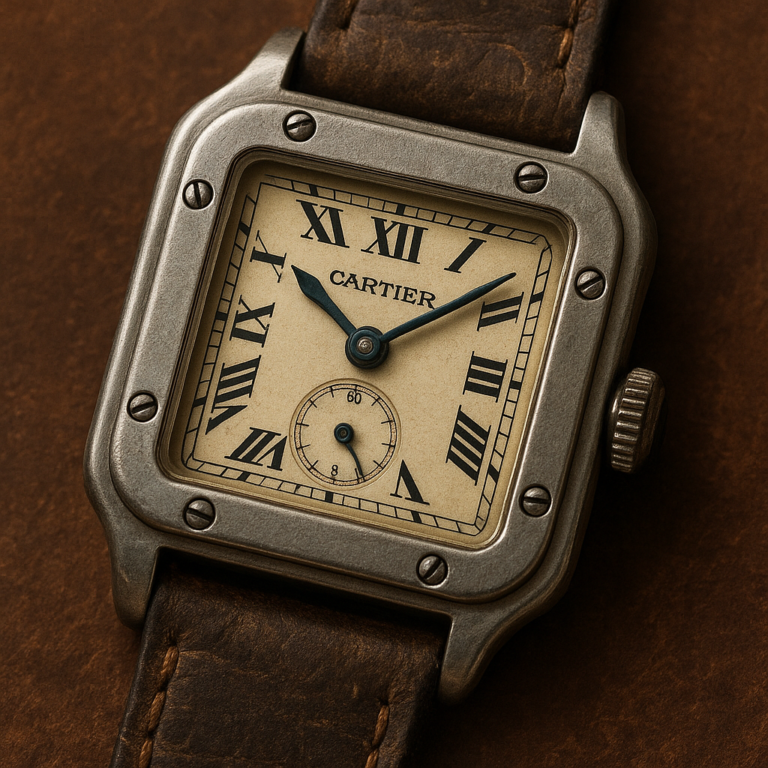
- The square case, exposed screws, Roman numerals, blue hands, and sapphire cabochon remain defining Cartier signatures.
- Buy the Santos for its design, history, and versatility, not because it was technically the first wristwatch ever made.
Table of Contents
- ⚡️ Quick Tips and Facts: Did Cartier Make the First Wristwatch?
- The Short Answer: Cartier Was an Early Pioneer, Not the First Ever
- Why the Cartier Santos Still Matters
- 🕰️ Wristwatch History Before Cartier
- Early Wrist-Worn Timepieces for Women
- Military Wristwatches and the Shift From Pocket Watches
- Patek Philippe, Girard-Peregaux, and Other Early Wristwatch Makers
- ✈️ The Birth of the Cartier Santos: Louis Cartier and Alberto Santos-Dumont
- Why Alberto Santos-Dumont Needed a Practical Pilot’s Watch
- Louis Cartier’s Solution for In-Flight Timekeeping
- 🎁 From Private Gift to Public Icon: The First Cartier Men’s Wristwatch
- The 1904 Cartier Santos and Its Place in Watch History
- The 191 Commercial Launch of the Santos-Dumont
- Was the Santos the First Modern Pilot’s Wristwatch?
- 📜 Cartier Santos Timeline: Evolution Through the Decades
- 1904–191: From Aviation Instrument to Luxury Wristwatch
- 1910s–1930s: Cartier’s Early Wristwatch Design Language
- 1970s: The Santos de Cartier and the Rise of Steel-and-Gold
- 1980s–200s: Quartz, Mechanical, and Sport-Luxury Variations
- 2018 to Today: Modern Santos Collections
- 🔩 Design Elements That Define the Cartier Santos
- The Square Case and Exposed Bezel Screws
- Roman Numerals, Sword Hands, and the Cartier Signature
- The Sapphire Cabochon Crown
- Interchangeable Straps and the SmartLink Bracelet System
- 🏆 What Makes the Cartier Santos Special?
- A Watch Designed Around Real-World Utility
- The Blend of Jewelry Craftsmanship and Watchmaking
- Why the Santos Looks Modern More Than a Century Later
- Cartier Santos Versus the Tank
- Cartier Santos Versus the Rolex Datejust and Pilot Watches
- ⌚ The Different Cartier Santos Models Explained
- Santos-Dumont
- Santos de Cartier
- Santos Galbée
- Santos 100
- Santos Chronograph and Complications
- Large, Medium, Small, and Extra-Large Case Sizes
- Quartz Versus Automatic Cartier Santos Movements
- 🧭 How to Identify an Authentic Cartier Santos
- Reference Numbers, Serial Numbers, and Hallmarks
- Movement, Dial, Case, and Bracelet Checks
- Common Cartier Santos Counterfeit Warning Signs
- Why Professional Authentication Still Matters
- 💎 Cartier Santos Materials, Movements, and Craftsmanship
- Gold, Steel, Two-Tone, and ADLC Finishes
- Manufacture Calibers and Automatic Power Reserves
- Water Resistance and Everyday Wear
- Servicing, Reliability, and Long-Term Ownership
- 📈 Cartier Santos Price History and Value
- What Determines a Cartier Santos’s Market Value?
- Vintage Cartier Santos Versus Modern Santos Watches
- Rarity, Condition, Provenance, and Originality
- Is the Cartier Santos a Good Investment?
- Buying New, Pre-Owned, or Vintage
- 🛍️ How to Buy the Right Cartier Santos
- Choosing the Best Santos Size for Your Wrist
- Selecting a Dial, Metal, and Strap Combination
- Questions to Ask a Cartier Authorized Dealer or Reseller
- Cartier Warranty, Box, Papers, and Service Records
- 🧼 Cartier Santos Care and Wearing Tips
- How to Clean and Store a Santos Watch
- When to Service a Cartier Automatic Movement
- Protecting Polished Bezel Screws and Sapphire Crystal
- 🌍 The Enduring Legacy of the Santos de Cartier Watch
- Cartier’s Influence on the Modern Luxury Wristwatch
- The Santos in Aviation, Fashion, and Popular Culture
- Why the Cartier Santos Remains a Collector Favorite
- ✅ Final Verdict: Did Cartier Make the First Wristwatch?
- What Cartier Actually Pionered
- The Difference Between the First Wristwatch and the First Famous Men’s Wristwatch
- Conclusion
- Recommended Links
- FAQ
- Did Cartier make the first wristwatch in history?
- Was the Cartier Santos the first men’s wristwatch?
- When was the first Cartier Santos made?
- Who invented the first wristwatch?
- Is the Cartier Santos a pilot’s watch?
- What is the difference between the Santos-Dumont and Santos de Cartier?
- Are Cartier Santos watches good investments?
- How can you tell if a Cartier Santos is authentic?
- Reference Links
Quick Tips and Facts: Did Cartier Make the First Wristwatch? ⌚
Short answer: no, not the first wristwatch ever made. The strongest historical case points to Breguet No. 2639, commissioned for Queen Caroline Murat of Naples in 1810. However, Cartier’s 1904 Santos-Dumont is widely regarded as one of the first purpose-built wristwatches for a man and one of the earliest practical pilot’s watches.
For a deeper look at the 1904 milestone, see our guide on who invented the wristwatch in 1904.
| Question | Best-supported answer |
|---|---|
| Did Cartier invent the first wristwatch? | ❌ No |
| Who is often credited with the earliest purpose-built wristwatch? | Breguet, for Queen Caroline Murat |
| When did Cartier create the Santos? | 1904 |
| Who requested the watch? | Brazilian aviator Alberto Santos-Dumont |
| What made the Santos important? | It was designed for practical use by a male pilot |
| Was it commercially released immediately? | ❌ No; the Santos entered commercial production later |
| Why is Cartier still credited as a pioneer? | It helped make the wristwatch desirable, masculine, practical, and fashionable |
The Short Answer: Cartier Was an Early Pioneer, Not the First Ever
The phrase “first wristwatch” hides several different claims:
- The first watch designed to be worn on the wrist.
- The first wristwatch made for a woman.
- The first Swiss wristwatch.
- The first men’s wristwatch.
- The first pilot’s wristwatch.
- The first commercially successful modern wristwatch.
Those are not the same achievement. Historical summaries from Breguet, Patek Philippe, and watch historians often separate these milestones rather than awarding one brand every trophy.
Cartier’s strongest claim is the first influential modern men’s wristwatch, represented by the Santos-Dumont. That distinction matters. Before 1904, wrist-worn watches were commonly associated with women’s jewelry, while men generally used pocket watches. Santos-Dumont helped change that perception.
Why the Cartier Santos Still Matters
The Santos was not merely a pocket watch with a strap slapped onto it. It was conceived around a real problem: how could a pilot check the time without taking one hand away from the controls?
The answer had:
- A flat, legible dial
- A wrist-worn leather strap
- A compact case
- Large Roman numerals
- A distinctive square profile
- A design polished enough for Parisian society, not just an aircraft cockpit
That combination was revolutionary in the social sense. A military watch might be useful. The Santos made usefulness look elegant.
👉 CHECK PRICE on:
- Cartier Santos watches: Amazon | Cartier Official Website
🕰️ Wristwatch History Before Cartier

The story begins long before Louis Cartier sketched the Santos. In fact, the history of wristwatches is less like a straight road and more like a watchmaker’s workbench: several mechanisms, traditions, and competing claims scattered everywhere.
Early Wrist-Worn Timepieces for Women
In the 18th and 19th centuries, watches worn on the wrist were often treated as jewelry first and timekeepers second. Wealthy women wore small watches as bracelets, broches, or pendants because their clothing often lacked convenient pockets.
The most famous early example is Breguet No. 2639, commissioned for Queen Caroline Murat of Naples in 1810 and reportedly delivered in 1812. According to historical accounts summarized by Breguet’s Reine de Naples collection, the watch had a highly unusual elongated case and was designed to be worn on the wrist.
Its reported features included:
- An oval-shaped case
- A small silver dial
- Curved Arabic numerals
- A repeating mechanism
- A bracelet made with hair and gold threads
The original watch is lost, which creates a natural problem: how do you prove the “first” when the object itself no longer survives?
The answer is documentary evidence. The Breguet claim rests on commission records and later repair documentation. It is persuasive, but not quite as visually satisfying as holding a surviving antique watch in a museum.
Military Wristwatches and the Shift From Pocket Watches
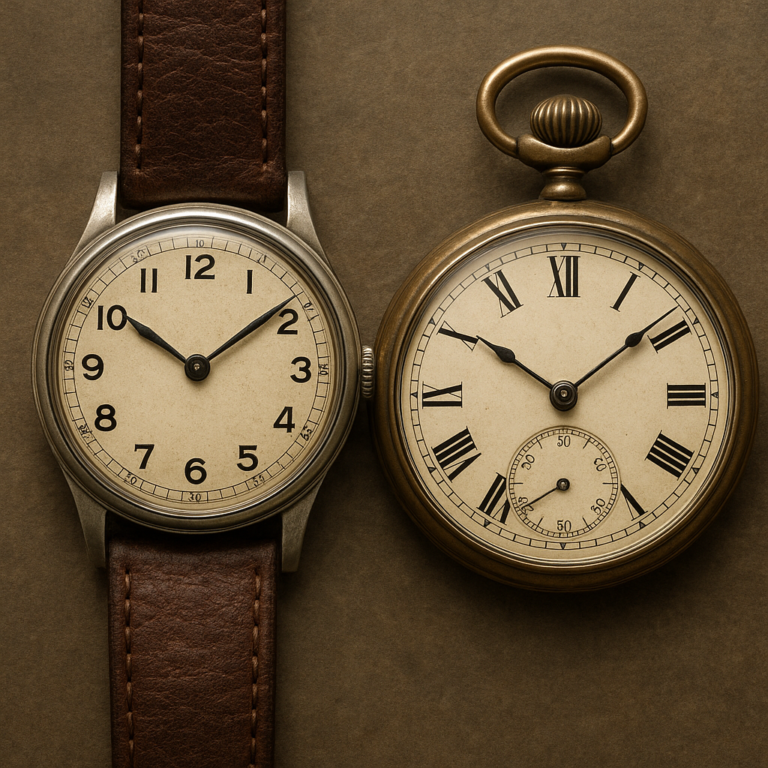
Military necessity gradually gave wristwatches a tougher reputation. Soldiers needed to coordinate movements, artillery, patrols, and attacks without fumbling through clothing for a pocket watch.
Early military conversions were often crude:
- A pocket-watch case was adapted with wire lugs.
- A leather strap was added.
- Protective grills or guards shielded the crystal.
- Dials were made more legible.
- Seconds hands became useful for timing maneuvers.
During World War I, wristwatches became increasingly practical for military personnel. The battlefield did not care whether society considered wristwatches feminine. It cared whether the watch could be read quickly while carrying a rifle.
This is one reason the Cartier Santos should not be viewed in isolation. Cartier introduced a fashionable, purpose-built men’s watch in 1904, but aviation and war helped turn wristwatches into a mainstream masculine tool.
Patek Philippe, Girard-Peregaux, and Other Early Wristwatch Makers
The “first wristwatch” debate also includes Patek Philippe. Guinness World Records has credited Patek Philippe with an 1868 wristwatch made for Countess Koscowicz of Hungary. That watch survives in the Patek Philippe Museum, giving the claim a powerful physical foundation.
The disagreement is mostly about definitions:
| Claim | Brand or maker | Date | Why it matters |
|---|---|---|---|
| Earliest documented purpose-built wristwatch claim | Breguet | 1810 commission | Earlier than the other major claims |
| First surviving Swiss wristwatch claim | Patek Philippe | 1868 | Physical object and Swiss provenance |
| Early military wristwatch production | Various makers | Late 19th century | Established practical wrist use |
| Influential men’s pilot wristwatch | Cartier | 1904 | Connected wristwear with aviation and masculine style |
| Early mass-market military wristwatch influence | Multiple Swiss and British makers | 1910s | Helped normalize wristwatches globally |
Guiness World Records and Patek Philippe may emphasize the first Swiss wristwatch, while historians discussing Breguet focus on the earliest documented purpose-built example overall. Both can be accurate because they answer different questions.
✈️ The Birth of the Cartier Santos: Louis Cartier and Alberto Santos-Dumont
The Santos story begins with friendship, aviation, and an irritating practical problem.
Alberto Santos-Dumont was a Brazilian aviation pioneer who lived in Paris and moved among the city’s fashionable and technological circles. Louis Cartier was not merely a jeweler working behind a counter; he was an enthusiastic designer with a keen interest in engineering, aviation, and modern life.
According to Cartier’s official Santos history, the two men were friends. Their conversation reportedly led to a watch designed around Santos-Dumont’s need to tell time while flying.
Why Alberto Santos-Dumont Needed a Practical Pilot’s Watch
Flying an early aircraft was not a relaxed activity. The pilot needed to manage controls, monitor the machine, and maintain concentration. Reaching into a pocket for a watch was inconvenient at best and dangerous at worst.
Santos-Dumont’s problem can be reduced to three steps:
- A pocket watch was difficult to reach in flight.
- Both hands needed to remain available for controlling the aircraft.
- A wristwatch could be read with a glance and minimal movement.
That sounds obvious now. At the time, it was a clever shift in human-machine interaction. The watch was no longer hidden in a waistcoat. It became part of the pilot’s equipment.
The Smithsonian National Air and Space Museum provides broader context on early aviation, where cockpit instruments were developing rapidly alongside aircraft design. The wristwatch fit naturally into that new world of dashboards, gauges, and split-second decisions.
Louis Cartier’s Solution for In-Flight Timekeeping
Louis Cartier’s response was a watch with a distinctive square case and a flat profile. The dial was intended to be read quickly, but it also looked unmistakably like Cartier.
The early Santos design is associated with:
- A square or rounded-square case
- Exposed bezel screws
- Roman numeral hour markers
- Blue steel hands
- A leather strap
- A compact mechanical movement
- A clean, architectural silhouette
The screws were not decorative afterthoughts. They contributed to the watch’s industrial personality. Later observers often compare their visual language with rivets on the Eiffel Tower, although the exact design inspiration is part of Cartier lore rather than a fully documented engineering brief.
This is where Cartier’s genius becomes clear: the brand converted a technical necessity into a recognizable luxury object.
🎁 From Private Gift to Public Icon: The First Cartier Men’s Wristwatch
The watch made for Santos-Dumont was a private creation before it became a commercial product. That distinction is essential. A prototype worn by one famous person is not the same as a mass-produced wristwatch available to the public.
The 1904 Cartier Santos and Its Place in Watch History
The Santos is generally dated to 1904, when Louis Cartier created the watch for Santos-Dumont. Many watch historians call it the first wristwatch specifically designed for a male wearer, or one of the earliest such watches.
That wording is safer than claiming Cartier invented every form of wristwatch. The Watch Centre history of Cartier watches describes the Santos as “one of the first modern wristwatches for men.”
That phrase is useful because it acknowledges earlier wrist-worn watches and other early male wristwatch makers, including Dimier Frères & Cie and Wilsdorf & David, the company later known as Rolex.
The 191? Commercial Launch of the Santos-Dumont
Cartier began selling the Santos commercially in the early 20th century, commonly dated to 191 in many secondary historical accounts. Some sources state the model entered production around 191, while others compress the timeline between the 1904 prototype and later commercial availability.
Why the uncertainty? Early luxury-watch records were not always organized like modern product launches. A watch could exist as:
- A private commission
- A prototype
- A limited production piece
- A catalog item
- A later renamed collection
The commercial Santos was associated with movements supplied by specialist makers. The Watch Centre account notes Cartier’s 1907 agreement with Edmond Jaeger, an important relationship in Cartier’s development as a watchmaker.
Was the Santos the First Modern Pilot’s Wristwatch?
The Santos has a very strong claim as an early purpose-built pilot’s watch, but “first” still requires caution.
| Question | Assessment |
|---|---|
| Was it made for a pilot? | ✅ Yes |
| Was the pilot a famous aviation pioneer? | ✅ Yes |
| Was it designed for quick wrist-based time reading? | ✅ Yes |
| Was it the first wristwatch ever? | ❌ No |
| Was it among the earliest purpose-built men’s pilot watches? | ✅ Very likely |
| Did it influence later luxury watch design? | ✅ Clearly |
The distinction is not nitpicking. It helps us appreciate what Cartier actually accomplished: not invention from an empty page, but refinement, cultural positioning, and extraordinary timing.
📜 Cartier Santos Timeline: Evolution Through the Decades
The Santos did not remain frozen in 1904. Cartier repeatedly adjusted its materials, movements, sizes, and wearing experience while preserving its recognizable geometry.
1904–191: From Aviation Instrument to Luxury Wristwatch
- 1904: Louis Cartier creates a wristwatch for Alberto Santos-Dumont.
- 1906: Santos-Dumont’s aviation achievements increase public attention.
- 1907: Cartier develops an important movement-supply relationship with Edmond Jaeger.
- Around 191: The Santos becomes commercially available.
- Early 20th century: The square Cartier watch gains recognition as a stylish men’s wristwatch.
Santos-Dumont’s public image mattered enormously. He was not anonymous test pilot. He was a celebrity inventor whose clothing, hats, aircraft, and accessories attracted attention.
1910s–1930s: Cartier’s Early Wristwatch Design Language
During this period, Cartier developed many of the codes that still define its watches:
- Roman numerals
- Blue hands
- Sapphire cabochon crowns
- Geometric cases
- Formal proportions
- Strong contrast between polished metal and dark straps
Cartier’s Tank collection, introduced in 1917, further established the brand’s reputation for geometric wristwatch design. The Santos and Tank are related in spirit, but they are not interchangeable: the Santos feels more technical and industrial, while the Tank leans toward architectural elegance.
1970s: The Santos de Cartier and the Rise of Steel-and-Gold
The late 1970s brought a major shift in luxury-watch culture. Consumers increasingly wanted watches that could move between office, travel, and social settings. The Santos became associated with steel-and-gold construction and a more accessible sport-luxury identity.
This mattered because the watch was no longer simply a precious object worn formal occasions. It could be:
- Worn with a suit
- Paired with casual clothing
- Styled as jewelry
- Recognized from across a room
- Used as a daily watch
For readers exploring similar design-led pieces, our guide to Luxury Watch Brands compares Cartier with brands such as Rolex, Omega, and Jaeger-LeCoultre.
1980s–200s: Quartz, Mechanical, and Sport-Luxury Variations
Cartier expanded the Santos family through different sizes, materials, and movements. Quartz versions offered convenience, while automatic models appealed to enthusiasts who valued traditional mechanical watchmaking.
The Santos 100, introduced for Cartier’s centenary of the original Santos, pushed the design toward a larger, bolder wrist presence. It demonstrated how Cartier could enlarge a historical design without abandoning its essential DNA.
2018 to Today: Modern Santos Collections
Modern Santos watches typically offer:
- Automatic mechanical movements
- Steel, gold, or two-tone cases
- Quick-change straps
- Adjustable bracelets
- Multiple case sizes
- Date displays on selected models
- Water resistance suitable for everyday wear, depending on reference
The current collection separates the elegant Santos-Dumont from the more robust Santos de Cartier. The former usually feels slimmer and more faithful to the dressier historical profile; the latter is generally better suited to daily wear.
🔩 Design Elements That Define the Cartier Santos
The Santos is instantly identifiable because Cartier repeated a small number of visual ideas with unusual discipline.
The Square Case and Exposed Bezel Screws
The square case is the obvious signature, but its real strength is proportion. The corners are softened, preventing the watch from looking like a rigid piece of industrial equipment.
The exposed screws create tension:
- They look functional.
- They contrast with Cartier’s refined finishing.
- They reinforce the aviation and engineering story.
- They make the bezel visually distinctive.
A round watch can disappear into a crowd of round watches. The Santos arrives wearing a tiny architectural hard hat.
Roman Numerals, Sword Hands, and the Cartier Signature
The dial combines formal and practical elements:
| Design feature | Function or effect |
|---|---|
| Roman numerals | Strong brand identity and formal character |
| Sword-shaped hands | Legibility with a refined silhouette |
| Minute track | Helps precise reading |
| Blue accents | Adds Cartier’s recognizable color signature |
| Secret signature | Anti-counterfeit detail on many Cartier dials |
| Rail-track minute scale | Supports visual precision |
Cartier’s use of Roman numerals is not merely traditional. The numerals radiate across the square dial, balancing the geometry and drawing the eye outward.
The Sapphire Cabochon Crown
The crown is topped with a blue sapphire cabochon on many Santos references. It is one of Cartier’s most recognizable signatures, alongside the blue hands and Roman numerals.
The cabochon offers little practical benefit over a conventional crown, but that misses the point. Luxury watches are partly about recognition, touch, and ritual. The rounded stone feels like a small jewel attached to a mechanical instrument.
Interchangeable Straps and the SmartLink Bracelet System
Modern Santos models often feature Cartier’s strap-change and bracelet-adjustment systems. Depending on the reference, these may allow the wearer to:
- Change from bracelet to leather strap
- Adjust bracelet length without specialized tools
- Match the watch to formal or casual clothing
- Reduce the need for a jeweler visit
That versatility is a major advantage for a daily luxury watch. The drawback is that proprietary straps and bracelet components may be less convenient to source than standard aftermarket parts.
🏆 What Makes the Cartier Santos Special?
The Santos is special because its history is not decorative wallpaper. The original design really did respond to a practical aviation problem.
A Watch Designed Around Real-World Utility
The basic utility chain is straightforward:
- The pilot needed both hands.
- A pocket watch was awkward.
- A wristwatch allowed quick glances.
- Cartier refined the idea into a compact, wearable design.
- Public attention helped normalize the men’s wristwatch.
The Santos therefore sits at the intersection of tool watch, dress watch, aviation watch, and jewelry.
The Blend of Jewelry Craftsmanship and Watchmaking
Cartier is often described as a jeweler that makes watches. That description is partly fair, but incomplete. The brand’s influence comes from combining:
- Case design
- Gem-setting traditions
- Dial typography
- Mechanical watchmaking
- Fashion awareness
- Strong visual branding
For some collectors, this blend is the appeal. For others, it is a drawback. A buyer focused primarily on movement finishing may prefer a haute horlogerie specialist such as Vacheron Constantin or A. Lange & Söhne. A buyer who wants a watch recognizable for its design may prefer Cartier.
Why the Santos Looks Modern More Than a Century Later
The Santos has survived because its design is specific without being fragile.
It is specific because of the square case, screws, numerals, and cabochon. It is flexible because the watch works in steel, gold, two-tone, small, medium, and large formats.
The watch also benefits from visual balance:
- The square case is softened by rounded edges.
- The screws add structure without clutter.
- The Roman numerals are expressive but readable.
- The strap and bracelet change its personality.
Cartier Santos Versus the Tank
| Feature | Santos | Tank |
|---|---|---|
| Core visual language | Rounded-square case and screws | Rectangular case with brancards |
| Historical association | Aviation and Alberto Santos-Dumont | Military-inspired modernism |
| Personality | Sporty, technical, architectural | Elegant, formal, artistic |
| Best for | Daily luxury wear and statement style | Dressier versatility |
| Wrist presence | Often stronger | Usually more discreet |
| Typical buyer | Wants recognizable geometry and history | Wants classic Cartier refinement |
The Cartier Tank is not simply a slimmer Santos. It tells a different story.
Cartier Santos Versus the Rolex Datejust and Pilot Watches
The Rolex Datejust emphasizes round-case familiarity, bracelet engineering, and understated status. The Santos emphasizes design identity and historical individuality. Traditional pilot watches from brands such as IWC and Longines prioritize legibility and aviation instrumentation.
| Watch family | Main strength | Main compromise |
|---|---|---|
| Cartier Santos | Design heritage and versatility | Less conventional tool-watch legibility |
| Rolex Datejust | Robust everyday luxury and broad recognition | More visually conservative |
| IWC Pilot’s Watch | Aviation authenticity and readability | Less jewelry-like refinement |
| Longines Spirit | Strong pilot-watch value and specifications | Less distinctive luxury branding |
| Omega Speedmaster | Chronograph history and technical legacy | Larger, busier, and less formal |
For help comparing categories before buying, our Guide to Buying Watches covers movement types, sizing, materials, and service considerations.
⌚ The Different Cartier Santos Models Explained
Cartier’s naming can confuse even experienced buyers. “Santos,” “Santos-Dumont,” “Santos de Cartier,” “Galbée,” and “Santos 100” refer to related but distinct families.
Santos-Dumont
The Santos-Dumont is generally the dressier and slimmer interpretation. It tends to emphasize:
- Historical proportions
- Thin cases
- Manual-winding or quartz options, depending on reference
- Leather straps
- A more formal wrist presence
It is the better choice for someone who values the original story and elegant proportions over sportier daily durability.
Santos de Cartier
The modern Santos de Cartier is the most broadly versatile family. It commonly offers:
- Steel, gold, or two-tone construction
- Automatic movements
- Bracelet and strap options
- Multiple sizes
- Date display on selected models
- More substantial everyday wearability
This is usually the model we recommend to buyers seeking one Cartier watch to wear frequently.
Santos Galbée
The Santos Galbée is a vintage and discontinued family known for its softer, more curved case shape. Collectors appreciate it for:
- Rounded lugs
- Integrated-looking bracelets
- Vintage proportions
- Strong 1980s and 1990s character
The main drawback is condition. Vintage bracelet stretch, replacement parts, polishing, and service history deserve careful inspection.
Santos 100
The Santos 100 introduced a larger, more assertive interpretation of the classic design. It suits wearers who want:
- More wrist presence
- A sportier attitude
- Larger case dimensions
- Chronograph or date variations, depending on reference
It can wear larger than its measurements suggest because the square case occupies substantial visual space.
Santos Chronograph and Complications
Cartier has produced chronograph and other complicated Santos variations. These models add functionality but also increase dial density and service complexity.
Choose a chronograph if you genuinely use or enjoy chronograph functions. Do not buy one merely because extra subdials make a watch look more “serious.” Three small circles cannot manufacture a personality.
Large, Medium, Small, and Extra-Large Case Sizes
Case diameter alone does not determine fit. Square watches present more surface area across the wrist than round watches with the same nominal measurement.
| Wrist profile | Often suitable Santos direction |
|---|---|
| Slim wrist | Small or medium |
| Average wrist | Medium or large |
| Broad wrist | Large or extra-large |
| Dress-watch preference | Santos-Dumont |
| Bold everyday preference | Santos de Cartier large |
Try the watch on with the bracelet adjusted. A loose bracelet can make a well-sized watch feel oversized, while a properly fitted strap can make a larger case surprisingly comfortable.
Quartz Versus Automatic Cartier Santos Movements
| Movement type | Advantages | Drawbacks |
|---|---|---|
| Quartz | Accurate, convenient, low daily fuss | Less mechanical character |
| Automatic | Traditional craftsmanship and self-winding operation | Requires periodic servicing |
| Manual-winding | Thin profile and engaging ritual | Requires regular winding |
| Chronograph mechanical | Added timing function and visual interest | More complexity and higher service demands |
Our view is simple: choose quartz for convenience, automatic for daily mechanical enjoyment, and manual winding for thiness and ritual.
🧭 How to Identify an Authentic Cartier Santos
Counterfeit Cartier watches exist, and the Santos’s recognizable design makes it a tempting target. Authentication should involve more than checking whether the dial has Roman numerals.
Reference Numbers, Serial Numbers, and Hallmarks
Check:
- Case-back markings
- Reference number
- Serial number
- Metal hallmarks
- Cartier branding
- Movement caliber
- Documentation consistency
A serial number alone proves little. Counterfeiters can copy numbers from genuine watches, and genuine watches can contain replaced parts.
The safest route is an experienced specialist, Cartier service center, or reputable dealer with a documented authentication process.
Movement, Dial, Case, and Bracelet Checks
Inspect the watch step by step:
- Dial printing: Cartier typography should be crisp and proportionate.
- Roman numerals: Spacing should feel balanced.
- Hands: Shape, finish, and alignment should match the reference.
- Secret signature: Check the expected numeral area under magnification.
- Crown: The cabochon should be correctly shaped and seated.
- Bezel screws: Their alignment and finishing should look deliberate.
- Case edges: Avoid crude machining or excessive softness.
- Movement: Verify the caliber against the reference.
- Bracelet: Check links, clasp quality, and finishing.
- Papers: Compare dates, serials, and reference details.
Common Cartier Santos Counterfeit Warning Signs
❌ Misspeled markings
❌ Croked or uneven Roman numerals
❌ Cheap-feling bracelet links
❌ Incorrect crown stone
❌ Excessive case thickness
❌ Incorrect hand shape
❌ Generic movement hidden behind a display back
❌ Seller refuses independent inspection
❌ Price far below comparable market examples
❌ Inconsistent serial numbers across case and paperwork
A bargain that cannot survive scrutiny is not a bargain. It is an expensive mystery wearing a tiny suit.
Why Professional Authentication Still Matters
Cartier watches may contain replaced crystals, crowns, bracelets, dials, or movements after decades of servicing. That does not automatically make a watch fake, but it affects originality and value.
Professional authentication helps answer separate questions:
- Is the watch genuine?
- Is it correct for the stated reference?
- Are major components original?
- Has it been heavily polished?
- Does it need immediate service?
- Is the documentation credible?
💎 Cartier Santos Materials, Movements, and Craftsmanship
Gold, Steel, Two-Tone, and ADLC Finishes
Cartier offers the Santos in several material combinations.
| Material | Benefits | Drawbacks |
|---|---|---|
| Stainless steel | Durable, versatile, lower visual formality | Scratches remain visible |
| Yellow gold | Warm, luxurious, historically expressive | Softer and more conspicuous |
| Two-tone | Balances durability and luxury | More visually specific |
| Rose gold | Contemporary warmth | Can clash with some jewelry |
| ADLC or dark coatings | Dramatic modern appearance | Coating damage may be difficult to repair |
Steel is usually our most practical recommendation for daily wear. Two-tone is ideal if you want the Santos to feel unmistakably luxurious without wearing a full-gold watch.
Manufacture Calibers and Automatic Power Reserves
Modern Cartier Santos models use automatic mechanical movements, including Cartier calibers in selected references. Specifications vary by model, so check the exact reference on Cartier’s official Santos collection.
When comparing movements, inspect:
- Power reserve
- Frequency
- Date-change behavior
- Magnetic resistance claims
- Service availability
- Movement finishing
- Case-back visibility
A longer power reserve is convenient, but it should not outweigh case comfort, dial clarity, or design preference.
Water Resistance and Everyday Wear
Water resistance varies by Santos model and reference. A watch marked as water resistant is not automatically suitable for diving, hot tubs, or high-pressure water.
Practical rules:
- Keep the crown fully closed.
- Do not operate pushers underwater unless specified.
- Rinse salt or chlorine residue from the case.
- Have seals checked during service.
- Avoid sudden temperature changes.
- Treat vintage models more cautiously than modern ones.
Servicing, Reliability, and Long-Term Ownership
A Cartier Santos can be a reliable daily watch, but it is not maintenance-free. Mechanical watches require periodic inspection and servicing, while quartz watches eventually need battery and seal replacement.
Potential ownership costs include:
- Movement service
- Gasket replacement
- Crystal replacement
- Bracelet refinishing
- Crown or cabochon replacement
- Strap replacement
- Water-resistance testing
The watch’s greatest long-term advantage is its design longevity. A style introduced more than a century ago still looks intentional rather than costume-like.
📈 Cartier Santos Price History and Value
We will not list specific prices, but the value structure is worth understanding.
What Determines a Cartier Santos’s Market Value?
The principal factors are:
- Exact reference
- Material
- Case size
- Movement
- Production era
- Condition
- Originality
- Box and papers
- Service history
- Bracelet completeness
- Dial rarity
- Provenance
A common steel Santos in excellent condition may be more attractive to a practical buyer than a rarer but heavily modified example.
Vintage Cartier Santos Versus Modern Santos Watches
| Consideration | Vintage Santos | Modern Santos |
|---|---|---|
| Character | Strong patina and period charm | Crisp finishing and updated usability |
| Reliability | Depends heavily on service history | Generally easier to support |
| Bracelet | May show stretch | Better adjustment systems |
| Water resistance | Often limited | Better documented |
| Authenticity | More complicated due to replacements | Easier to compare with current references |
| Wearability | Often slimmer and smaller | More size and strap choices |
Vintage watches can be emotionally rewarding, but modern examples reduce uncertainty. That trade-off should guide the purchase.
Rarity, Condition, Provenance, and Originality
Collectors often focus on rarity, but condition may matter more. A rare Santos with:
- Over-polished edges
- Replacement dial
- Non-original bracelet
- Unclear movement
- Corosion
- Missing parts
may be less desirable than a less rare, untouched example.
Originality is not always absolute. A replacement crystal or service crown may be perfectly acceptable. The key is documentation and accurate disclosure.
Is the Cartier Santos a Good Investment?
Our answer: buy it first as a watch, not as a financial instrument.
Reasons to consider it:
✅ Long-running design heritage
✅ Strong brand recognition
✅ Broad model selection
✅ Established collector interest
✅ Distinctive identity compared with round luxury watches
Reasons for caution:
❌ Retail and resale values can differ
❌ Fashion preferences change
❌ Servicing can be costly
❌ Modified vintage examples may be difficult to value
❌ Not every reference performs equally on the secondary market
The Santos has durable cultural value, but durable cultural value is not the same as guaranteed financial appreciation.
Buying New, Pre-Owned, or Vintage
- New: Best for warranty, current features, and a clean buying experience.
- Pre-owned: Often offers better selection and can avoid initial depreciation.
- Vintage: Best for historical personality, provided you can assess originality and service needs.
For broader comparisons between new and pre-owned watches, browse our Guide to Buying Watches.
🛍️ How to Buy the Right Cartier Santos
Choosing the Best Santos Size for Your Wrist
Follow this process:
- Measure your wrist circumference.
- Measure the watch’s lug-to-lug span, not just case width.
- Consider case thickness.
- Try both bracelet and strap.
- View the watch from above and from the side.
- Wear it for at least several minutes.
- Check whether the corners extend beyond the wrist.
A square case can look larger than its stated width. If you usually wear round watches, start with a medium Santos before assuming you need the largest size.
Selecting a Dial, Metal, and Strap Combination
Choose based on your wardrobe:
- White dial and steel: Most versatile.
- Two-tone: More jewelry-like and vintage-inspired.
- Gold: Formal and expressive.
- Dark dial: Modern and assertive.
- Leather strap: Dressier.
- Bracelet: More durable and integrated.
- Ruber or casual strap: Sportier, where compatible.
Our favorite all-rounder is a medium or large steel Santos with a light dial and interchangeable strap. It retains the history without demanding that every outfit be tailored around it.
Questions to Ask a Cartier Authorized Dealer or Reseller
Ask:
- What is the exact reference?
- Is the watch serviced?
- Are all components original?
- Has the case been polished?
- Is the bracelet complete?
- Are box and papers included?
- Is the warranty transferable?
- Can I have an independent inspection?
- What is the return period?
- Has the watch been exposed to water damage?
A trustworthy seller will answer directly. Evasion is louder than a rotor.
Cartier Warranty, Box, Papers, and Service Records
Box and papers support provenance, but they do not replace examination. Service records are often more useful than presentation boxes because they reveal what has actually been done to the watch.
Prioritize:
- Genuine watch
- Correct reference
- Sound movement
- Honest condition
- Documented service
- Box and papers
🧼 Cartier Santos Care and Wearing Tips
How to Clean and Store a Santos Watch
For routine care:
- Remove the watch before applying lotions or fragrances.
- Wipe the case with a soft microfiber cloth.
- Use a slightly damp cloth for steel or solid water-resistant cases.
- Avoid household chemicals.
- Dry the bracelet thoroughly.
- Store it away from magnets and humidity.
- Keep straps ventilated.
Do not use an ultrasonic cleaner on the complete watch unless a qualified professional has disassembled it appropriately.
When to Service a Cartier Automatic Movement
Service timing depends on use, condition, and manufacturer guidance. Arrange inspection sooner if you notice:
- Significant time loss or gain
- Reduced power reserve
- Grinding or unusual rotor noise
- Condensation under the crystal
- Crown resistance
- Date-change problems
- Water exposure
A watch that still runs is not necessarily a watch that is healthy.
Protecting Polished Bezel Screws and Sapphire Crystal
Sapphire crystal is highly scratch-resistant, but it is not indestructible. Hard impacts can chip or fracture it. The polished bezel and screws can also collect marks quickly.
Wear intelligently:
- Remove the watch for contact sports.
- Avoid knocking it against doorframes.
- Do not rest it crystal-down on rough surfaces.
- Use a soft travel pouch.
- Be cautious around polished metal furniture and stone countertops.
🌍 The Enduring Legacy of the Santos de Cartier Watch
The Santos’s legacy extends beyond the question of who made the first wristwatch.
Cartier’s Influence on the Modern Luxury Wristwatch
Cartier helped establish several ideas now central to luxury watches:
- A wristwatch could be an object of design, not merely equipment.
- A men’s watch could be practical and elegant.
- A strong case silhouette could become a brand signature.
- Historical storytelling could support long-term desirability.
- Jewelry expertise could elevate watch design.
The result can be seen across the Luxury Watch Brands category, where design identity is often as important as movement specifications.
The Santos in Aviation, Fashion, and Popular Culture
The Santos links three worlds:
- Aviation: It answered a real cockpit problem.
- Fashion: It made technical utility socially desirable.
- Luxury: It turned a functional object into a recognizable status symbol.
The first featured video in this article makes the same broad point: early wristwatches were often viewed as feminine accessories until aviation and warfare changed their social meaning. Its memorable summary is that “the Cartier Santos took to the skies and changed history.” The video also describes the Tank as a watch that “was introduced in 1917 and has never disappeared,” reinforcing Cartier’s broader influence on enduring geometric design. You can revisit that perspective at #featured-video.
Why the Cartier Santos Remains a Collector Favorite
Collectors return to the Santos because it offers something many luxury watches lack: a clear origin story that connects directly to the physical design.
The screws look engineered. The case looks aerodynamic. The strap makes sense. The watch’s history is not pasted on afterward.
That is why the original question eventually becomes more interesting than a simple yes or no. Cartier did not make the first wristwatch, but it helped define what a modern men’s wristwatch could be.
✅ Final Verdict: Did Cartier Make the First Wristwatch?
No. Cartier did not make the first wristwatch in history.
The earliest widely cited purpose-built example is Breguet No. 2639, commissioned for Queen Caroline Murat in 1810. Patek Philippe has a separate and well-supported claim for the first Swiss wristwatch, made in 1868 for Countess Koscowicz.
Cartier’s historic achievement arrived in 1904 with the Santos-Dumont.
What Cartier Actually Pionered
Cartier pioneered the combination of:
- A wristwatch designed for a male wearer
- A purpose-built pilot’s application
- A strong geometric case
- Readable, formal dial design
- Luxury craftsmanship
- Public acceptance of wristwear for men
The most accurate wording is:
Cartier did not invent the wristwatch, but the 1904 Santos-Dumont was one of the first influential modern men’s wristwatches and an early purpose-built pilot’s watch.
The Difference Between the First Wristwatch and the First Famous Men’s Wristwatch
This is the mystery we teased at the beginning. Why do so many people think Cartier made the first wristwatch?
Because Cartier’s claim is culturally louder.
Breguet’s early watch was made for royalty and is now lost. Patek Philippe’s 1868 watch is historically important but less familiar to the general public. Cartier’s Santos was connected to a charismatic aviator, visible in the age of flight, commercially developed, and preserved as a continuing collection.
So, the first wristwatch overall was probably not Cartier’s, but the first wristwatch many people associate with modern male style and aviation is the Cartier Santos.
Conclusion

The answer is clear: Cartier did not make the first wristwatch ever made. Breguet has the strongest early claim for a purpose-built wristwatch, while Patek Philippe has a compelling claim for the first Swiss wristwatch.
Cartier’s Santos-Dumont, created in 1904 for Alberto Santos-Dumont, deserves a different honor. It was among the earliest important wristwatches designed specifically for a man and a pilot. More than that, it helped transform the wristwatch from a novelty or piece of jewelry into a practical, stylish object for men.
Cartier Santos Positives
✅ Exceptional and instantly recognizable design
✅ Genuine connection to early aviation
✅ Strong historical importance
✅ Excellent versatility across formal and casual clothing
✅ Multiple sizes, metals, straps, and movements
✅ More distinctive than many conventional round luxury watches
Cartier Santos Negatives
❌ Not the first wristwatch in history
❌ Square cases can wear larger than expected
❌ Polished surfaces show scratches
❌ Proprietary parts and servicing may be costly
❌ Vintage examples require careful authentication
❌ Some buyers may prefer a more technically focused pilot watch
Our recommendation: choose the Cartier Santos if you want a luxury watch with genuine history, strong design identity, and daily versatility. Choose the Santos-Dumont for a slimmer, dressier interpretation. Choose the Santos de Cartier for a more practical everyday companion.
Recommended Links
👉 CHECK PRICE on:
- Cartier Santos de Cartier: Amazon | Cartier Official Website
- Cartier Santos-Dumont: Amazon | Cartier Official Website
- Cartier Tank: Amazon | Cartier Official Website
- Breguet Reine de Naples: Amazon | Breguet Official Website
- Patek Philippe Watches: Amazon | Patek Philippe Official Website
Recommended reading:
- Watch Brands™ Luxury Watch Brands
- Watch Brands™ Guide to Buying Watches
- Watch Brands™ Men’s Watches
- Watch Brands™ Who Invented the Wristwatch in 1904?
- A History of Cartier Watches
- Patek Philippe Museum
- Breguet Reine de Naples Collection
- The Watch Book: Rolex
- The Watch Book: Cartier
- Wristwatch Handbook by Ryan Schmidt
FAQ

Did Cartier invent the first wristwatch?
No. Cartier did not invent the first wristwatch overall. The earliest widely cited purpose-built example is Breguet No. 2639, commissioned for Queen Caroline Murat in 1810.
Cartier’s important contribution came in 1904, when Louis Cartier created the Santos-Dumont for aviator Alberto Santos-Dumont. It is commonly described as one of the first influential men’s wristwatches and an early purpose-built pilot’s watch.
Why do some articles call Cartier’s Santos the first wristwatch?
They are usually referring to a narrower claim: the first major wristwatch designed specifically for a man, or the first purpose-built pilot’s wristwatch. The wording becomes misleading only when that narrower claim is presented as the first wristwatch ever.
Read more about “⌚ The Wristwatch Revolution: From Trenches to Timeless Icons (2026)”
Who made the first wristwatch in history?
The strongest documented claim generally goes to Abraham-Louis Breguet, who made a wristwatch for Queen Caroline Murat of Naples. The commission dates to 1810, with delivery reported in 1812.
However, the original watch has been lost. That is why Patek Philippe’s surviving 1868 watch for Countess Koscowicz remains important and is sometimes described as the first Swiss wristwatch.
Why are there competing “first wristwatch” claims?
Because historians use different definitions:
- First commissioned wristwatch
- First surviving wristwatch
- First Swiss wristwatch
- First men’s wristwatch
- First pilot’s wristwatch
- First commercially successful wristwatch
The most trustworthy sources state their category clearly rather than treating the claims as identical.
Read more about “🕰️ What Was the First Ever Best Watch? (2026)”
What was the first Cartier wristwatch called?
The first famous Cartier wristwatch was the Santos, later known as the Santos-Dumont. Louis Cartier created it in 1904 for Alberto Santos-Dumont.
The commercially developed model became one of Cartier’s signature collections and remains central to the brand’s modern watch lineup.
Read more about “⏳ Men: What Were the First Watches Ever? (2026)”
Why is Cartier considered a pioneering luxury watch brand?
Cartier is considered pioneering because it combined practical watchmaking with highly recognizable design. The Santos introduced a bold geometric case and a wrist-based solution for aviation, while the Tank helped establish another enduring design language in 1917.
Cartier also helped make men’s wristwatches socially acceptable by presenting them as refined luxury objects rather than merely military tools.
Is Cartier primarily a jeweler or a watchmaker?
Cartier is both. Its jewelry heritage strongly influences its watches, but the brand has developed serious mechanical watch collections, complications, manufacture movements, and long-running case designs.
Read more about “Is Bulova a Luxury Watch? The Moon Landing Truth (2026) 🌕”
Was the Cartier Santos a pilot’s watch?
Yes, in an early historical sense. It was created for Alberto Santos-Dumont, who needed to read the time while flying. It was not a modern aviation instrument watch with a rotating bezel or flight computer, but it was purpose-built around a pilot’s practical need.
Read more about “🏆 25 Best Watch Brands in 2026”
Is the Cartier Santos a good everyday watch?
Yes, particularly the modern Santos de Cartier in steel or two-tone form. It offers a distinctive design, automatic movement options, interchangeable straps, and useful everyday versatility.
Be aware that polished surfaces show scratches, square cases can wear prominently, and water resistance varies by reference.
Read more about “🏆 The 25 Best Watch Brands in the World (2026): Craftsmanship Over Sales”
Which is better: Santos-Dumont or Santos de Cartier?
Choose the Santos-Dumont if you want:
- A slimmer profile
- A dressier appearance
- Stronger visual connection to the earliest design
- Leather-strap elegance
Choose the Santos de Cartier if you want:
- A more robust daily watch
- Automatic movement options
- Bracelet versatility
- A sportier wrist presence
- Easier transition between casual and formal clothing
Read more about “🕰️ Who Invented the First Watch and When? (2026)”
How can you authenticate a Cartier Santos?
Check the exact reference, serial number, dial printing, secret signature, hands, crown, bezel screws, movement, bracelet, and paperwork. Because counterfeit and modified watches can look convincing, professional authentication is the safest option.
Do not rely on a serial number or box alone.
Read more about “🕰️ The First Wristwatch in the World: Was It Really Cartier? (2026)”
Reference Links
- Cartier Santos Collection
- Cartier Santos-Dumont Collection
- Cartier Tank Collection
- Breguet Reine de Naples
- Patek Philippe Museum
- Patek Philippe Collection
- Guiness World Records: First Wristwatch
- Smithsonian National Air and Space Museum
- Imperial War Museums: Why Did Soldiers Wear Wristwatches?
- A History of Cartier Watches | Watch Centre
- Watch Brands™: Who Invented the Wristwatch in 1904?
- Watch Brands™ Luxury Watch Brands
- Watch Brands™ Guide to Buying Watches
- Watch Brands™ Men’s Watches
- Watch Brands™ Fashion Trends in Watches
- Watch Brands™ Affordable Watches