Support our educational content for free when you purchase through links on our site. Learn more
How World War I Put Wristwatches on the Map ⌚

World War I helped popularize wristwatches by showing soldiers that checking the time on their wrist was faster and more practical than pulling out a pocket watch. The answer to “What role did World War I play in popularizing the use of wristwatches among soldiers and civilians?” is that the war accelerated adoption—not invented the wristwatch—and helped turn a once-unusual accessory into an everyday choice.
Before the war, pocket watches were the familiar standard for many men. In the trenches, where timing and keeping a hand free could matter, a wristwatch offered a simple advantage: glance down, read the dial, keep moving. 🪖
That practical reputation followed soldiers home. Wristwatches didn’t become universally popular overnight, but wartime experience helped make them feel useful and respectable—and postwar fashion and watchmakers carried the shift further.
Key Takeaways
- Wristwatches existed before World War I. The war popularized their use; it didn’t invent them.
- Hands-free access to time was a practical advantage for soldiers coordinating tasks and movements.
- Wartime watches varied widely. “Trench watch” doesn’t mean every soldier wore one standardized model.
- Veterans helped bring wristwatches into civilian life, while changing fashions and postwar marketing broadened their appeal.
- The shift was gradual: military necessity helped open the door, and civilian demand kept wristwatches there.
Table of Contents
- ⚡️ Quick Tips and Facts: World War I and the Rise of Wristwatches
- 🕰️ Before the War: Why Pocket Watches Ruled
- Pocket watches, social convention, and men’s fashion
- Early wristwatches and the “wristlet”
- ⚔️ Trench Warfare and the Need for Hands-Free Timekeeping
- Cordinating attacks, artillery, and troop movements
- Why a pocket watch was impractical in combat
- 🎖️ How Soldiers Adapted Wristwatches for the Front
- Leather straps, wire lugs, and improvised wristlets
- Luminous dials, sturdy cases, and other battlefield features
- Trench watches versus purpose-built military watches
- ⏱️ Why Synchronised Time Became a Military Advantage
- Timing artillery barrages and infantry advances
- Communication, coordination, and split-second decisions
- 🏭 Watchmakers, Military Supply, and Wartime Innovation
- British, German, French, and American military watch needs
- How wartime demand influenced watch design and production
- 🔄 From Battlefield Tool to Civilian Fashion
- Returning soldiers bring wristwatches home
- Changing attitudes toward men’s wristwatches
- Advertising, celebrities, and the new wristwatch market
- 🌍 The Wristwatch’s Postwar Rise Around the World
- Women’s wristwatches and evolving fashion
- From military necessity to everyday accessory
- 🧭 What World War I Changed—and What It Didn’t
- Separating popular accounts from historical evidence
- Why wristwatches did not become popular overnight
- ⌚ World War I’s Lasting Influence on Modern Watches
- Military design features still seen in wristwatches
- The enduring appeal of field watches
- ❓ Frequently Asked Questions About World War I and Wristwatches
- Did World War I invent the wristwatch?
- Why did soldiers wear wristwatches in the trenches?
- Were trench watches waterproof or shock-resistant?
- When did wristwatches become popular with men?
- What is the difference between a trench watch and a modern field watch?
- ✅ Conclusion: How the Great War Put Time on the Wrist
- 🔗 Recommended Links
- ❔ FAQ
- 📚 Reference Links
⚡️ Quick Tips and Facts: World War I and the Rise of Wristwatches
World War I didn’t invent the wristwatch. It made the wristwatch hard to ignore. Earlier wrist-worn watches already existed, but trench warfare gave soldiers a compelling reason to choose one over a pocket watch: they could check the time quickly without fumbling for it or taking a hand off another task.
| Quick fact | What it means |
|---|---|
| Wristwatches existed before 1914 | The war accelerated their practical use and acceptance, rather than creating them from scratch. |
| Timing mattered in modern warfare | Coordinated advances and artillery schedules made quick access to a watch useful. |
| Soldiers’ needs shaped design | Clear dials, luminous markings, sturdy cases, and wrist straps were valued, though early watches had limits. |
| Civilian acceptance followed gradually | Veterans, changing fashions, advertising, and new designs helped normalize wristwatches after the war. |
| “Trench watch” is a useful label, not a perfect category | Wartime wristwatches varied; not every example was a standardized military issue watch. |
For a broader timeline, start with our guide to the history of the wristwatch. The key takeaway: war created urgency; wider social change turned utility into habit. 🕰️
🕰️ Before the War: Why Pocket Watches Ruled
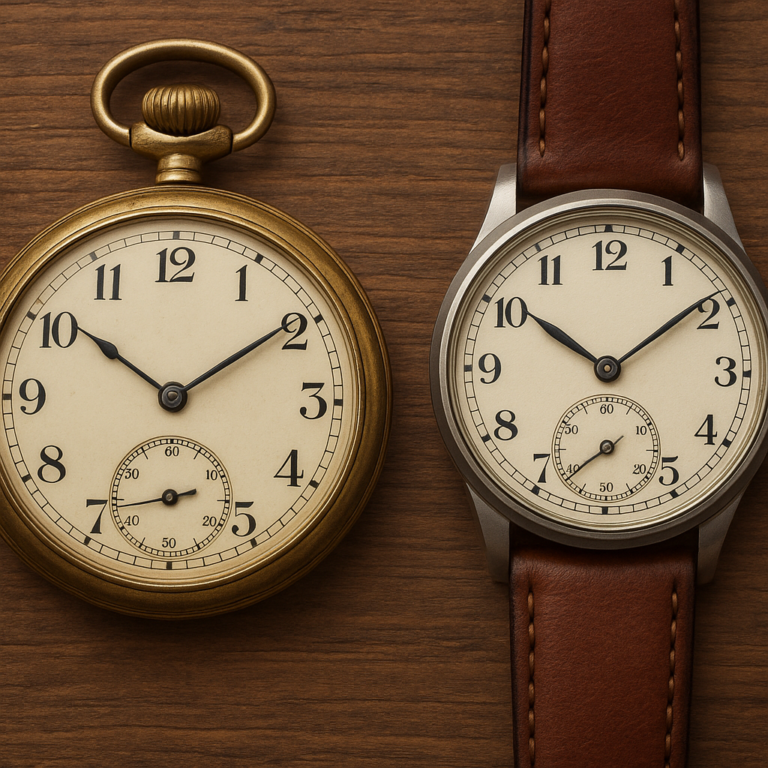
Before 1914, the pocket watch was the respectable default for many men. It sat in a waistcoat pocket, attached to a chain, and came out when its owner wanted the time. A wristwatch, by contrast, was often associated with women’s jewelry or seen as an unusual novelty.
That didn’t mean nobody wore one. Wrist-worn watches had appeared earlier, and military, sporting, and practical uses helped keep the idea alive. But the pocket watch had convention on its side—and convention is stubborn until circumstances give it a shove.
Pocket watches, social convention, and men’s fashion
A pocket watch was familiar, fashionable, and generally easier to protect from knocks than a watch worn exposed on the wrist. Its drawbacks became more obvious when the wearer needed both hands, was wearing gloves, or was working in cramped and dangerous conditions.
The contrast was simple:
- Pocket watch: discreet and established, but usually required a hand to retrieve and open.
- Wristwatch: immediately visible and easier to check, but more exposed to impact, dirt, and moisture.
The cultural shift was already underway before the war. A historical account highlighted by Analog:Shift’s Cartier Tank history recounts that The New York Times dismissed wristwatches as a “silly-ass fad” in 1910, then described them as “here to stay” by 1916. The change in tone captures the period neatly: skepticism met a very practical test.
Early wristwatches and the “wristlet”
Early wrist-worn watches were sometimes called wristlets or strap watches. Some were jewelry-like; others were adaptations of small watches fitted with straps or protective mounts. The category was diverse, so it’s misleading to imagine one standard design suddenly appearing in every soldier’s kit.
What changed during the war was the strength of the use case. A visible watch was no longer merely a fashion experiment. It could help a soldier coordinate tasks without reaching into a pocket. For more on watch styles and how they move from practical gear to personal expression, browse our fashion trends in watches.
⚔️ Trench Warfare and the Need for Hands-Free Timekeeping
World War I brought mass armies, complex logistics, and operations that relied on coordination across units. In that setting, checking the time quickly could be more than a convenience. It could help people follow a timetable, coordinate a movement, or keep an operation on schedule.
Cordinating attacks, artillery, and troop movements
Military operations often depended on timing between groups that could not communicate freely once an action began. Watches could help officers and soldiers follow schedules for advances, bombardments, and other coordinated movements. That does not mean every attack was synchronized to the second, or that every soldier carried a watch. Conditions, orders, visibility, and communication failures all mattered.
A watch was one tool in a much larger system of planning. Still, when a person needed to check the time while moving, a wristwatch offered a clear advantage over a pocket watch.
Why a pocket watch was impractical in combat
A pocket watch could be awkward in the field because it generally required the wearer to:
- Reach into a pocket.
- Retrieve the watch without dropping or snaging it.
- Open orient it for viewing.
- Put it away before returning to another task.
A wristwatch reduced those steps. The wearer could glance at the dial while keeping a hand available for equipment, a map, or other work. In our view, the wristwatch’s biggest wartime advantage wasn’t glamour or precision—it was access.
But exposure brought trade-offs. A watch on the wrist could be struck, caught, muddied, or damaged. That tension between easy reading and protection shaped the watches soldiers wore.
🎖️ How Soldiers Adapted Wristwatches for the Front
Soldiers and manufacturers adapted wristwatches to meet field conditions, but early examples should not be confused with today’s rugged, water-resistant military watches. Designs varied, and surviving watches range from improvised conversions to purpose-made pieces.
Leather straps, wire lugs, and improvised wristlets
Some watches were fitted into metal guards or “cages” that helped protect the crystal from knocks while leaving the dial visible. Others used straps, wire attachments, or lugs to hold the watch on the wrist. These solutions were practical, but not always elegant or standardized.
| Feature | Why it helped | Trade-off |
|---|---|---|
| Wrist strap | Kept the watch accessible and hands free | Strap could wear, loosen, or become uncomfortable |
| Protective cage or guard | Helped shield the crystal from impacts | Could obstruct parts of the dial or add bulk |
| Large, readable numerals | Made quick glances easier | Legibility depended on light and dial condition |
| Luminous markings on some watches | Improved visibility in low light | Early luminous materials require careful historical context and may present safety concerns in vintage pieces |
A surviving antique watch can be fascinating, but it isn’t automatically suitable for daily wear. If you’re considering vintage military-style watches, our guide to buying watches covers the practical checks worth making before you buy.
Luminous dials, sturdy cases, and other battlefield features
Low-light readability mattered. Luminous paint appeared on some watch dials and hands, while bold numerals and contrasting dial layouts helped users read the time quickly. Protective covers and reinforced constructions also appeared, though features differed from maker to maker.
One caution deserves emphasis: not every “trench watch” had every feature, and the term is often used broadly in collecting. A modern field watch may offer water resistance, shock protection, and standardized construction that an early twentieth-century wristwatch simply did not.
If you handle a vintage luminous watch, don’t scrape or disturb the dial. Early luminous compounds may contain radioactive materials; the U.S. Environmental Protection Agency’s guidance on radium explains why old radium-bearing items call for care.
Trench watches versus purpose-built military watches
| Category | Typical meaning | What to keep in mind |
|---|---|---|
| Trench watch | Broad term for early wristwatches associated with World War I use | May include civilian, adapted, or military-suplied examples |
| Military-issued watch | Suplied under a military contract or standard | Documentation and specifications matter; not all were alike |
| Modern field watch | Contemporary watch designed for legibility and practical use | Often includes materials and resistance levels unavailable a century ago |
The distinction matters because popular retellings sometimes suggest a single standardized “trench watch” transformed warfare. The more accurate story is less tidy and more interesting: many designs and practices converged around a need for accessible timekeeping.
⏱️ Why Synchronised Time Became a Military Advantage
A watch is useful for more than knowing the hour. In military settings, a shared schedule helps people coordinate actions even when they cannot see or hear one another.
Timing artillery barrages and infantry advances
Artillery and troop movements could be planned around timing. A watch helped an individual follow an order, but it could not guarantee that every unit’s timepiece was perfectly synchronized or that the plan would unfold as expected.
This is where the nuance matters: wristwatches supported coordination; they did not single-handedly create it. Orders, maps, clocks, communications, training, and leadership all played their parts.
Communication, coordination, and split-second decisions
When signals were unreliable or dangerous to send, a prearranged time could serve as a coordination point. A wristwatch made it easier to check that time without exposing a pocket watch or pausing as long.
The benefit was particularly clear for people whose work demanded frequent time checks. Yet accuracy still varied by watch, upkeep, and conditions. The soldier’s watch was a practical instrument, not a magical synchronization device.
🏭 Watchmakers, Military Supply, and Wartime Innovation
World War I increased demand for watches that could be worn on the wrist and read quickly. Watchmakers responded to changing consumer and military needs, while wartime service demonstrated the usefulness of the format to a much wider audience.
British, German, French, and American military watch needs
There was no single wristwatch design used identically by every army. Requirements and supply varied by country, unit, maker, and moment in the conflict. Some soldiers acquired watches privately; others may have used watches supplied or adapted for service.
That variety helps explain why historical claims about “the standard World War I watch” should be treated cautiously. Look for provenance, manufacturer records, military markings, and reliable museum or archival documentation rather than relying on a dramatic label alone.
How wartime demand influenced watch design and production
The war helped establish demand for wristwatches as practical tools, but it would be too simple to credit wartime production alone with making them universally affordable or instantly dependable. Industrial capacity, evolving movement designs, commercial marketing, and postwar consumer choices also mattered.
The broader effect was a shift in expectations: a watch could be worn, seen, and checked at a glance, rather than kept safely in a pocket. That idea proved useful long after the trenches fell silent.
🔄 From Battlefield Tool to Civilian Fashion
The move from military use to civilian popularity was not a single dramatic moment. Returning soldiers helped make wristwatches familiar, but manufacturers, retailers, fashion, and changing ideas about masculinity helped keep them there.
Returning soldiers bring wristwatches home
Veterans returning to civilian life could continue wearing the kind of watch they had found practical. Their example helped normalize a style that once seemed unusual to many men. The wristwatch’s appeal was easy to understand: it was visible, convenient, and ready for a quick glance.
The featured video presents this same broad arc: wartime needs showed the wristwatch’s usefulness, and returning soldiers helped carry that habit into civilian life. It’s a compelling summary, though the full history also includes prewar wristwatches and gradual changes in fashion and manufacturing.
Changing attitudes toward men’s wristwatches
Before the war, some observers regarded men’s wristwatches as fussy, fragile, or overly decorative. Military utility helped challenge that perception. A watch worn on the wrist could look practical rather than ornamental—especially when associated with service and daily work.
This changing image laid groundwork for the broad range of men’s watches we see today, from field watches to dress watches. The same object could be an instrument, a status symbol, and a style choice.
Advertising, celebrities, and the new wristwatch market
Wartime usefulness helped create credibility, but civilian popularity also depended on postwar design and marketing. The Cartier Tank is a striking example of the wristwatch becoming a deliberate style statement. According to Analog:Shift’s Tank history, Louis Cartier conceived the design in 1917, with the Renault FT-17 tank inspiring its distinctive rectangular form.
That design story illustrates an important distinction: the war helped popularize wristwatches generally, while particular brands and models gave the new format fashion authority. The Tank did not single-handedly cause the wristwatch boom, but it became one of its most influential design icons.
🌍 The Wristwatch’s Postwar Rise Around the World
After the armistice, wristwatches continued to gain ground. Their growth reflected both practicality and changing taste. The wartime association made the watch feel modern; new designs and wider production helped make it desirable and accessible to more people.
Women’s wristwatches and evolving fashion
Women had worn wrist-worn watches before the war, often as jewelry or fashionable accessories. The wartime shift did not create women’s wristwatches, either. Rather, it helped reshape public ideas about what wristwatches could be: not just delicate adornments, but useful timekeeping devices for many kinds of wearers.
That dual identity persists. Some watches emphasize jewelry and fashion; others prioritize legibility and function. Both traditions belong to the wristwatch’s history.
From military necessity to everyday accessory
As civilian demand grew, wristwatches became part of everyday dress and work. Their quick readability suited changing routines, while product variety allowed people to choose according to taste, occupation, and budget.
The war opened the door; civilian life furnished the room. Postwar popularity depended on more than battlefield experience—it also depended on watches people wanted to wear when no one was ordering them to check the time.
🧭 What World War I Changed—and What It Didn’t
World War I was a major turning point, but “the war invented the wristwatch” is too neat to be true. The more defensible claim is that the war accelerated practical adoption among men and strengthened the wristwatch’s cultural legitimacy.
Separating popular accounts from historical evidence
Popular summaries often say soldiers wore wristwatches because they could check them “quickly and easily.” That is a fair description of the practical advantage, but it leaves out prewar history, regional differences, and the variety of watches used.
A useful comparison is:
| Popular shorthand | More careful historical view |
|---|---|
| “World War I invented wristwatches.” | Wristwatches existed earlier; the war helped make them more practical and socially acceptable. |
| “Every soldier wore a trench watch.” | Use varied. Not every soldier carried a watch, and designs were not uniform. |
| “The war immediately made wristwatches mass-market.” | Wartime demand mattered, but civilian adoption and manufacturing changes unfolded over time. |
| “Military use alone made men accept wristwatches.” | Service helped, alongside fashion, marketing, and influential designs. |
The two competing perspectives are compatible when kept in proportion. Analog:Shift emphasizes the war’s role in the wristwatch’s rise and the Tank’s 1917 design context. Consumer-oriented accounts such as Mio Jewelry’s wristwatch article similarly stress the practical appeal for soldiers. Neither should be read as proof that wristwatches first appeared during the war or that adoption happened everywhere at once.
Why wristwatches did not become popular overnight
People do not abandon familiar habits just because a new object has a good argument. Pocket watches remained established, and wristwatches still had to prove their durability, reliability, and suitability for different kinds of wear.
Postwar acceptance grew through repetition: veterans kept wearing them, manufacturers made and promoted them, and designs such as Cartier’s Tank showed that a wristwatch could be stylish as well as useful. Practicality won attention; culture made it stick.
⌚ World War I’s Lasting Influence on Modern Watches
The watches soldiers wore in World War I were not identical today’s field watches, but the basic appeal remains familiar: clear time, quick access, and a design that feels ready for use.
Military design features still seen in wristwatches
Modern field watches often echo qualities that mattered in military use:
- Legible dials with clear numerals or indices.
- High-contrast hands for fast reading.
- Wrist straps that keep the watch accessible.
- Practical cases designed for regular wear.
- Luminous elements for low-light visibility, using modern materials in many current models.
These features have evolved considerably. A contemporary watch’s water resistance or shock protection should never be assumed of antique simply because both are described as “military style.”
The enduring appeal of field watches
Field watches remain popular because they are straightforward. They favor readability and utility over ornament, though modern versions can be just as much about personal style as rugged function.
For shoppers, we recommend looking past the word “military” in a product description. Check the actual specifications, construction, serviceability, and comfort. Our guide to buying watches can help you compare modern options, while our affordable watches section offers more everyday-wear inspiration.
❓ Frequently Asked Questions About World War I and Wristwatches
Did World War I invent the wristwatch?
No. Wrist-worn watches existed before 1914. The war helped make them more practical and familiar, particularly among men who valued hands-free access to time.
Why did soldiers wear wristwatches in the trenches?
A wristwatch was easier to check quickly than a pocket watch while moving or working. It could support time-based coordination and leave a hand free, although watches were not universal equipment and conditions varied.
Were trench watches waterproof or shock-resistant?
Not by modern standards. Some had protective cages or other practical adaptations, but early watches could still be vulnerable to impacts, dust, moisture, and mechanical damage. Treat claims about a vintage watch’s durability as something to verify, not assume.
When did wristwatches become popular with men?
Their popularity grew substantially around and after World War I, but there was no single date when all men switched from pocket watches. Wartime utility helped shift attitudes; postwar fashion and commerce broadened acceptance.
What is the difference between a trench watch and a modern field watch?
“Trench watch” generally refers to an early wristwatch associated with World War I-era use, while “field watch” describes a broader modern style focused on practical legibility and wear. Modern field watches may offer materials and resistance features that early examples lacked.