Support our educational content for free when you purchase through links on our site. Learn more
Was the Santos the First Wristwatch? ⌚

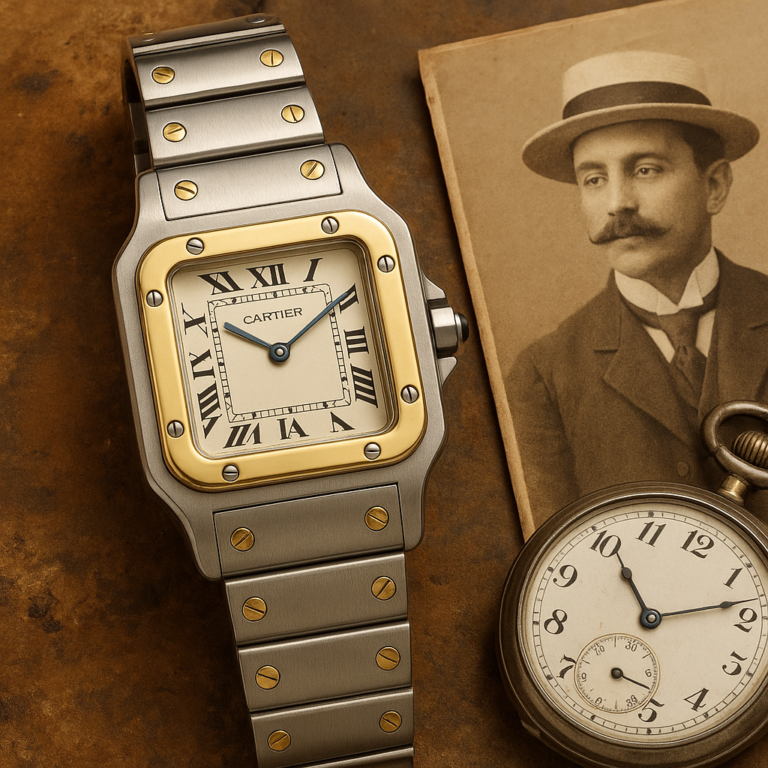
No—the Cartier Santos was not the first wristwatch ever made. But it was arguably the first purpose-built men’s aviation wristwatch, created in 1904 for Brazilian aviation pioneer Alberto Santos-Dumont.
That distinction turns a simple question into a fascinating watchmaking mystery. Earlier wrist-worn watches existed, including Breguet’s watch for Caroline Murat in the early 19th century and Patek Philippe’s documented 1868 wristwatch. So why does the Santos keep receiving the “first wristwatch” crown?
The answer is partly practical and partly theatrical. Santos-Dumont needed to check the time while flying without fumbling with a pocket watch, and Louis Cartier transformed that problem into a square, highly legible watch with exposed screws and unmistakable Parisian style.
We think of the Santos as the watch that helped make the wristwatch modern, masculine, useful, and desirable. It may not have been first chronologically, but it was among the first to make people see the wristwatch as the future rather than a piece of jewelry attached to a bracelet.
Key Takeaways
- The Cartier Santos was not the first wristwatch ever made.
- The Santos-Dumont was created in 1904 for aviator Alberto Santos-Dumont.
- It is widely regarded as the first purpose-built men’s aviation wristwatch.
- Breguet’s 1810 commission for Caroline Murat and Patek Philippe’s 1868 wristwatch predate the Santos.
- The Santos became historically important through its square case, legible dial, aviation purpose, and lasting influence.
- Our recommendation: choose the Santos-Dumont for historical elegance or the Santos de Cartier for more practical everyday wear.
- The most accurate verdict is: not the first wristwatch, but one of the first truly modern men’s wristwatches.
Table of Contents
- ⚡️ Quick Tips and Facts
- The short answer: was the Cartier Santos the first wristwatch?
- What “first wristwatch” actually means
- Pocket watch, wristlet, wristwatch, or purpose-built watch?
- 🕰️ The Origins of Wrist-Worn Timekeeping
- Early wrist-worn watches before Cartier
- The 16th-century arm watch and Elizabethan wrist ornaments
- Napoleon, Queen Victoria, and the rise of wristwatch jewelry
- The first men’s wristwatches and military field watches
- 📜 A Timeline of the First Wristwatch Claims
- 1. The earliest known wrist-worn timepieces
- 2. Patek Philippe’s 1868 wristwatch for Countess Koscowicz
- 3. Girard-Peregaux and naval wristwatches in the 1880s
- 4. Omega, Longines, and early commercial wristwatches
- 5. The Santos-Dumont aviation watch of 1904
- 6. Rolex, Cartier, and the wristwatch boom after World War I
- 7. The modern wristwatch becomes the global standard
- ✈️ Alberto Santos-Dumont and the Birth of the Santos Watch
- Who was Alberto Santos-Dumont?
- Why Santos-Dumont needed a wristwatch for aviation
- How Louis Cartier designed the original Santos
- When was the first Cartier Santos wristwatch made?
- The 1904 Santos-Dumont watch versus the 1906 commercial model
- 🔍 Was the Santos the First Wristwatch? The Evidence Examined
- Why some sources call the Santos the first men’s wristwatch
- Why the claim is historically too broad
- Was the Santos the first purpose-built aviation wristwatch?
- Was it the first commercially successful men’s wristwatch?
- The most accurate historical verdict
- 👥 The People Who Shaped the First Wristwatches
- Louis Cartier and the Santos design
- Alberto Santos-Dumont and wearable aviation technology
- Patek Philippe and Countess Koscowicz
- Breguet and Caroline Murat
- Hans Wilsdorf and the practical wristwatch revolution
- 🧭 The Santos Design: What Made It Revolutionary?
- The square case and exposed screw aesthetic
- The integrated strap and bracelet concept
- Legible Roman numerals and railroad minute track
- The bezel inspired by the Eiffel Tower
- Why the Santos was built for aviation, not jewelry alone
- ⚙️ How the Original Cartier Santos Worked
- Movement, winding, and timekeeping technology
- Case construction and early materials
- Leather straps, buckles, and wrist comfort
- How the early Santos compares with a pocket watch
- 📸 Cartier Santos Models Through the Decades
- The original Santos-Dumont wristwatch
- The 1970s Santos de Cartier and the quartz era
- Santos Galbée and the evolution of the case
- Modern Santos-Dumont watches
- Modern Santos de Cartier watches
- ⌚ Modern Santos Collections and Technical Specifications
- Cartier Santos-Dumont with lacquered case and bezel
- Cartier Santos de Cartier in yellow gold
- Cartier Santos de Cartier Skeleton
- Cartier Santos de Cartier steel models
- Cartier Santos Dual Time and chronograph variants
- Quick comparison of Santos case sizes, movements, and complications
- 🏆 Santos-Dumont vs. Santos de Cartier: Which One Is Historically Closer?
- Dress-watch elegance versus everyday sports-watch practicality
- Manual-wind versus automatic movements
- Thin profile, water resistance, and daily wear
- Which Santos best reflects the 1904 original?
- ⚖️ Cartier Santos Compared With Other Early Wristwatches
- Santos versus Patek Philippe’s 1868 wristwatch
- Santos versus Breguet’s early wristwatch tradition
- Santos versus Girard-Peregaux military wristwatches
- Santos versus Rolex Oyster and the trench watch
- Santos versus the first mass-market wristwatches
- 🧪 What Counts as a “First” in Watch History?
- First wrist-worn timepiece
- First known wristwatch made for a client
- First men’s wristwatch
- First purpose-built aviation wristwatch
- First commercially marketed wristwatch
- First iconic luxury sports watch
- ✅ Common Myths About the Cartier Santos
- Myth: Cartier invented the wristwatch
- Myth: the Santos was the first wristwatch ever made
- Myth: every early Santos was identical
- Myth: the Santos was designed as a military watch
- Myth: the square case was purely decorative
- 🛒 Buying a Cartier Santos Today
- Which Santos model should you choose?
- New versus vintage Cartier Santos watches
- How to check authenticity and provenance
- Movement, dial, case, and bracelet inspection checklist
- Servicing, parts, and long-term ownership
- Who should avoid buying a Santos?
- 🧼 Wearing and Caring for a Santos Watch
- Choosing the right Santos case size
- How to fit the bracelet and QuickSwitch strap
- Water resistance and everyday precautions
- Cleaning the steel, gold, leather, and sapphire crystal
- How often should a Cartier Santos be serviced?
- 🌍 Why the Santos Still Matters in Watchmaking
- The Santos as a bridge between jewelry and aviation
- Its influence on square and integrated-bracelet watches
- The Santos legacy in luxury watch design
- Why collectors still debate its “first wristwatch” status
- 🧾 Final Verdict: Was the Santos the First Wristwatch?
- Conclusion
- Recommended Links
- ❓ FAQ
- Was the Cartier Santos the first wristwatch ever made?
- What year was the first Cartier Santos made?
- Who wore the first Santos watch?
- Why was the Santos-Dumont watch invented?
- Is the Santos the first men’s wristwatch?
- What is the difference between Santos-Dumont and Santos de Cartier?
- Is the Cartier Santos a good everyday watch?
- Which watch is commonly considered the first wristwatch?
- 🔗 Reference Links
⚡️ Quick Tips and Facts
The short answer: was the Cartier Santos the first wristwatch?
No—not the first wristwatch ever made. The most defensible answer is more precise:
- Breguet No. 2639, commissioned for Queen Caroline Murat in 1810 and delivered in 1812, is often considered the earliest purpose-built wristwatch.
- Patek Philippe’s 1868 wristwatch for Countess Koscowicz is the earliest famous surviving example and is sometimes credited as the first wristwatch by record-keeping organizations.
- Cartier’s Santos-Dumont, created in 1904, is widely regarded as the first men’s wristwatch and the first purpose-built pilot’s wristwatch.
That distinction matters. Calling the Santos “the first wristwatch” is catchy, but historically incomplete. Cartier itself describes the Santos as its first wristwatch, while watch historians such as Teddy Baldassarre separate “first ever” from “first made specifically for a man and an aviator.”
Our first relevant stop is our deeper history of who invented the wristwatch in 1904, which examines the Santos-Dumont story in greater detail.
| Claim | Best-supported answer | Why it matters |
|---|---|---|
| First wrist-worn timepiece | Earlier wristlet watches and disputed historical examples | Wrist-worn timekeeping predates Cartier |
| First purpose-built wristwatch | Usually attributed to Breguet No. 2639 | Designed from the outset for the wrist |
| First surviving famous wristwatch | Patek Philippe, 1868 | A physical watch survives in the Patek Philippe Museum |
| First men’s wristwatch | Cartier Santos-Dumont, 1904 | Designed for a male wearer |
| First pilot’s wristwatch | Cartier Santos-Dumont, 1904 | Solved a genuine aviation problem |
| First Cartier wristwatch | Santos, 1904 | The foundation of Cartier’s wristwatch identity |
Our verdict: the Santos was not the first wristwatch in all history. It was arguably the first modern men’s aviation wristwatch, and that is still a spectacular achievement. 🛩️
What “first wristwatch” actually means
The phrase can describe several different milestones:
- The first watch worn on the wrist
- The first watch designed specifically for wrist wear
- The first wristwatch made for a man
- The first pilot’s wristwatch
- The first commercially successful men’s wristwatch
- The first wristwatch to make the format fashionable
Those are not interchangeable. A jeweled watch attached to a bracelet may qualify as an early wristwatch, but it does not necessarily represent the same design challenge as a legible, secure, practical watch intended for aviation.
This is why sources disagree. Guiness World Records has credited Patek Philippe’s 1868 watch, while historical research favors earlier documented examples. Breguet traces its Reine de Naples lineage to the 1810 watch made for Caroline Murat.
The word “first” needs a qualifier. Without one, watch history becomes a courtroom drama where everyone brings a different definition of evidence.
Pocket watch, wristlet, wristwatch, or purpose-built watch?
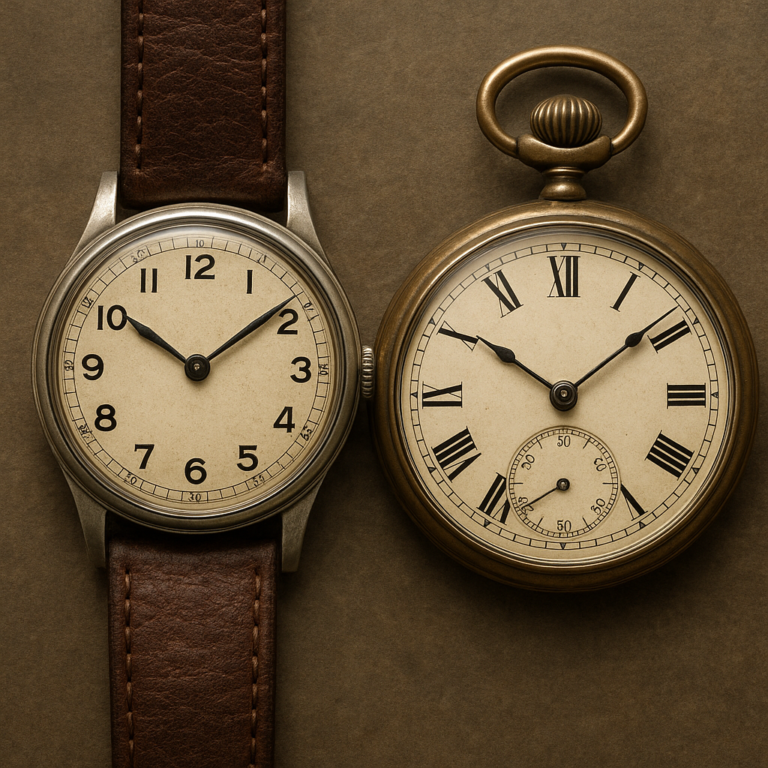
A pocket watch adapted with a strap is not quite the same thing as a watch designed around the wrist.
| Type | Typical characteristics | Historical significance |
|---|---|---|
| Pocket watch | Round case, crown at 12 o’clock, chain or fob | Dominant men’s format before the 20th century |
| Wristlet watch | Small watch attached to a bracelet or ribbon | Popular among women as jewelry |
| Converted wristwatch | Pocket-watch movement fitted to lugs or a strap | Practical transitional design |
| Purpose-built wristwatch | Case, dial, crown, lugs, and strap designed for wrist use | The clearest definition of a true wristwatch |
| Pilot’s wristwatch | Built for quick reading and hands-free operation | The Santos-Dumont’s historical category |
The original Santos was important because it combined purpose, legibility, masculine styling, and a recognizable case design. It was not merely a pendant watch dragged onto a leather strap.
🕰️ The Origins of Wrist-Worn Timekeeping
Early wrist-worn watches before Cartier
Wrist-worn timepieces appeared long before Louis Cartier met Alberto Santos-Dumont. During the 16th through 19th centuries, miniature watches were worn as jewelry, attached to bracelets, necklaces, broches, and clothing.
The survival rate of these watches is poor, and documentation is inconsistent. That creates a familiar archival problem: the oldest surviving example is not automatically the first example ever made.
Women adopted wrist-mounted watches earlier than men because women’s clothing often lacked practical pockets. Men generally carried pocket watches in waistcoats, where a chain provided both security and a little social theater.
According to Patek Philippe’s historical account, the company’s 1868 watch for Countess Koscowicz is an important early wristwatch, but its existence does not erase earlier documented commissions.
The 16th-century arm watch and Elizabethan wrist ornaments
Small mechanical watches became technically possible during the Renaissance as watchmakers refined spring-driven movements. Early examples were expensive, delicate, and inaccurate by modern standards, but they were marvels of miniaturization.
A frequently cited early example is a small watch associated with Elizabeth I, although descriptions of historical arm watches vary and some popular retellings blur the line between a watch worn on the arm and a watch attached to clothing.
The broader fact is reliable: watches were being worn on the body centuries before the Santos. Their role was usually ornamental or ceremonial, not occupational.
That difference foreshadows the Santos story. Early wrist watches decorated the wearer; Santos-Dumont needed one to help operate an aircraft.
Napoleon, Queen Victoria, and the rise of wristwatch jewelry
By the 18th and 19th centuries, watchmaking had become closely linked with luxury jewelry. Wristlets and bracelet watches appealed to aristocratic clients who wanted timekeeping without sacrificing ornament.
Queen Caroline Murat, Napoleon’s sister and Queen of Naples, commissioned Breguet’s famous watch in 1810. Breguet’s Reine de Naples history identifies this lineage as one of the earliest purpose-built wristwatch traditions.
The watch reportedly included:
- An oval case
- A slim, jewelry-like profile
- A repeater complication
- An attachment made from hair and gold threads
- A movement designed specifically for wrist placement
This was not a rugged pilot’s instrument. It was a refined object made for a royal client. But technically and historically, it is a strong candidate for the first purpose-built wristwatch.
The first men’s wristwatches and military field watches
Men’s wristwatches gained credibility gradually through sport, military service, and aviation.
The transformation accelerated because wrist-worn timekeeping offered practical advantages:
- Faster time checks
- Hands remaining available for equipment
- Easier coordination during maneuvers
- Better visibility while riding, flying, or operating machinery
Early military wristwatches were sometimes created by attaching wire lugs to pocket-watch cases. Brands such as Longines and Omega later helped refine the format.
Here is the twist: the Santos arrived before World War I made men’s wristwatches normal, but military use helped make the category unavoidable. Cartier supplied the style; the battlefield supplied the mass adoption.
📜 A Timeline of the First Wristwatch Claims
1. The earliest known wrist-worn timepieces
Early wrist-worn watches were typically miniature timepieces integrated into jewelry. They were expensive, fragile, and often designed for women or aristocratic patrons.
Their importance lies in showing that the wrist was not a new location for a watch in 1904. What changed with Cartier was the intended user and the social meaning.
2. Patek Philippe’s 1868 wristwatch for Countess Koscowicz
Patek Philippe made an ornate gold wristwatch for Countess Koscowicz of Hungary in 1868. The watch is preserved at the Patek Philippe Museum in Geneva.
It is often described as the first Swiss wristwatch, a narrower and more defensible claim than “the first wristwatch ever.”
| Detail | Patek Philippe 1868 wristwatch |
|---|---|
| Maker | Patek Philippe |
| Date | 1868 |
| Client | Countess Koscowicz |
| Format | Ornate gold wristwatch |
| Surviving example | Yes |
| Historical role | Early documented Swiss wristwatch |
The surviving object gives this claim considerable strength. Historians, however, must distinguish surviving evidence from earliest creation date.
3. Girard-Peregaux and naval wristwatches in the 1880s
Girard-Peregaux is associated with early wristwatch production for military use, including watches supplied to German naval personnel in the late 19th century.
These watches mattered because they moved wristwatches away from pure jewelry and toward professional equipment. Their success also demonstrates that the Santos did not emerge from a vacuum.
Visit Girard-Peregaux’s official history for the brand’s perspective on early wristwatch development.
4. Omega, Longines, and early commercial wristwatches
By the early 20th century, established Swiss manufacturers were producing wristwatches for men, women, military users, and sports applications.
Brands including:
helped turn wristwatches into a commercial category.
The Santos was therefore not necessarily the first commercially available wristwatch. Its distinction was the combination of a famous wearer, a purpose-built design, and a powerful luxury brand.
5. The Santos-Dumont aviation watch of 1904
In 1904, Louis Cartier created a wristwatch for Brazilian aviator Alberto Santos-Dumont. The practical problem was simple: a pilot cannot easily remove a pocket watch while controlling an aircraft.
The solution was a square watch worn on a leather strap, with a bold dial and an instantly recognizable bezel.
The original watch was reportedly fitted with a movement supplied by Edmond Jaeger, who later became associated with Jaeger-LeCoultre.
This is the moment that gives Cartier its strongest “first” claim: the first wristwatch designed for a male pilot.
6. Rolex, Cartier, and the wristwatch boom after World War I
World War I accelerated the adoption of wristwatches among men. Timing artillery, coordinating movements, and checking schedules were all easier with a watch on the wrist.
Cartier’s Santos helped make the format elegant and aspirational. Rolex later emphasized durability and water resistance with the Oyster case, introduced in 1926. Rolex explains the Oyster’s development here.
The two approaches were complementary:
- Cartier made the wristwatch stylish and socially desirable
- Military suppliers made it practical and widespread
- Rolex made it robust and technically convincing
7. The modern wristwatch becomes the global standard
By the 1920s, wristwatches had largely defeated the pocket watch in everyday use. The transition was not caused by one model alone.
It was driven by:
- Aviation
- Military service
- Industrial manufacturing
- Improved miniature movements
- Lower production costs
- Changing men’s fashion
- Marketing and celebrity influence
The Santos deserves credit as an early catalyst, but not as the sole inventor of the wristwatch.
✈️ Alberto Santos-Dumont and the Birth of the Santos Watch
Who was Alberto Santos-Dumont?
Alberto Santos-Dumont was a Brazilian aviation pioneer born in 1873. He moved to Paris in 1892 and became famous for ballooning, airships, and powered flight.
He gained major public attention after his 1901 flight around the Eiffel Tower during the Deutsch Prize challenge. The route covered approximately 11 kilometers, and the recorded flight took roughly 29 minutes and 30 seconds before landing time was added.
In 1906, he flew the 14-bis in a publicly witnessed powered flight in Europe. The Smithsonian National Air and Space Museum provides historical information about the aircraft.
Santos-Dumont was not simply a customer with a fashionable hobby. He was a celebrity engineer constantly surrounded by machines, experiments, and public expectations.
Why Santos-Dumont needed a wristwatch for aviation
Flying demanded concentration. A pilot checking a pocket watch had to:
- Remove one hand from the controls.
- Reach into a pocket.
- Open or expose the watch.
- Read the time.
- Return the watch.
- Re-establish control.
That sequence is awkward in a balloon and potentially dangerous in a powered aircraft.
A wristwatch solves the problem:
- Keep both hands near the controls.
- Rotate the wrist.
- Read the dial immediately.
- Continue flying.
The Santos-Dumont was therefore an early example of human-centered design. It placed information where the user needed it.
How Louis Cartier designed the original Santos
Louis Cartier’s design departed from the conventional round pocket watch. The case featured:
- A square profile
- Rounded corners
- Broad shoulders
- Integrated lugs
- Exposed bezel screws
- Large Roman numerals
- A leather strap
- A highly legible dial
The exposed screws are often linked to the industrial architecture of Paris, particularly the Eiffel Tower. Whether every inspiration story is perfectly documented or not, the visual message is clear: this was a machine for a modern age.
The shape also created a recognizable identity. A round watch can disappear into a crowd of round watches. The Santos announces itself from across a room.
When was the first Cartier Santos wristwatch made?
The Santos-Dumont watch was created in 1904 for Alberto Santos-Dumont. Cartier later developed the model for commercial production, with sales commonly associated with 1908 or 191, depending on how one defines the first public availability.
This is one of the timeline disputes readers should treat carefully:
| Date | Event |
|---|---|
| 1904 | Louis Cartier creates the original watch for Santos-Dumont |
| 1906 | Santos-Dumont wears the watch during a notable aviation period |
| 1908 | Cartier revisits and develops the design |
| 191 | Commercial availability is commonly cited |
| 1978 | Santos de Cartier returns in a steel-and-gold luxury-sports format |
| 1987 | Santos Galbée refines the case and bracelet |
| 2018 | Modern Santos redesign adds QuickSwitch and SmartLink systems |
| 2019 | Santos-Dumont returns as a core collection model |
The safest wording is: the original Santos was created in 1904; broader commercial introduction followed later.
The 1904 Santos-Dumont watch versus the 1906 commercial model
The original Santos-Dumont was a personal commission, not necessarily a standardized catalog reference. Later commercial models necessarily changed materials, movements, proportions, and finishing.
That means a modern Santos is historically related to the original, but it is not a museum-piece replica.
Our collector’s rule: treat “the first Santos” as a design origin, not as one perfectly frozen production specification.
🔍 Was the Santos the First Wristwatch? The Evidence Examined
Why some sources call the Santos the first men’s wristwatch
The Santos has an unusually strong claim because it solved a clearly documented problem for a clearly identified male user.
Teddy Baldassarre describes it as “the first wristwatch designed for a male wearer and the first one purpose-built for a pilot.” That is a much more defensible statement than claiming it was the first wristwatch, full stop.
The claim rests on four pillars:
- A male client: Alberto Santos-Dumont
- A professional use case: aviation
- A purpose-built wrist format: not merely jewelry
- A famous public wearer: Santos-Dumont himself
In our view, this is why the Santos is historically more influential than some earlier wrist watches. It connected wristwear with modern masculinity, technology, and adventure.
Why the claim is historically too broad
The Santos cannot be the first wristwatch overall if earlier documented wristwatches existed.
The strongest counterexamples include:
- Breguet’s 1810 commission for Caroline Murat
- Patek Philippe’s 1868 wristwatch
- Late-19th-century military and naval wristwatches
- Earlier wristlet and bracelet watches
The Revolution Watch account quotes Cartier heritage and style director Pierre Rainero describing the Santos as “the first modern wristwatch ever and the first watch designed to be worn on the wrist.”
That statement is best understood as Cartier’s brand interpretation, not a universally accepted chronology. It emphasizes modern purpose and design rather than every wrist-worn timepiece that came before.
Was the Santos the first purpose-built aviation wristwatch?
Probably yes, based on the available historical record.
The watch was created specifically because Santos-Dumont needed to read time while flying. That makes it different from a jewelry watch that happened to be worn on the wrist.
Its aviation credentials were practical rather than decorative:
- Easy wrist access
- Clear minute reading
- Secure leather strap
- Distinctive case orientation
- No need to remove a pocket watch from clothing
The term “pilot’s watch” later became associated with large black dials, luminous numerals, and oversized crowns. The Santos belongs to an earlier, more elegant branch of aviation watch history.
Was it the first commercially successful men’s wristwatch?
That claim is difficult to prove. Cartier sold the Santos, but the explosion of men’s wristwatch ownership came later through military service and mass production.
The Santos was influential because it made the wristwatch desirable. The trench watch made it necessary. Rolex, Omega, Longines, and many others helped make it dependable and accessible.
So:
- First influential luxury men’s wristwatch: strong claim
- First commercial men’s wristwatch: too broad
- First mass-market men’s wristwatch: no
The most accurate historical verdict
Here is the wording we would happily put on a museum label:
The Cartier Santos was created in 1904 as one of the earliest purpose-built men’s wristwatches and is widely regarded as the first dedicated pilot’s wristwatch. It was not the first wristwatch ever made.
That sentence resolves the apparent contradiction. The Santos was not first chronologically, but it was first in a category that would become hugely important.
👥 The People Who Shaped the First Wristwatches
Louis Cartier and the Santos design
Louis Cartier understood that a watch could be more than a timekeeping device. It could be architecture on the wrist.
He gave the Santos:
- A geometric silhouette
- Industrial details
- Jewelry-quality finishing
- A masculine profile
- A shape distinct from ordinary pocket watches
His achievement was not simply miniaturization. It was reframing the watch as a wearable object with its own visual language.
Alberto Santos-Dumont and wearable aviation technology
Santos-Dumont supplied the practical brief. He needed quick access to time without sacrificing control of his aircraft.
This is a recurring pattern in watchmaking: the user’s problem creates the product’s identity.
Examples include:
- Diving watches for underwater timing
- Racing chronographs for lap timing
- Field watches for military legibility
- GMT watches for international travel
- Pilot watches for cockpit readability
The Santos began as a tool, even though it later became a luxury icon.
Patek Philippe and Countess Koscowicz
Patek Philippe’s 1868 watch demonstrates that wristwear had already entered elite European society decades before Cartier’s aviation commission.
Its significance is twofold:
- It is an important surviving artifact
- It represents the wristwatch as jewelry and social display
The watch’s existence weakens the claim that Cartier invented wristwatches, but it strengthens the distinction between jewelry wristwatches and men’s utility watches.
Breguet and Caroline Murat
Breguet’s watch for Caroline Murat is arguably the strongest “first wristwatch” candidate because it was reportedly designed specifically for wrist wear rather than simply adapted.
The commission also included a repeater, meaning the wearer could hear the time without looking at the dial. That was a remarkable technical feature for an early wrist-mounted watch.
The Breguet Reine de Naples collection preserves the memory of this royal commission through an oval case and wrist-focused design.
Hans Wilsdorf and the practical wristwatch revolution
Hans Wilsdorf and Rolex helped establish the wristwatch as a serious precision instrument. The Oyster case gave the format a powerful technical argument: a wristwatch could be reliable, durable, and resistant to water.
This matters because Cartier’s contribution was primarily design, identity, and social acceptance, while Rolex emphasized engineering and robustness.
The modern wristwatch needed both.
🧭 The Santos Design: What Made It Revolutionary?
The square case and exposed screw aesthetic
The square Santos case challenged the dominance of round watch design. Its corners were softened, but its geometry remained unmistakable.
The exposed screws served several roles:
- They visually anchored the bezel
- They suggested engineering
- They created a repeatable design signature
- They connected the watch with modern architecture
This is why a Santos can be recognized even without seeing the dial. The bezel is doing a lot of talking.
The integrated strap and bracelet concept
The original watch used a leather strap, but later Santos models developed a stronger relationship between case and bracelet.
The bracelet does not merely hang from the case. It visually continues the geometry, creating a unified object.
Modern Santos de Cartier models add:
- QuickSwitch, allowing strap and bracelet changes without tools
- SmartLink, allowing bracelet sizing by removing links with an integrated system
Cartier describes these systems on its official Santos collection page.
Legible Roman numerals and railroad minute track
The dial uses Roman numerals, but they are not timid decorative flourishes. They are large, high-contrast, and arranged around the square case.
The minute track reinforces precision and helps the wearer read the time quickly. This is a small but important point: the Santos looks elegant because its functional elements were made beautiful, not because function was ignored.
The bezel inspired by the Eiffel Tower
The Eiffel Tower connection is one of the most repeated Santos stories. The exposed screws and structural geometry evoke the industrial architecture Santos-Dumont admired.
Even if the exact design conversation is not fully documented, the symbolism is fitting:
- Aircraft
- Steel structures
- Engineering
- Modernity
- Public spectacle
The Santos looks like a piece of Parisian infrastructure politely attending a formal dinner.
Why the Santos was built for aviation, not jewelry alone
The design makes sense when viewed through the pilot’s needs:
- The strap keeps the watch secure
- The dial is visible at a glance
- The case is distinctive and easy to orient
- The watch sits above clothing rather than disappearing into a pocket
The jewelry-like finishing came later as part of Cartier’s identity. The original spark was utility.
⚙️ How the Original Cartier Santos Worked
Movement, winding, and timekeeping technology
The early Santos used a manually wound movement associated with Edmond Jaeger. Exact historical specifications are difficult to verify because the original 1904 watch is lost and early production was not standardized like modern reference systems.
Manual winding meant the wearer had to:
- Remove or loosen the watch if necessary.
- Access the crown.
- Turn the crown repeatedly.
- Set the time when required.
- Wear the watch during flight.
Modern manual-winding Santos-Dumont watches continue this tradition, including models powered by Cartier’s 430 MC movement.
Case construction and early materials
Early Cartier watches were made in precious metals and crafted for elite clients. The case had to balance:
- Low enough weight for comfort
- Sufficient rigidity
- A secure crystal
- A stable strap attachment
- A readable dial
Modern Santos models use materials such as stainless steel, yellow gold, rose gold, platinum, sapphire crystal, and lacquer.
Leather straps, buckles, and wrist comfort
Leather was the logical early strap material. It was flexible, light, and available to a luxury maker.
The strap also reinforced the Santos-Dumont’s dressier personality. Compared with a modern integrated-bracelet sports watch, it wears slimmer and more discreetly.
Potential drawbacks include:
- Leather absorbs moisture
- Sweat and water shorten strap life
- Alligator straps require careful maintenance
- Dressier straps are less suitable for swimming or rough use
How the early Santos compares with a pocket watch
| Feature | Pocket watch | Early Santos |
|---|---|---|
| Storage | Waistcoat or trouser pocket | Wrist |
| Access | Requires reaching into clothing | Immediate wrist glance |
| Hands-free use | Poor | Much better |
| Case shape | Usually round | Square |
| Strap or chain | Chain/fob | Leather strap |
| Social message | Traditional, conservative | Modern, adventurous |
| Best use | Formal timekeeping | Aviation and active use |
The Santos was not just a pocket watch with a bracelet. It represented a new relationship between the wearer, the machine, and time.
📸 Cartier Santos Models Through the Decades
The original Santos-Dumont wristwatch
The original model established the basic DNA:
- Square case
- Rounded corners
- Exposed screws
- Roman numerals
- Leather strap
- Cartier styling
- Aviation association
That DNA remains unusually stable. Many watches become unrecognizable after a century of updates. The Santos changed materials and movements but kept the face of its ancestor.
The 1970s Santos de Cartier and the quartz era
Cartier revived the design in 1978 as the Santos de Cartier. This version introduced a more modern luxury-sports personality, including:
- Stainless steel construction
- Gold bezel and screws
- Integrated bracelet
- Automatic or quartz-era practicality
- A stronger everyday-wear identity
The model arrived alongside the rise of the Audemars Piguet Royal Oak and Patek Philippe Nautilus. It was not identical in philosophy, but it shared the era’s interest in luxury watches made from steel.
The result was a watch that could move between office, travel, and social settings without looking like it had changed costumes.
Santos Galbée and the evolution of the case
Introduced in 1987, the Santos Galbée refined the silhouette with smoother lines and more ergonomic case shaping.
Compared with earlier models, it offered:
- Softer case contours
- Better integration with the bracelet
- A more comfortable wrist profile
- A slightly less rigid visual character
The Galbée remains popular among vintage Cartier enthusiasts because it captures the 1980s and 1990s design language without losing the original identity.
Modern Santos-Dumont watches
Modern Santos-Dumont watches emphasize thiness, elegance, and historical continuity.
Typical characteristics include:
- Manual-winding movements
- Leather straps
- Slim cases
- Hours-and-minutes displays
- Precious-metal or lacquer treatments
- Strong visual connection to the original 1904 design
They are best understood as dress watches with aviation ancestry, not as rugged tool watches.
Modern Santos de Cartier watches
Modern Santos de Cartier models are broader and more versatile. Depending on the reference, you may find:
- Automatic movement
- Date display
- Stainless steel, gold, or two-tone cases
- 100-meter water resistance
- Interchangeable bracelet and leather strap
- QuickSwitch and SmartLink systems
- Skeletonized movements
The modern collection is more practical for everyday wear, while the Santos-Dumont stays closer to the elegant original.
⌚ Modern Santos Collections and Technical Specifications
Cartier Santos-Dumont with lacquered case and bezel
The lacquered Santos-Dumont gives the traditional design a more contemporary artistic finish. Selected references include CRWSSA0046, CRWGSA0053, and CRWGSA0054.
| Specification | Santos-Dumont lacquered models |
|---|---|
| Movement | Manual-winding Cartier 430 MC |
| Power reserve | Approximately 38 hours |
| Functions | Hours and minutes |
| Case dimensions | Approximately 43.5 × 31.4 mm |
| Materials | Stainless steel, platinum, or 18K rose gold |
| Water resistance | 30 meters |
| Dial | Lacquer with geometric concentric-square pattern |
| Strap | Alligator leather |
| Character | Thin, elegant, historically focused |
Strengths:
- Closely reflects the Santos-Dumont dress-watch identity
- Manual winding encourages ritual and connection
- Thin profile
- Distinctive lacquer finishing
- Excellent formal versatility
Drawbacks:
- Limited water resistance
- Leather strap is less practical for active wear
- Manual winding is not for everyone
- The rectangular dimensions can wear larger than expected
See the official Cartier Santos-Dumont collection for current availability and specifications.
Cartier Santos de Cartier in yellow gold
A full-yellow-gold Santos de Cartier, such as reference CRWGSA0029, pushes the design firmly into luxury territory.
| Specification | Santos de Cartier yellow gold |
|---|---|
| Movement | Automatic Cartier 1847 MC |
| Power reserve | Approximately 42 hours |
| Functions | Hours, minutes, seconds, date |
| Case dimensions | Approximately 47.5 × 39.8 mm |
| Material | 18K yellow gold |
| Water resistance | 100 meters |
| Dial | Silvered opaline with Roman numerals |
| Bracelet | Interchangeable yellow-gold bracelet |
| Additional strap | Brown alligator leather |
| Best for | Luxury daily wear and formal occasions |
Strengths:
- Strong wrist presence
- Automatic convenience
- Date display
- High water resistance for a dress-luxury watch
- Bracelet and strap flexibility
Drawbacks:
- Gold is more vulnerable to scratches
- High visual presence may not suit understated wardrobes
- Heavier than steel
- Full-gold styling is less discreet
Cartier Santos de Cartier Skeleton
The Santos de Cartier Skeleton uses Cartier’s 961 MC manual-winding movement. The bridges are shaped into Roman numerals, making the movement architecture part of the dial.
| Specification | Santos de Cartier Skeleton |
|---|---|
| Movement | Manual-winding Cartier 961 MC |
| Power reserve | Approximately 72 hours |
| Functions | Hours and minutes |
| Case dimensions | Approximately 47.5 × 39.8 mm |
| Material | Stainless steel in selected references |
| Water resistance | 100 meters |
| Dial | Openworked blue, gray, or green |
| Bracelet | Interchangeable steel bracelet |
| Strap | Matching alligator leather |
| Best for | Collectors seeking technical artistry |
The key benefit is that Cartier designed the skeleton movement from the beginning rather than simply cutting holes into a conventional caliber. The Roman numerals become structural bridges.
Drawbacks:
- Manual winding requires regular interaction
- Openworked dials can be less immediately legible
- Larger case dimensions may overwhelm smaller wrists
- Skeleton finishing requires careful protection from impacts
Cartier Santos de Cartier steel models
Steel Santos models are arguably the most versatile modern versions. They retain the luxury identity but are less precious and easier to wear daily.
Typical advantages include:
- Strong durability
- Lower visual formality
- Better pairing with casual clothing
- Automatic convenience
- Bracelet and strap interchangeability
- 100-meter water resistance on many models
The primary drawback is that polished surfaces show scratches quickly. That is not a defect unique to Cartier; it is the price of looking like a small piece of architecture.
Cartier Santos Dual Time and chronograph variants
The Santos family has appeared in versions with additional complications, including chronograph and dual-time functions.
These watches expand the collection beyond the simple two-hand format, but they also introduce more visual complexity. The original Santos was admired for immediate readability, so additional subdials can dilute some of its historical clarity.
Choose a complication if you genuinely need the function. Do not buy a chronograph merely because the subdials look busy and expensive.
Quick comparison of Santos case sizes, movements, and complications
| Model family | Movement type | Main display | Strap/bracelet | Water resistance | Personality |
|---|---|---|---|---|---|
| Santos-Dumont | Manual | Hours and minutes | Leather | Around 30 m | Thin and dressy |
| Santos de Cartier steel | Automatic | Time, often date | Bracelet and leather | Often 100 m | Everyday luxury |
| Santos de Cartier gold | Automatic | Time and date | Gold bracelet and leather | Around 100 m | High-luxury statement |
| Santos Skeleton | Manual | Openworked hours and minutes | Bracelet and leather | Around 100 m | Technical and artistic |
| Vintage Santos Galbée | Quartz or automatic, depending on reference | Time, sometimes date | Integrated bracelet | Varies | Vintage everyday elegance |
🏆 Santos-Dumont vs. Santos de Cartier: Which One Is Historically Closer?
Dress-watch elegance versus everyday sports-watch practicality
The Santos-Dumont and Santos de Cartier share DNA but serve different lifestyles.
| Characteristic | Santos-Dumont | Santos de Cartier |
|---|---|---|
| Historical mood | Closest to 1904 | Modern reinterpretation |
| Profile | Slimer | Broader |
| Movement | Usually manual | Usually automatic |
| Strap | Leather | Bracelet plus interchangeable strap |
| Water resistance | Lower | Higher |
| Best setting | Formal and smart-casual | Daily wear, travel, business |
| Visual impact | Refined | More assertive |
The Santos-Dumont is the better choice if you want the historical story to remain visible. The Santos de Cartier is the better choice if you want one watch to handle a busy week.
Manual-wind versus automatic movements
Manual winding ✅
- Historically appropriate
- Often thinner
- Creates a daily ritual
- Can allow a more elegant case profile
Manual winding ❌
- Requires regular winding
- Less convenient for rotation
- Can be forgotten after a few days off the wrist
Automatic movement ✅
- More convenient
- Better suited to daily wear
- Often includes a date
- Works naturally with a bracelet
Automatic movement ❌
- Usually thicker
- Less historically faithful
- Rotor adds mechanical complexity
Thin profile, water resistance, and daily wear
A thin watch can disappear beneath a cuff. A thicker automatic watch may offer better impact resistance and water protection but feels more substantial.
For actual daily wear, consider:
- How often you wear a suit or tailored clothing
- Whether you swim with your watch
- Whether you rotate among several watches
- How much you value manual winding
- Whether bracelet comfort matters more than historical purity
A Santos-Dumont is not a substitute for a dive watch. A Santos de Cartier is more robust, but it is still a luxury watch with polished surfaces.
Which Santos best reflects the 1904 original?
The Santos-Dumont on leather is the closest modern interpretation of the original concept.
The Santos de Cartier retains the design’s broader identity but leans into the later luxury-sports tradition that emerged in the 1970s.
Our recommendation:
- Choose Santos-Dumont for historical fidelity and dress-watch elegance.
- Choose Santos de Cartier steel for versatility.
- Choose Santos Skeleton for movement artistry.
- Choose yellow gold for unmistakable luxury presence.
⚖️ Cartier Santos Compared With Other Early Wristwatches
Santos versus Patek Philippe’s 1868 wristwatch
Patek Philippe’s 1868 watch predates the Santos by 36 years. It is a strong historical example, but it was made as an ornate women’s wristwatch.
The Santos differs in:
- Male target wearer
- Aviation purpose
- More legible dial
- More masculine styling
- Greater connection to modern industrial design
Santos versus Breguet’s early wristwatch tradition
Breguet’s 1810 watch likely wins the chronological “first purpose-built wristwatch” argument.
The Santos wins a different argument: it helped move the wristwatch from aristocratic jewelry into male professional life.
Santos versus Girard-Peregaux military wristwatches
Girard-Peregaux’s military wristwatches were important because they treated the wristwatch as equipment.
The Santos added something military watches generally lacked: a coherent luxury design language.
Santos versus Rolex Oyster and the trench watch
The trench watch and Rolex Oyster established practicality, durability, and water resistance. The Santos established a more expressive idea of what a men’s wristwatch could look like.
| Watch tradition | Main contribution |
|---|---|
| Breguet | Early purpose-built wristwatch |
| Patek Philippe | Surviving Swiss wristwatch |
| Military trench watch | Practical mass adoption |
| Cartier Santos | Men’s aviation wristwatch and luxury design |
| Rolex Oyster | Water-resistant precision wristwatch |
Santos versus the first mass-market wristwatches
The Santos was never the cheapest route into wristwatch ownership. Its importance was cultural and design-led.
Mass-market brands made wristwatches affordable; Cartier made one desirable as a statement of taste and modernity.
🧪 What Counts as a “First” in Watch History?

First wrist-worn timepiece
This category is difficult because early records are incomplete. Wristlets, bracelet watches, and arm watches existed before the 19th century, but surviving documentation is uneven.
Answer: no single universally accepted winner.
First known wristwatch made for a client
Breguet’s 1810 commission for Caroline Murat is a leading candidate.
Answer: likely Breguet No. 2639, delivered in 1812.
First men’s wristwatch
The Santos-Dumont has the strongest popular and historical claim.
Answer: Cartier Santos-Dumont, created in 1904.
First purpose-built aviation wristwatch
The Santos-Dumont was commissioned because of aviation requirements.
Answer: Cartier Santos-Dumont, based on current documented evidence.
First commercially marketed wristwatch
This depends on whether the question means the first wristwatch sold commercially, first Swiss wristwatch sold commercially, or first successful men’s model.
Answer: no single uncontested model.
First iconic luxury sports watch
The Santos de Cartier’s 1978 steel-and-gold revival predates the Audemars Piguet Royal Oak and Patek Philippe Nautilus in certain luxury steel-and-gold interpretations, though categorization varies.
Answer: the Santos is one of the earliest luxury watches to combine precious metal, steel, integrated design, and a recognizable sports-luxury identity.
✅ Common Myths About the Cartier Santos
Myth: Cartier invented the wristwatch
❌ False. Wrist-worn watches existed before Cartier’s 1904 Santos.
✅ Cartier created one of the earliest influential men’s wristwatches and the first purpose-built pilot’s wristwatch in the commonly accepted historical narrative.
Myth: the Santos was the first wristwatch ever made
❌ Too broad.
✅ It was likely the first wristwatch purpose-built for a male aviator.
Myth: every early Santos was identical
❌ Unlikely. Early commissioned and commercial watches varied in movement, materials, and details.
✅ Modern reference numbers help collectors identify differences more precisely.
Myth: the Santos was designed as a military watch
❌ No. It was designed for Alberto Santos-Dumont, a civilian aviation pioneer.
✅ Military use later helped normalize wristwatches for men.
Myth: the square case was purely decorative
❌ Not entirely.
✅ The square case improved identity, supported a clear dial layout, and visually communicated the watch’s modern engineering purpose.
🛒 Buying a Cartier Santos Today
Which Santos model should you choose?
Start with use, not hype.
| Your priority | Best direction |
|---|---|
| Closest historical feel | Santos-Dumont |
| Everyday versatility | Santos de Cartier steel |
| Formal luxury | Santos-Dumont in precious metal |
| Bracelet presence | Santos de Cartier |
| Technical artistry | Santos Skeleton |
| Vintage character | Santos Galbée |
| Easy strap changes | 2018-and-later Santos de Cartier |
Read our broader Guide to Buying Watches before making a major purchase. A rectangular or square watch wears differently from a round watch, even when the stated dimensions look modest.
New versus vintage Cartier Santos watches
New Santos ✅
- Modern warranty
- Current servicing support
- Improved water resistance
- QuickSwitch and SmartLink on selected models
- Consistent finishing
New Santos ❌
- Less patina
- Larger dimensions on some references
- Higher replacement-part complexity
- Polished surfaces still scratch easily
Vintage Santos ✅
- Strong period character
- Smaller proportions
- Historical charm
- Often more discreet on the wrist
Vintage Santos ❌
- Unknown service history
- Potentialy tired bracelet
- Water resistance should not be assumed
- Replacement parts can be complicated
- Authentication requires care
How to check authenticity and provenance
Use a layered inspection:
- Check the seller’s reputation.
- Request clear photographs of the dial, caseback, movement, clasp, and bracelet.
- Compare reference and serial details with Cartier documentation.
- Inspect dial printing and Roman numerals.
- Look for correct case geometry.
- Confirm movement type and finishing.
- Ask for service records.
- Use an independent watchmaker or authentication service.
A Cartier watch with no credible provenance is not automatically fake, but it deserves more questions than a watch with documented ownership and service history.
Movement, dial, case, and bracelet inspection checklist
| Component | What to inspect |
|---|---|
| Dial | Crisp printing, aligned numerals, correct hands |
| Crystal | Scratches, chips, correct shape |
| Case | Consistent brushing and polishing, sharp geometry |
| Screws | Correct alignment and finish |
| Crown | Cartier cabochon and appropriate shape |
| Movement | Correct caliber, clean service condition |
| Bracelet | Stretch, missing links, clasp action |
| Strap | Genuine leather, correct stitching and buckle |
| Papers | Reference, serial, purchase, service details |
Servicing, parts, and long-term ownership
Cartier recommends professional servicing through its official network. Visit Cartier Care for support information.
Budget for the realities of luxury ownership:
- Mechanical servicing
- Strap replacement
- Bracelet refinishing
- Crystal replacement after severe damage
- Water-resistance testing
- Movement regulation
- Battery replacement for quartz vintage models
Avoid polishing vintage cases aggressively. The Santos’s geometry is part of its identity, and over-polishing can soften the very edges collectors value.
Who should avoid buying a Santos?
A Santos may not suit you if:
- You want a rugged tool watch
- You dislike polished surfaces
- You prefer a discreet round case
- You never want to think about servicing
- You need extreme shock resistance
- You expect a watch to behave like a dive computer
For alternatives, browse our Luxury Watch Brands and Men’s Watches categories.
🧼 Wearing and Caring for a Santos Watch
Choosing the right Santos case size
Do not judge a Santos only by its millimeter width. Square and rectangular watches present more surface area than round watches.
Measure:
- Your wrist circumference.
- The flat width of your wrist.
- The lug-to-lug span.
- The visual effect of the bezel.
- How the watch sits beneath a cuff.
A medium Santos can look substantial because the bezel and square case create strong visual boundaries.
How to fit the bracelet and QuickSwitch strap
For a comfortable fit:
- Start with the bracelet slightly loose.
- Center the clasp beneath your wrist.
- Remove or add links evenly where possible.
- Use SmartLink only according to Cartier’s instructions.
- Test the fit while your wrist is warm and naturally expanded.
- Confirm that the case does not slide onto the wrist bone.
QuickSwitch is useful because the same watch can move from leather-strapped formality to bracelet-based practicality in moments.
Water resistance and everyday precautions
Water resistance is not permanent. Gaskets age, crowns wear, and caseback seals can lose effectiveness.
Follow these habits:
- Keep the crown fully closed.
- Avoid operating pushers underwater.
- Do not expose leather straps to prolonged water.
- Have water resistance tested after service.
- Treat vintage models as non-water-resistant unless professionally verified.
- Rinse steel watches with fresh water after saltwater exposure.
A Santos de Cartier with 100-meter water resistance is more capable than a 30-meter Santos-Dumont, but neither should be treated like a dedicated dive watch.
Cleaning the steel, gold, leather, and sapphire crystal
Steel and gold:
- Wipe with a soft microfiber cloth.
- Use lukewarm water and mild soap only when appropriate.
- Dry thoroughly.
- Avoid abrasive polishing cloths on brushed areas.
Leather:
- Keep away from water and sweat where possible.
- Allow it to dry naturally.
- Do not use household leather conditioner without checking compatibility.
- Replace when cracking or odor becomes persistent.
Sapphire crystal:
- Highly scratch-resistant but not impossible to chip.
- Clean with a soft cloth.
- Avoid contact with hard edges and abrasive grit.
How often should a Cartier Santos be serviced?
Service intervals depend on age, use, performance, and movement condition. Cartier’s official service network should provide the most appropriate recommendation after inspection.
Seek service sooner if you notice:
- Loss or gain of several minutes per day
- Reduced power reserve
- Crown resistance
- Moisture under the crystal
- Grinding during winding
- Bracelet or clasp looseness
- Suden stopping
A watch is not a toaster. Waiting until it completely fails can turn routine maintenance into a more complicated repair.
🌍 Why the Santos Still Matters in Watchmaking
The Santos as a bridge between jewelry and aviation
The Santos combined two worlds that were not naturally friends:
- Fine jewelry
- Practical aviation equipment
That combination became Cartier’s signature strength. The watch could function as a pilot’s instrument while looking appropriate at a formal Parisian gathering.
This duality remains central to Cartier’s place among Luxury Watch Brands.
Its influence on square and integrated-bracelet watches
The Santos helped prove that a wristwatch did not need to be round. Its case and bracelet also anticipated later interest integrated designs.
It influenced the broader conversation around:
- Shaped watches
- Architectural bezels
- Case-bracelet continuity
- Visible hardware
- Luxury steel
- Sport-dress versatility
The later Tank, Tonneau, and other Cartier forms extended the idea that the case itself could be the watch’s most memorable feature.
The Santos legacy in luxury watch design
The Santos established several enduring principles:
- A watch can be identified by silhouette alone.
- Functional details can become decorative signatures.
- A famous wearer can accelerate adoption.
- Luxury and practicality can coexist.
- Historical continuity matters more than frozen replication.
That final point explains why modern versions can include automatic movements, water resistance, skeletonization, and tool-free bracelet systems while still feeling like Santos watches.
Why collectors still debate its “first wristwatch” status
Collectors debate the claim because “first” carries emotional weight. It sounds cleaner to say “Cartier invented the wristwatch” than to explain Breguet, Patek Philippe, wristlets, military watches, and commercial success.
But the nuanced answer is better:
- Breguet likely came first in purpose-built wristwatch history.
- Patek Philippe offers an important surviving early example.
- Cartier created the first iconic male aviation wristwatch.
- World War I made the format mainstream.
- Cartier’s design helped make the wristwatch desirable, not merely useful.
The mystery introduced at the start is now resolved: the Santos was not the first wristwatch ever, but it may have been the first wristwatch to make the modern male wearer say, “I want one of those.”
🧾 Final Verdict: Was the Santos the First Wristwatch?
No, the Cartier Santos was not the first wristwatch overall.
The strongest historical reading is:
- Breguet No. 2639 is the leading candidate for the first purpose-built wristwatch.
- Patek Philippe’s 1868 watch is one of the earliest surviving and best-documented Swiss wristwatches.
- Cartier’s Santos-Dumont, created in 1904, was the first wristwatch designed specifically for a male aviator and is widely regarded as the first dedicated pilot’s wristwatch.
The Santos’s greatness lies in what it accomplished, not in a simplistic date claim. It combined:
- A genuine aviation need
- A masculine wristwatch design
- A groundbreaking square case
- Recognizable Roman-numeral styling
- Luxury craftsmanship
- A famous public wearer
- A legacy that remains intact more than a century later
Our rating of the Cartier Santos
| Category | Rating / 10 | Watch Brands™ assessment |
|---|---|---|
| Historical importance | 10 | One of the defining early men’s wristwatches |
| Design originality | 10 | Square case and exposed screws remain instantly recognizable |
| Legibility | 9 | Strong dial layout and high-contrast numerals |
| Everyday versatility | 9 | Especially strong in steel Santos de Cartier models |
| Comfort | 8 | Excellent when correctly sized; larger references wear boldly |
| Movement technology | 8 | Reliable modern calibers, though not always haute horlogerie |
| Strap/bracelet flexibility | 9 | QuickSwitch is genuinely useful |
| Water resistance | 8 | Strong on Santos de Cartier, modest on Santos-Dumont |
| Vintage appeal | 9 | Galbée and early examples have excellent character |
| Value as a long-term icon | 10 | A design with unusually durable identity |
| Overall | 9.1 | Highly recommended for the right wearer |
Positives and negatives
What we love ✅
- Extraordinary historical significance
- Instantly recognizable design
- Strong connection to aviation
- Excellent formal and smart-casual versatility
- Multiple case materials and sizes
- Useful strap and bracelet systems
- Distinctive alternative to round watches
- Broad vintage and modern appeal
What gives us pause ❌
- Polished surfaces show scratches
- Some models wear larger than their measurements suggest
- Santos-Dumont water resistance is limited
- Vintage examples require careful authentication
- The “first wristwatch” marketing claim can oversimplify history
- Skeleton versions may sacrifice instant legibility for artistry
Our recommendation
Buy the Cartier Santos if you want a historic luxury watch with genuine design identity—not merely a famous logo.
Choose the Santos-Dumont if the 1904 story, slim profile, and dress-watch character matter most. Choose the Santos de Cartier in steel if you want the strongest everyday option. Choose a Skeleton model if movement architecture excites you more than historical minimalism.
For most buyers, our confident pick is the steel Santos de Cartier with interchangeable bracelet and leather strap. It best balances the original watch’s spirit with modern practicality.
The final answer is therefore wonderfully Cartier-like: not the first wristwatch, but one of the first wristwatches that truly understood what the wristwatch could become.
Featured video perspective
The featured video reaches a similar conclusion from a more enthusiast-focused angle. It calls the Santos “the world’s first sports watch, pilots watch and wrist watch,” a deliberately broad statement that captures its cultural importance but should not be read as a strict chronological claim.
The video also makes an astute design observation: the Santos has retained its DNA through multiple generations. From the original aviation-inspired square case to modern QuickSwitch and SmartLink models, it is still unmistakably a Santos.
That may be the most convincing measure of its historical importance. Many watches came before it. Few remained this recognizable afterward.