Support our educational content for free when you purchase through links on our site. Learn more
⏳ The Evolution of Watch Case Shapes: 10 Icons That Changed Time (2026)

The Evolution of watch case shapes and design proves that while the round case remains the safe standard, the most iconic timepieces in history are the ones that dared to break the circle. From the square Santos that saved a pilot’s life to the octagonal Royal Oak that invented the luxury sports category, geometry has always been the silent language of horological rebellion.
Did you know that in the 1970s, round cases dropped to just 60% of the market as brands went wild with cushions, toneaus, and asymetrical oddities? It was a decade where a watch wasn’t just a tool, but a statement of architectural defiance.
We’ve traced the lineage from the pocket watch era to the ultra-thin titanium marvels of today, uncovering why your wrist deserves more than just a circle. Whether you’re hunting for a vintage Tank or a modern Nautilus, understanding these shapes is the key to unlocking a collection with true character.
Key Takeaways
- Round is King, but Geometry is Queen: While 90% of modern watches are round, the most collectible and historically significant pieces often feature square, octagonal, or toneau shapes.
- Materials Dictate Form: The shift from gold to steel in the 1970s allowed for complex, sharp-edged designs like the cushion and octagon that were previously too difficult to manufacture.
- Ergonomics Drive Innovation: Shapes like the Tonneau and integrated bracelet designs weren’t just aesthetic choices; they were engineered to hug the wrist better than traditional round cases.
- The “Genta” Effect: One designer, Gerald Genta, single-handedly reshaped the industry with the Royal Oak, proving that a “tool watch” could be made of steel and command luxury prices.
👉 Shop the Icons:
- Round Classics: Rolex Submariner | Omega Seamaster
- Geometric Legends: Cartier Tank | Audemars Piguet Royal Oak
- Modern Shapes: Bulgari Octo | Patek Philippe Nautilus
Table of Contents
- ⚡️ Quick Tips and Facts
- 🕰️ A Brief History of Watch Case Shapes: From Pocket to Wrist
- 📐 The Round Revolution: Why Circles Still Rule the Wrist
- 📏 The Rise of the Rectangle: Art Deco and the Tank Legacy
- 🔺 Beyond the Box: Exploring Tonneau, Cushion, and Barrel Cases
- 🔶 The Geometric Shift: Octagons, Hexagons, and Asymetrical Designs
- 🛡️ The Integrated Bracelet Era: How Case Shapes Changed Forever
- 🧪 Material Matters: How Steel, Gold, and Titanium Influence Case Geometry
- 📏 Case Dimensions Decoded: Diameter, Lug Width, and Wearability
- 🎨 Design Icons: 10 Legendary Watch Cases That Defined an Era
- 🔍 How to Choose the Right Case Shape for Your Wrist and Style
- 🛠️ Maintenance and Care: Preserving Unique Case Geometries
- 🔮 Future Trends: What’s Next in Watch Case Design?
- 💡 Quick Tips and Facts
- 🏁 Conclusion
- 🔗 Recommended Links
- ❓ FAQ
- 📚 Reference Links
⚡️ Quick Tips and Facts
Before we dive into the deep end of horological history, let’s hit the pause button and grab a few nugets of wisdom that might save you from a fashion faux pas or a collector’s regret.
- The 90% Rule: If you walk into any watch store today, roughly 90% of the timepieces on the shelf will be round. It’s the “safe” bet, but as we’ll see, the most interesting stories happen in the other 10%.
- The 1970s Wildcard: The decade of disco and bell-bottoms was also the decade of chaos in case design. While round cases dipped to a mere 60% market share, brands went wild with octagons, toneaus, and asymetrical shapes.
- Material Matters: Don’t assume a square watch is always gold. In the 1970s, steel cushion cases (like the Patek Nautilus) became the kings of sports luxury, flipping the script on traditional dress-watch materials.
- Ergonomics First: The Tonneau (barel) shape wasn’t just for looks; its curved sides were originally designed to hug the wrist better than a flat rectangle, a lesson Cartier learned early on.
- The “Genta” Effect: If you see an octagonal bezel with exposed screws, thank Gerald Genta. His 1972 design for the Audemars Piguet Royal Oak changed the industry forever, proving that “tool watches” could be made of steel and cost a fortune.
For a deeper dive into how we got from pocket watches to these modern marvels, check out our comprehensive guide on the history of watches.
🕰️ A Brief History of Watch Case Shapes: From Pocket to Wrist

The story of the watch case is a story of survival, style, and the relentless march of technology. It didn’t start with the sleek titanium sports watches of today. It started with a fob.
The Pocket Watch Era: The Round Standard
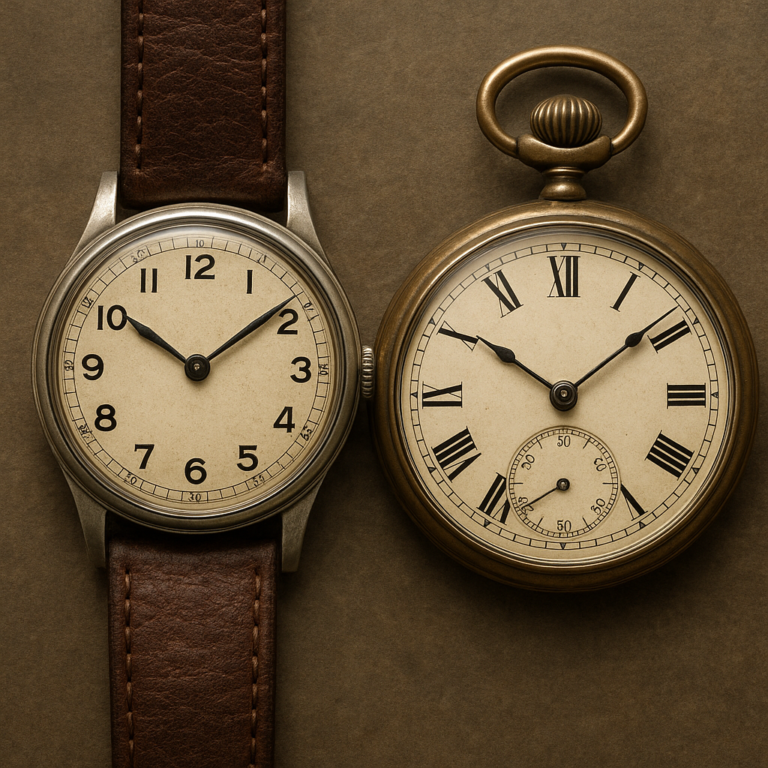
In the 19th century, if you owned a timepiece, it was likely a pocket watch. The round case was the undisputed king. Why? Simple physics. A round case is the strongest shape against pressure, easiest to manufacture, and fits perfectly in a pocket. The dial was always readable, and the crown was always at the 3 o’clock position.
But then, the world changed. The automobile arrived, and with it came a new problem: how do you check the time while driving a car?
The Birth of the Wristwatch: A Functional Necessity
Enter Alberto Santos-Dumont, a Brazilian aviation pioneer. His friend, Louis Cartier, noticed that fumbling with a pocket watch while piloting a plane was dangerous. In 1904, Cartier created the Santos, widely considered the first modern wristwatch.
“His mastery over shapes was not experimentation but a bold declaration that watches could transcend their traditional forms to become pieces of wearable art.” — SwissWatchExpo
The Santos was square. It was bold. It was different. But it wasn’t the only shape to emerge. As the 1910s rolled in, the Tonneau (barel) shape appeared, offering a more ergonomic fit for the wrist. By 1917, the Tank was born, inspired by the geometric lines of WWI Renault tanks.
The 1968 Turning Point: Design Control
For decades, watch brands bought cases from third-party manufacturers. But in 1968, everything shifted. Patek Philippe introduced the Golden Ellipse. This wasn’t just a new shape; it was a statement that the brand now controlled the entire design language, from movement to case geometry.
As noted by data analyst Marcus Siems in his analysis of over 4,0 watches: “The entire system was turned upside down in 1968 with the introduction of Patek Philippe’s Golden Ellipse.” This sparked a golden age of experimentation that would define the 1970s.
📐 The Round Revolution: Why Circles Still Rule the Wrist
Despite the wild experiments of the 20th century, the round case remains the evergreen of watch design. But why?
The Physics of Perfection
- Water Resistance: A round case allows for a uniform gasket seal. When you screw down a case back, the pressure is distributed evenly. Try doing that with a square case, and you risk weak points at the corners.
- Readability: The human eye naturally scans a circle. The dial is symetrical, and the hands move in a predictable arc.
- Versatility: A round watch looks at home on a dive suit, a tuxedo, or a denim jacket. It is the chameleon of the watch world.
The Data Doesn’t Lie
According to Chrono24 data, round cases dominate the market with over 90% share. However, the 1970s saw this number dip to 60% as collectors craved something new. By the 1980s, the pendulum swung back, and round cases reclaimed their throne.
Popular Round Icons:
- Rolex Submariner: The definition of the tool watch.
- Omega Seamaster: A naval legend with a modern twist.
- Cartier Ballon Bleu: Where round meets elegance.
👉 CHECK PRICE on:
- Rolex Submariner: Amazon | Brand Official
- Omega Seamaster: Amazon | Brand Official
But don’t let the round dominance fool you. The real fun lies in the shapes that tried to dethrone it.
📏 The Rise of the Rectangle: Art Deco and the Tank Legacy
If the round case is the king, the rectangle is the queen of the Art Deco era. It’s a shape that screams sophistication, geometry, and history.
The Cartier Tank: A War-Time Masterpiece
Created in 1917, the Cartier Tank was inspired by the top-down view of a Renault FT tank. The “brancards” (side bars) mimic the tank treads, and the case resembles the turret. It was a radical departure from the round norm.
- Tank Louis Cartier: The purest, most elegant version.
- Tank Americaine: A curved rectangle that hugs the wrist, introduced in 1989.
- Tank Francaise: Features an integrated bracelet with square links, blending sport and dress.
Beyond Cartier: The Rectangular Renaissance
While Cartier owns the genre, other brands have played with the rectangle:
- Jaeger-LeCoultre Reverso: The ultimate reversible case, designed for polo players to protect the dial.
- Longines Evidenza: A modern take on the toneau-rectangular hybrid.
Comparison: Rectangular vs. Tonneau
| Feature | Rectangular (Tank) | Tonneau (Barel) |
|---|---|---|
| Primary Era | 1920s (Art Deco) | 1910s & 1970s |
| Edges | Sharp, straight lines | Curved sides, flat top/bottom |
| Wrist Fit | Can feel long on small wrists | Ergonomic, hugs the wrist |
| Best For | Formal wear, dress codes | Casual, sporty, vintage vibes |
| Iconic Model | Cartier Tank | Vacheron Constantin Historiques |
🔺 Beyond the Box: Exploring Tonneau, Cushion, and Barrel Cases
Let’s talk about the shapes that sit somewhere between a square and a circle. These are the hybrids that offer the best of both worlds: the presence of a square with the comfort of a round case.
The Tonneau: The Barrel That Rolled In
“Tonneau” is French for “barel.” These cases have straight top and bottom edges but bowed sides.
- History: Debuted in 1912 by Cartier (the Tonneau model).
- The 1970s Boom: In the 70s, the Tonneau became a staple for chronographs. The curved sides allowed for larger movements while maintaining a sleek profile.
- Modern Examples: The Vacheron Constantin Historiques American 1921 and the Bulgari Octo Finissimo (which often uses a toneau-like silhouette in its ultra-thin iterations).
The Cushion: The Soft Square
The cushion case is a square with rounded corners. It’s softer, friendlier, and often used for “tool watches.”
- The 1970s Peak: Cushion cases hit nearly 25% market share in the early 70s.
- Material Shift: Unlike the gold-heavy square watches of the 50s, the 70s cushion was dominated by steel (71%), signaling the rise of the luxury sports watch.
- Icons:
Patek Philippe Nautilus: The original “cushion” sports watch.
Heuer Camaro: A vintage classic.
Zenith Defy Classic: A modern reinterpretation.
👉 Shop Cushion Cases on:
- Patek Philippe Nautilus: Amazon | Brand Official
- Zenith Defy: Amazon | Brand Official
🔶 The Geometric Shift: Octagons, Hexagons, and Asymetrical Designs
If you thought the 1970s was wild, the octagon was its wildest child. This is where watch design stopped being about “time” and started being about “statement.”
The Gerald Genta Revolution
In 1972, Gerald Genta designed the Audemars Piguet Royal Oak. It was an octagonal bezel with exposed screws, made of steel, and priced like gold. It was a shock to the system.
- Impact: It created the “luxury sports watch” category.
- Legacy: Every octagonal watch since owes a debt to the Royal Oak.
- Other Octagons:
Cartier Santos Octagon: A nod to the original Santos but with a distinct 8-sided bezel.
Bulgari Octo Finissimo: Taking the octagon to ultra-thin extremes.
Asymetry: The Rule Breakers
Not all shapes played by the rules.
- Hamilton Ventura: The first electric watch, featuring a triangular, asymetrical case.
- Cartier Crash: Legend has it a patron’s watch melted in a car crash, and Cartier loved the distorted shape so much they mass-produced it. It’s a crescent-shaped masterpiece.
- Rolex Midas: A deformed, asymetrical case that looks like liquid gold.
Why Asymetry?
It forces the eye to look at the watch differently. It’s not just a time-telling device; it’s a piece of sculpture.
🛡️ The Integrated Bracelet Era: How Case Shapes Changed Forever
You can’t talk about case shapes without talking about the bracelet. In the 1970s, the line between the case and the bracelet blurred.
The “One Piece” Illusion
Brands like Audemars Piguet (Royal Oak) and Patek Philippe (Nautilus) introduced cases where the lugs flowed seamlessly into the bracelet links.
- Design Challenge: This required precise engineering. The case had to be shaped to accommodate the bracelet’s articulation.
- Aesthetic: It created a fluid, continuous look that felt modern and sporty.
- The Shift: Before this, bracelets were often separate accessories. Now, the case was the bracelet.
The Return of the Integrated Look
In the 2010s and 2020s, the integrated bracelet saw a massive resurgence.
- Tudor Black Bay Pro: A modern take on the integrated sports look.
- Grand Seiko Sport: Bringing Japanese precision to the integrated form.
👉 CHECK PRICE on:
- Audemars Piguet Royal Oak: Amazon | Brand Official
- Tudor Black Bay: Amazon | Brand Official
🧪 Material Matters: How Steel, Gold, and Titanium Influence Case Geometry
The material you choose dictates the shape you can achieve. It’s not just about looks; it’s about physics and manufacturing.
Steel: The Versatile Workhorse
- Characteristics: Hard, durable, and easy to machine into complex shapes.
- Best For: Cushion and Octagonal cases. The 1970s saw a surge in steel sports watches because steel could be polished to a mirror finish or brushed to hide scratches.
- Trend: Steel is now the most popular material for luxury sports watches.
Gold: The Traditionalist
- Characteristics: Softer, more malleable, but prone to scratching.
- Best For: Rectangular and Oval dress watches. Gold’s warmth complements the elegance of a square or oval case.
- Data Point: In the 1950s, 60% of square watches were gold.
Titanium: The Modern Challenger
- Characteristics: Lightweight, hypoallergenic, and incredibly strong.
- Best For: Large, complex geometries like the Bulgari Octo Finissimo. Titanium allows for ultra-thin cases that would be too fragile in steel or gold.
- Challenge: Titanium is harder to machine, making it more expensive to produce.
Material vs. Shape Matrix
| Material | Ideal Shapes | Why? |
|---|---|---|
| Steel | Octagon, Cushion, Round | Durable, holds sharp edges, great for sports. |
| Gold | Rectangle, Oval, Tonneau | Malleable, warm aesthetic, traditional dress. |
| Titanium | Octagon, Large Round | Lightweight, allows for thin profiles. |
| Ceramic | Round, Tonneau | Scratch-resistant, but brittle for sharp corners. |
📏 Case Dimensions Decoded: Diameter, Lug Width, and Wearability
A beautiful shape is useless if it doesn’t fit your wrist. Here’s how to decode the numbers.
Diameter: The Big Picture
- 34mm – 38mm: The vintage sweet spot. Perfect for dress watches and smaller wrists.
- 40mm – 42mm: The modern standard. Fits most men’s wrists comfortably.
- 4mm+: The “oversized” category. Often found in dive watches and chronographs.
Lug Width: The Hidden Factor
The lug width (distance between the lugs) determines if the watch sits flat on your wrist.
- Short Lugs: Better for small wrists; the watch doesn’t overhang.
- Long Lugs: Can make a 40mm watch feel like a 4mm.
The “Case Thickness” Myth
Don’t just look at the diameter. A 42mm Tonneau might feel smaller than a 40mm Round because of how the thickness distributes.
- Tip: Always check the lug-to-lug distance. If it’s wider than your wrist, the watch will overhang, regardless of the diameter.
🎨 Design Icons: 10 Legendary Watch Cases That Defined an Era
Let’s count down the top 10 cases that changed the game.
- Cartier Santos (1904): The first modern wristwatch. Square, bold, and functional.
- Cartier Tank (1917): The Art Deco icon. Rectangular perfection.
- Vacheron Constantin Tonneau (1912): The barrel shape that defined early elegance.
- Heuer Monaco (1969): The square chronograph that broke the rules.
- Audemars Piguet Royal Oak (1972): The octagonal revolution.
- Patek Philippe Nautilus (1976): The cushion-shaped luxury sports watch.
- Cartier Crash (1967): The melted masterpiece.
- Hamilton Ventura (1957): The triangular asymetry.
- Bulgari Octo Finissimo (2014): The ultra-thin octagon.
- Rolex Oyster (1926): The round case that made water resistance possible.
👉 Shop These Icons on:
- Cartier Santos: Amazon | Brand Official
- Heuer Monaco: Amazon | Brand Official
- Bulgari Octo: Amazon | Brand Official
🔍 How to Choose the Right Case Shape for Your Wrist and Style
So, you’re ready to buy. But which shape? Here’s our Watch Brands™ guide to finding your perfect match.
Step 1: Measure Your Wrist
- Small Wrist (< 6.5 inches): Stick to 34mm-38mm. Avoid long lugs. Rectangular and Oval shapes often look more proportional.
- Medium Wrist (6.5 – 7.5 inches): You can wear almost anything. Round and Cushion are safe bets.
- Large Wrist (> 7.5 inches): Go bold. 42mm+ Octagonal or Tonneau cases will look fantastic.
Step 2: Define Your Lifestyle
- Office/Dress: Rectangular (Tank) or Oval.
- Sport/Adventure: Round (Submariner) or Cushion (Nautilus).
- Statement/Art: Octagonal (Royal Oak) or Asymetrical (Crash).
Step 3: Consider the Strap
- Leather: Pairs best with Rectangular and Oval.
- Metal Bracelet: Essential for Integrated designs (Royal Oak, Nautilus).
- Ruber: Perfect for Round and Cushion sports watches.
Need more help? Check out our Guide to Buying Watches for a comprehensive checklist.
🛠️ Maintenance and Care: Preserving Unique Case Geometries
Unique shapes require unique care. A round case is forgiving; a square or octagonal case is not.
The Corner Problem
- Risk: Sharp corners (like on a Tank or Monaco) are prone to dings and scratches.
- Solution: Regular polishing can round off sharp edges, ruining the design. Avoid polishing unless absolutely necessary. Use a microfiber cloth for daily cleaning.
The Integrated Bracelet Challenge
- Risk: Dust and grime get trapped between the case and the bracelet.
- Solution: Use a soft brush and mild soapy water. For deep cleaning, take it to a professional.
Water Resistance
- Risk: Non-round cases can have weaker seals at the corners.
- Solution: Test water resistance annually. Don’t assume a Tonneau is as water-resistant as a Submariner.
🔮 Future Trends: What’s Next in Watch Case Design?
Where is the industry heading? The pendulum is swinging back to minimalism, but with a twist.
The Return of the “Small” Watch
After decades of oversized watches, 36mm-38mm cases are making a comeback. Brands are embracing the vintage aesthetic with modern materials.
3D Printing and New Materials
- Possibility: 3D printing allows for impossible geometries that traditional machining can’t achieve.
- Material: Carbon fiber and ceramic are enabling lighter, stronger cases with complex shapes.
The “Deconstructed” Look
We are seeing more exposed screws, skeletonized cases, and asymetrical designs. The future is about transparency and individuality.
Watch the video below for a visual journey through these shapes:
Featured Video: The Evolution of Watch Case Shapes
🏁 Conclusion

The evolution of watch case shapes is a testament to human creativity. From the round safety of the pocket watch to the square boldness of the Santos, and the octagonal revolution of the Royal Oak, each shape tells a story.
Why do we care? Because the case is the identity of the watch. It’s the first thing you see, the first thing you feel. As Marcus Siems noted, “In the watch enthusiasts’ hearts a non-circular hole has remained ever since.”
Our Recommendation:
- For the Purist: Stick with a Round case. It’s timeless.
- For the Historian: Choose a Rectangular or Tonneau. It’s a piece of art.
- For the Trendsetter: Go Octagonal or Asymetrical. Make a statement.
Don’t be afraid to try something different. The world of watches is vast, and there’s a shape for every wrist and every soul.
🔗 Recommended Links
Ready to explore these shapes in the real world? Here are our top picks for where to shop.
- Luxury Watch Brands: Explore the full range of Luxury Watch Brands at Watch Brands™.
- Affordable Alternatives: Find budget-friendly options in our Affordable Watches category.
- Investment Pieces: Looking to buy for the future? Check out our Luxury Watch Investments guide.
- Men’s Watches: Browse our curated selection of Men’s Watches.
Books to Read:
❓ FAQ

How have watch case shapes evolved from the 19th century today?
The evolution began with the round pocket watch, which dominated the 19th century. The early 20th century introduced the square (Santos) and rectangular (Tank) shapes for wristwatches. The 1970s saw a massive explosion of cushion, octagonal, and asymetrical designs. Today, while round cases still dominate (90%), there is a renewed appreciation for the geometric diversity of the 70s, with a modern twist on materials and ergonomics.
Read more about “⏳ The Complete History of Watches: 10 Eras That Changed Time (2026)”
What are the most popular modern watch case designs?
The round case remains the most popular due to its versatility and water resistance. However, the octagonal (Royal Oak style) and cushion (Nautilus style) shapes have seen a massive resurgence in the luxury sports watch market. The rectangular case is also enjoying a revival in the dress watch category.
Read more about “🕰️ Top 7 Watch Brands Offering Customizable Designs (2026)”
Why did round watch cases become the standard for timepieces?
Round cases became the standard because of physics. They are the strongest shape against pressure, making them ideal for water resistance. They are also the easiest to manufacture and offer the best readability. Additionally, the round shape is universally flattering on the wrist.
Read more about “🕰️ The First Watch of All Time: 3 Historic Contenders Revealed (2026)”
How do luxury watch brands influence case shape trends?
Luxury brands like Patek Philippe, Audemars Piguet, and Cartier set the trends. When Patek introduced the Golden Ellipse in 1968, it signaled a shift towards brand-controlled design. When AP launched the Royal Oak, it created the luxury sports watch category. These brands have the resources to experiment and the prestige to make new shapes desirable.
Read more about “What Are the Big 3 of Watches? Discover the Titans of Time ⌚️ (2026)”
What is the history of the toneau and cushion watch cases?
The Tonneau (barel) shape debuted in 1912 with Cartier, offering a more ergonomic fit than the rectangle. It became popular for chronographs in the 1970s. The Cushion case, a square with rounded corners, peaked in the 1970s as a “spearhead” of the space-age design movement, often made in steel for sports watches like the Nautilus.
Are square watch cases making a comeback in modern design?
Yes, but with a twist. While the traditional square dress watch is still around, the modern comeback is in the form of cushion and integrated square cases (like the Heuer Monaco and Patek Nautilus). The square shape is being reinterpreted for sports and luxury contexts, moving away from its traditional dress-only role.
How does case shape affect the readability of a watch dial?
Case shape influences the layout of the dial. A round case allows for a symetrical, balanced dial. A rectangular case often requires a narrower, more vertical layout. Asymetrical cases can force the dial to be off-center, which can be a design feature but may impact readability for some. The Tonneau shape often results in a dial that is wider at the top and bottom, creating a unique visual flow.
Read more about “12 Affordable Luxury Watch Brands You Can Actually Afford in 2026 ⌚✨”
📚 Reference Links
- SwissWatchExpo: Cartier Watches and their Many Shapes
- Goldammer: Watch Case Guide
- Audemars Piguet: Royal Oak Collection
- Cartier: Tank Collection
- Patek Philippe: Nautilus Collection
- Rolex: Oyster Perpetual Collection
- Omega: Seamaster Collection
- Bulgari: Octo Collection
- Tag Heuer: Monaco Collection