Support our educational content for free when you purchase through links on our site. Learn more
⌚ Which Was the First Wristwatch in the World?

The best answer to “Which was the first wrist watch in the world?” is Breguet No. 2639, commissioned in 1810 for Caroline Murat, Queen of Naples. Its original delivery was recorded in 1812, making it the earliest well-documented purpose-built wristwatch.
But there’s a twist worthy of a watchmaker’s loupe: Breguet’s original watch is lost. The earliest famous surviving example is Patek Philippe’s 1868 bracelet watch, created for Countess Koscowicz and preserved today at the Patek Philippe Museum in Geneva.
The first wristwatch was less battlefield tool than royal jewelry. Breguet reportedly fitted the oval watch with a wristlet made from hair and gold threads, plus a repeating mechanism that could chime the time. It was extravagant, delicate, and centuries away from your everyday field watch.
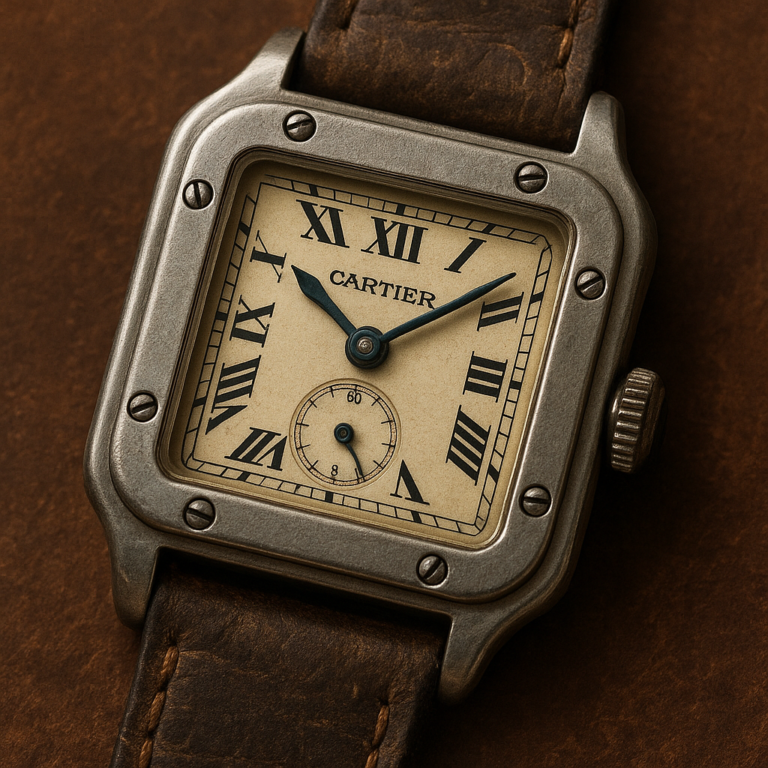
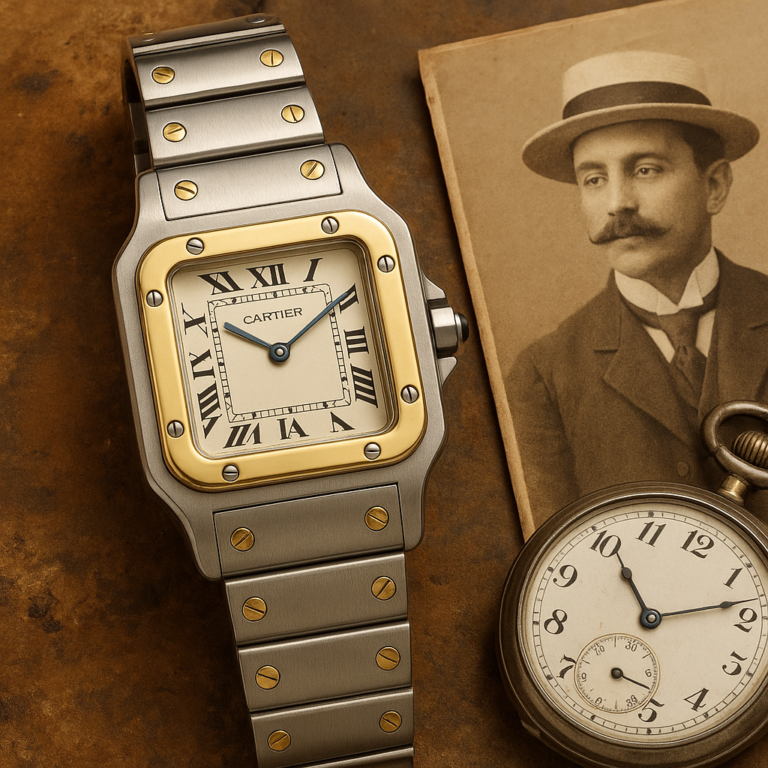
Later, aviation and military timing changed everything. Cartier’s 1904 Santos watch, made for pilot Alberto Santos-Dumont, helped transform wristwatches from elegant accessories into practical men’s instruments. That shift eventually led to the watches explored in our first wrist watch in the world Cartier guide.
Key Takeaways
- Breguet No. 2639 is the leading answer to which was the first wrist watch in the world, having been commissioned for Caroline Murat in 1810.
- Patek Philippe’s 1868 bracelet watch is the earliest famous surviving example and is held by the Patek Philippe Museum.
- The first wristwatch was created as luxury jewelry, not as a military instrument.
- Cartier’s Santos, made in 1904, helped popularize men’s wristwatches through aviation.
- World War I accelerated wristwatch adoption, thanks to the need for quick, hands-free timekeeping.
- “First” depends on the definition: earliest documented, oldest surviving, first men’s, first military, and first mass-produced can all produce different answers.
- Our verdict: call Breguet No. 2639 the first known purpose-built wristwatch, while recognizing Patek Philippe’s watch as the strongest surviving rival.
Table of Contents
- ⚡️ Quick Tips and Facts About the First Wristwatch
- The short answer: Patek Philippe or Abraham-Louis Breguet?
- Why the “first wristwatch” answer is surprisingly complicated
- ⌚ What Counts as the First Wristwatch in the World?
- Wristwatch, bracelet watch, or watch worn on a wrist?
- The difference between the first wristwatch and the first mass-produced wristwatch
- 🏛️ Early Watchmaking History Before Wristwatches
- From portable clocks to pocket watches
- How miniature mechanical movements made wristwatches possible
- The rise of decorative watch bracelets in the 18th century
- 1. Breguet’s 1810 Wristwatch for Caroline Murat
- Who was Caroline Murat?
- What made Abraham-Louis Breguet’s creation revolutionary?
- What happened to Breguet’s original wristwatch?
- Why some historians call it the first wristwatch
- 2. Patek Philippe’s 1868 Wristwatch for Countess Koscowicz
- The story behind the Patek Philippe bracelet watch
- Its design, movement, and jewelry construction
- Why Patek Philippe often receives the official credit
- Is the Countess Koscowicz watch still preserved?
- 3. Other Early Wristwatches and Bracelet Watches
- The early 19th-century wristwatch tradition
- Girard-Peregaux and military wristwatches
- Cartier Santos and the birth of the modern men’s wristwatch
- Omega, Longines, and other pioneering watchmakers
- 📜 A Timeline of the World’s First Wristwatches
- 1810: Breguet creates a wrist-worn timepiece
- 1868: Patek Philippe makes a famous bracelet watch
- Late 19th century: Wristwatches remain luxury jewelry
- 190–1914: Wristwatches gain practical appeal
- World War I: Military use transforms wristwatch design
- 1920s and 1930s: Wristwatches overtake pocket watches
- 🧭 Why Wristwatches Became Popular
- Military timing and the need for hands-free timekeeping
- Sport, aviation, motoring, and industrial work
- Changing fashion and the decline of the pocket watch
- 🔧 How the First Wristwatches Worked
- Mechanical movements and winding systems
- Cases, crystals, dials, and early watch straps
- Accuracy, durability, and everyday limitations
- ⚖️ Breguet vs. Patek Philippe: Which Was Really First?
- The case for Breguet
- The case for Patek Philippe
- Our expert verdict
- 🔍 How Historians Identify the First Wristwatch
- Surviving watches and museum records
- Archives, manufacture registers, and dated documentation
- Why claims from watch brands need careful checking
- 🆚 First Wristwatch vs. First Modern Wristwatch
- The earliest wrist-worn timepiece
- The first practical wristwatch
- The first wristwatch made for men
- The first commercially successful wristwatch
- 👩 🔬 Women, Jewelry, and the Forgotten Origins of Wristwatches
- Why early wristwatches were marketed as feminine accessories
- The role of aristocratic patrons and royal customers
- How wristwatches later became associated with men and military style
- 🏆 The Most Important Firsts in Wristwatch History
- First known wristwatch
- First famous surviving wristwatch
- First purpose-built military wristwatch
- First luxury wristwatch icons
- First quartz wristwatch
- First electronic and digital wristwatches
- 🌍 How the First Wristwatch Changed Watchmaking
- The shift from pocket watches to wristwatches
- The evolution of watch cases and straps
- The foundation of modern Swiss watchmaking
- 🛒 Can You Buy a Watch Inspired by the First Wristwatches Today?
- Modern Breguet wristwatch collections
- Historic Patek Philippe Calatrava and museum pieces
- Cartier, Longines, Omega, and other heritage alternatives
- What to look for in a historically inspired watch
- ✅ What to Check When Researching Watch History
- Reliable museum and manufacturer sources
- Common myths about the first wristwatch
- How to separate marketing language from historical evidence
- Conclusion
- Recommended Links
- FAQ
- Which was the first wristwatch in the world?
- Was Breguet’s 1810 watch the first wristwatch?
- Was Patek Philippe the first wristwatch brand?
- What is the oldest wristwatch still in existence?
- Who invented the wristwatch for men?
- When did wristwatches replace pocket watches?
- What was the first quartz wristwatch?
- Reference Links
Quick Tips and Facts About the First Wristwatch
The most widely accepted answer to “Which was the first wristwatch in the world?” is Breguet No. 2639, commissioned by Queen Caroline Murat of Naples in 1810 and documented as delivered in 1812. Abraham-Louis Breguet’s creation was reportedly designed specifically for the wrist, rather than being a pocket watch fitted with a strap.
For readers interested in the later development of men’s wristwatches, our guide to the first wrist watch in the world Cartier explains why the Cartier Santos-Dumont, created in 1904, became such a pivotal aviation watch.
| Question | Best-supported answer |
|---|---|
| First purpose-built wristwatch? | Breguet No. 2639, made for Caroline Murat in 1810 |
| First famous surviving wristwatch? | Patek Philippe’s 1868 bracelet watch for Countess Koscowicz |
| First men’s wristwatch? | Cartier Santos, made for Alberto Santos-Dumont in 1904 |
| First military wristwatch era? | Late 19th century, with widespread adoption during World War I |
| First wristwatch with major chronometer recognition? | A Rolex wristwatch certified by Kew Observatory in 1914 |
| First quartz watch in production? | Seiko Astron, released in 1969 |
The short answer: Patek Philippe or Abraham-Louis Breguet?
Here is where watch history produces a small but entertaining quarel. Guiness World Records credits Patek Philippe’s 1868 watch for Countess Koscowicz as the first wristwatch, while many historians place Breguet’s Caroline Murat watch nearly six decades earlier.
The disagreement exists because the Breguet watch is lost, while the Patek Philippe watch survives and can be examined in the Patek Philippe Museum. Patek Philippe itself describes its creation more narrowly as the first Swiss wristwatch, leaving room for Breguet’s earlier French-made watch.
The sensible answer is therefore:
- ✅ Earliest documented purpose-built wristwatch: Breguet No. 2639, 1810
- ✅ Oldest famous surviving wristwatch: Patek Philippe, 1868
- ✅ First major men’s wristwatch: Cartier Santos, 1904
Why the “first wristwatch” answer is surprisingly complicated
The word “first” can mean several different things:
- The first watch physically worn on a wrist.
- The first watch designed from the beginning for wrist wear.
- The first surviving watch with reliable documentation.
- The first men’s wristwatch.
- The first commercially successful wristwatch.
- The first military wristwatch.
- The first wristwatch produced by a particular country.
Those definitions produce different answers. A watch attached to a bracelet in the 170s may qualify as a wrist-worn timepiece, but it may have started life as a pendant or pocket watch. Breguet’s claim is stronger because the watch was reportedly conceived as a wristwatch, not merely adapted afterward.
As Wikipedia’s history of watches explains, earlier wearable watches existed as pendants and ornamental clock-watches. That history matters, but a pendant watch is not automatically a purpose-built wristwatch. A necklace is not a bracelet simply because both involve jewelry!
What Counts as the First Wristwatch in the World?
To answer accurately, we need a working definition. At Watch Brands™, we use this one:
A wristwatch is a portable timepiece deliberately configured to be worn around the wrist, with its case, attachment method, and winding or display arrangement suited to that position.
That definition separates the earliest wristwatches from:
- Pocket watches placed inside decorative bracelets.
- Pendant watches worn around the neck.
- Watches pinned to clothing.
- Military pocket watches later attached to leather straps.
- Tiny watches worn on rings or broches.
Wristwatch, bracelet watch, or watch worn on a wrist?
Historical sources often use terms such as bracelet watch, wristlet, and wristwatch interchangeably. They are related but not identical.
| Term | Typical meaning | Historical problem |
|---|---|---|
| Bracelet watch | A watch integrated into a jewelry bracelet | May be decorative rather than purpose-built |
| Wristlet | A watch attached to a strap or narrow wrist band | Can describe early military conversions |
| Wristwatch | A watch intended to be worn on the wrist | Modern term applied retrospectively |
| Pendant watch | Watch suspended from a necklace or clothing | Not a wristwatch |
| Trench watch | Early practical or military wristwatch | Often adapted from pocket-watch construction |
The Breguet archives and modern Reine de Naples collection preserve the strongest modern connection to Caroline Murat’s watch. The Reine de Naples line uses an elongated oval form, echoing the shape associated with the historic commission.
The difference between the first wristwatch and the first mass-produced wristwatch
Breguet’s 1810 watch was an exceptional luxury object made for royalty. It was not something sold from a shop window to thousands of customers.
A useful comparison:
| Category | Likely example | Date | Why it matters |
|---|---|---|---|
| First purpose-built wristwatch | Breguet No. 2639 | 1810 | Designed for Queen Caroline Murat |
| First famous surviving bracelet watch | Patek Philippe | 1868 | Extant museum example |
| Early practical wristlet | Military adaptations | 1880s–1890s | Demonstrated usefulness |
| First men’s aviation wristwatch | Cartier Santos | 1904 | Designed for flight |
| Mass-market wristwatch era | Swiss and American manufacturers | 1910s–1920s | Wristwear became ordinary |
The first wristwatch was therefore a luxury experiment, while the modern wristwatch became a practical tool much later.
Early Watchmaking History Before Wristwatches

The wristwatch did not arrive from nowhere. It emerged from centuries of shrinking clocks, improving springs, and increasingly ambitious jewelry design.
According to the British Museum’s watch and clock collections, early portable watches were as much about status and craftsmanship as accurate timekeeping. Their owners displayed wealth, curiosity, and access to specialized artisans.
From portable clocks to pocket watches
The earliest portable mechanical timepieces appeared in Europe during the late 15th and early 16th centuries. German centers such as Nuremberg and Augsburg became especially important.
These early watches were often:
- Bulky and drum-shaped.
- Powered by a mainspring rather than weights.
- Fitted with verge-and-foliot regulating systems.
- Accurate only to a rough approximation.
- Wound once or twice per day.
- Decorated with pierced cases and precious materials.
They commonly had only an hour hand. Minute hands became more useful as mechanical regulation improved, although precision remained modest by modern standards.
Peter Henlein is often associated with early portable watches, but historians are cautious. As the National Association of Watch and Clock Collectors notes through its historical resources, credit for invention rarely belongs to one person alone. Several workshops were developing miniature clocks around the same period.
How miniature mechanical movements made wristwatches possible
A wristwatch requires more than a small dial. It needs a movement compact enough to sit comfortably on the wrist and robust enough tolerate motion.
The crucial developments included:
-
Mainspring power
A wound spring replaced heavy hanging weights. -
Miniaturized gears
Smaller wheels allowed cases to shrink. -
Improved escapements
Better regulation made the watch less wildly inaccurate. -
Jewelled bearings
Synthetic or natural jewels reduced friction in high-wear points. -
Compact case construction
Thin metal cases made wearable formats less cumbersome. -
More reliable winding systems
Key winding eventually gave way to crown winding.
The early wristwatch was still delicate, but the engineering direction was clear: smaller, lighter, and easier to consult.
The rise of decorative watch bracelets in the 18th century
Before Breguet’s famous commission, affluent women wore watches incorporated into:
- Bracelets.
- Broches.
- Pendants.
- Chatelaines.
- Decorative chains.
These objects blurred the line between jewelry and horology. A watch could be an ornament first and a timekeeper second.
This is one reason historians avoid claiming that Breguet invented the concept of wearing a watch on the wrist. The more defensible claim is that Breguet created one of the earliest purpose-designed wristwatches with a clear documentary trail.
1. Breguet’s 1810 Wristwatch for Caroline Murat
The leading candidate for the world’s first wristwatch is Breguet No. 2639, created for Caroline Murat, Queen of Naples and younger sister of Napoleon Bonaparte.
The commission is recorded in Breguet’s archives, and reputable watch publications have described it as a watch “designed from the ground up to be worn on the wrist.” That phrase captures the key distinction: this was not merely a pocket watch wearing a strap as a last-minute costume change.
Who was Caroline Murat?
Caroline Bonaparte married Joachim Murat, Napoleon’s cavalry commander, in 180. She later became Queen of Naples.
She was known as a fashion-conscious patron of luxury goods, and her court helped turn unusual personal accessories into statements of status. A wristwatch made for her was therefore both:
- A technical object.
- A piece of elite jewelry.
- A highly personal fashion accessory.
The Breguet history archive identifies Caroline Murat as an important client whose commission helped shape the company’s legacy.
What made Abraham-Louis Breguet’s creation revolutionary?
Breguet No. 2639 reportedly combined an oval case with a complicated movement and a wristlet made from hair and gold threads.
| Feature | Reported detail |
|---|---|
| Maker | Abraham-Louis Breguet |
| Client | Caroline Murat, Queen of Naples |
| Commission date | 1810 |
| Reported delivery | 1812 |
| Case shape | Oblong or oval |
| Dial | Silver, with curved Arabic numerals |
| Complication | Repeating mechanism, reportedly chiming |
| Attachment | Wristlet of hair and gold threads |
| Current status | Original watch is lost |
| Modern design descendant | Breguet Reine de Naples |
The repeating mechanism would have allowed the wearer to hear the time, a useful feature in darkness. It also added extraordinary complexity to an object already difficult to miniaturize.
Why an oval case mattered
An oval case could sit along the wrist more naturally than a round pocket-watch case. It also gave Breguet a distinctive visual canvas for curved numerals and an elongated dial.
The modern Breguet Reine de Naples collection continues that elongated silhouette. It is not a museum replica, but the design lineage is unmistakable.
What happened to Breguet’s original wristwatch?
The original Breguet watch is lost. That fact weakens the certainty of the claim, but it does not erase the archival evidence.
A lost historical object creates several complications:
- We cannot inspect its movement directly.
- Its exact dimensions cannot be verified with modern instruments.
- Later descriptions may contain errors.
- The original wristlet may have been replaced or modified.
- Historians must rely heavily on manufacture records and correspondence.
This is the central tension in the debate: Breguet has the earlier date and a strong documentary claim, while Patek Philippe has the surviving object.
Why some historians call it the first wristwatch
Breguet’s claim rests on three points:
- The date is early: 1810 predates Patek Philippe by 58 years.
- The commission was specific: It was made for Queen Caroline Murat.
- The construction was purpose-oriented: The watch was configured as a wrist-worn object rather than a conventional pocket watch.
The strongest case is not that no one before Breguet ever wore a watch on the wrist. That would be difficult to prove. The strongest case is that Breguet produced the earliest well-documented, purpose-built wristwatch associated with a named client.
2. Patek Philippe’s 1868 Wristwatch for Countess Koscowicz
If Breguet wins the date contest, Patek Philippe wins the survival contest.
Patek Philippe created a gold bracelet watch for Countess Koscowicz of Hungary in 1868. The watch is preserved in Geneva at the Patek Philippe Museum.
The story behind the Patek Philippe bracelet watch
The 1868 watch is often cited as the first wristwatch because it is:
- Clearly documented.
- Still in existence.
- Recognizably designed as a bracelet watch.
- Associated with one of Switzerland’s most respected manufacturers.
The Guiness World Records entry gives Patek Philippe the official record, illustrating how a surviving artifact can carry more weight in record-keeping than an earlier but lost object.
Its design, movement, and jewelry construction
The watch was made as a refined gold bracelet with the timepiece integrated into the jewelry.
| Aspect | Patek Philippe 1868 watch |
|---|---|
| Year | 1868 |
| Manufacturer | Patek Philippe |
| Client | Countess Koscowicz of Hungary |
| Format | Gold bracelet watch |
| Character | Jewelry-focused, highly ornamental |
| Significance | Earliest famous surviving purpose-built example |
| Location | Patek Philippe Museum, Geneva |
This was not a rugged field watch. It was an elegant object meant formal wear, much closer to haute joaillerie than to the modern sports watch.
Why Patek Philippe often receives the official credit
Record organizations prefer claims that can be physically verified. Patek Philippe’s watch can be:
- Seen.
- Measured.
- Examined.
- Documented through museum records.
- Compared with other surviving examples.
Breguet’s watch may be earlier, but the physical evidence is absent. That distinction explains why some sources say Patek Philippe made the first wristwatch, while specialist historians more often say Breguet made the earliest known purpose-built wristwatch.
Is the Countess Koscowicz watch still preserved?
Yes. It is held by the Patek Philippe Museum in Geneva, whose collection includes historic watches, clocks, and automata.
The museum’s survival of the piece makes it exceptionally valuable for researchers. It also makes the watch a tangible benchmark for studying:
- Early bracelet construction.
- Miniature movement design.
- 19th-century luxury aesthetics.
- The relationship between jewelry and horology.
3. Other Early Wristwatches and Bracelet Watches
The early wristwatch story is not a straight line from Breguet to Patek Philippe to Cartier. Several makers contributed ideas that eventually transformed a royal novelty into a practical instrument.
The early 19th-century wristwatch tradition
During the 19th century, wrist-worn watches remained strongly associated with women’s jewelry. This reflected clothing and social customs:
- Women’s garments often lacked convenient pockets.
- Bracelets were already fashionable.
- Jewelry watches could be worn visibly.
- Men’s formal clothing favored the pocket watch.
- Accuracy and durability were not yet sufficient for demanding work.
A bracelet watch could therefore be socially acceptable for a woman long before a man would proudly wear one.
Girard-Peregaux and military wristwatches
Girard-Peregaux is often associated with an early military wristwatch order involving German naval officers in the late 19th century. The watches reportedly featured protective metal grilles over the crystal, helping shield the dial from impacts.
The Girard-Peregaux history reflects the brand’s long connection with technical watchmaking, although individual early military claims should be checked against archival evidence rather than repeated uncritically.
Military use pushed watch design toward:
- Better legibility.
- Protective guards.
- Leather straps.
- Reliable winding.
- More robust cases.
- Rapid time reading without removing equipment.
Cartier Santos and the birth of the modern men’s wristwatch
In 1904, Louis Cartier created a wristwatch for aviator Alberto Santos-Dumont. Santos-Dumont needed both hands on the aircraft controls, making a pocket watch impractical.
The design became known as the Cartier Santos. Its rounded-square case, exposed screws, Roman numerals, and leather strap made it visually distinctive and technically practical.
The official Cartier Santos history presents it as one of the earliest purpose-built pilot’s watches.
Our team particularly enjoys this chapter because it shows how a real problem produced a design classic. Santos-Dumont did not need another jewel for a display case. He needed to check the time while flying a machine that looked, frankly, like it was assembled by optimism and wire.
Omega, Longines, and other pioneering watchmakers
By the early 20th century, several brands helped turn wristwatches into credible precision instruments:
- Longines developed timing instruments for aviation and sporting use.
- Omega built a reputation for precision, military watches, and later spaceflight.
- Rolex advanced waterproof and self-winding wristwatch design.
- Jaeger-LeCoultre contributed compact and technically sophisticated movements.
- Tissot helped bring Swiss watchmaking to a wider audience.
- Mappin & Webb supplied early campaign watches.
- Seiko later transformed wristwatch accuracy through quartz technology.
For broader context, our Luxury Watch Brands category explores how historic manufacturers turned technical innovation into lasting design language.
A Timeline of the World’s First Wristwatches
The following timeline separates wearable watches, purpose-built wristwatches, men’s wristwatches, and later technical milestones.
| Year | Event | Historical importance |
|---|---|---|
| 16th century | German portable clock-watches appear | Early wearable timepieces |
| 17th century | Pocket watches become increasingly common for men | Wristwear remains largely ornamental |
| 1810 | Breguet commissions watch for Caroline Murat | Leading candidate for first purpose-built wristwatch |
| 1812 | Breguet delivery documented | Strengthens archival claim |
| 1868 | Patek Philippe makes watch for Countess Koscowicz | Oldest famous surviving wristwatch |
| 1880s | Military officers strap watches to wrists | Practical adoption begins |
| 1893 | Garstin “Watch Wristlet” patent | Early formal wristwatch design |
| 1898 | Mappin & Webb campaign watch | Military and field-use development |
| 1903 | Dimier Frères wire-lug patent | More modern strap architecture |
| 1904 | Cartier makes Santos for Santos-Dumont | Major men’s and aviation milestone |
| 1910 | Rolex wristwatch receives Swiss chronometer certification | Wristwatch precision gains credibility |
| 1914 | Rolex receives Kew Observatory recognition | Important accuracy milestone |
| 1914–1918 | World War I accelerates adoption | Wristwatch becomes a practical tool |
| 1923 | John Harwood develops successful automatic wristwatch | Self-winding wristwatch progress |
| 1926 | Rolex Oyster case introduced | Water resistance becomes a selling point |
| 1931 | Rolex Oyster Perpetual appears | Automatic and water-resistant combination |
| 1961 | Yuri Gagarin wears a Vostok in space | Wristwatch enters space history |
| 1969 | Seiko Astron launches | Quartz era begins |
1810: Breguet creates a wrist-worn timepiece
Breguet’s commission is the earliest major claim that satisfies the purpose-built definition. It also establishes an important pattern: the first wristwatch was not born as a military object. It emerged from royal luxury and jewelry craftsmanship.
1868: Patek Philippe makes a famous bracelet watch
Patek Philippe’s watch offers firmer physical evidence. The surviving object gives historians a rare chance to study exactly how a high-end bracelet watch was constructed in the 19th century.
Late 19th century: Wristwatches remain luxury jewelry
For much of the 180s, wristwatches were not yet universal tools. They were often:
- Delicate.
- Decorative.
- Expensive to make.
- Less accurate than pocket watches.
- Socialy associated with women.
Men who wanted a precise timekeeper generally reached into a waistcoat pocket.
190–1914: Wristwatches gain practical appeal
Aviation, motoring, military operations, and industrial work changed the equation. A wristwatch could be read with a glance, leaving both hands available.
Cartier’s Santos made the wristwatch fashionable for men, but it was not alone. Military and sporting demands were quietly preparing the larger revolution.
World War I: Military use transforms wristwatch design
World War I created a brutal but effective product test. Soldiers needed to synchronize movements, coordinate artillery, and check time while carrying weapons.
The Imperial War Museums hold examples of military watches and related equipment that show how battlefield needs influenced watch design.
Common features included:
- Luminous numerals and hands.
- Protective wire guards.
- Black dials with contrasting markings.
- Leather straps.
- Shatter-resistant or reinforced crystals.
- Compact crowns and sturdy cases.
1920s and 1930s: Wristwatches overtake pocket watches
After the war, veterans returned home accustomed to wristwear. The style no longer looked purely feminine or frivolous. It meant practicality, modernity, and experience.
By the 1930s, wristwatches had decisively overtaken pocket watches for everyday use. The pocket watch survived, but mostly as a traditional, formal, or specialist accessory.
Why Wristwatches Became Popular
A watch worn on the wrist is easier to consult than one hidden in a pocket. That sounds obvious now, but for centuries social convention outweighed convenience.
Military timing and the need for hands-free timekeeping
Military operations made quick time checks valuable. A soldier could not easily:
- Reach inside a uniform.
- Remove a pocket watch.
- Open its cover.
- Read the dial.
- Put it away while moving under pressure.
A wristwatch reduced the process to a glance.
This was especially important for artillery coordination and synchronized maneuvers. Timing errors could expose troops, disrupt attacks, or cause friendly-fire risks.
Sport, aviation, motoring, and industrial work
The wristwatch also suited:
- Pilots.
- Race drivers.
- Cyclists.
- Engineers.
- Doctors.
- Railroad workers.
- Factory operators.
- Explorers.
The Cartier Santos story is a perfect example. As the first video featured in this article explains, “The Santos Dumont wanted to pilot his rudimentary aircraft using both of his hands.” The quote captures the practical logic behind the design: the wristwatch was not simply fashionable; it solved a problem.
Changing fashion and the decline of the pocket watch
Fashion followed function. As wristwatches became thinner, more durable, and more accurate, men began wearing them with suits and uniforms.
The transition was also helped by changing clothing:
- Waistcoats became less universal.
- Casual clothing reduced the need formal pocket accessories.
- Wrist straps became more comfortable.
- Wristwatches became symbols of modern technology.
For style context, see our guide to Fashion Trends in Watches.
How the First Wristwatches Worked
The first wristwatches were mechanically ingenious but not effortless. Their construction reveals how much watchmaking had to accomplish before a wristwatch could survive ordinary life.
Mechanical movements and winding systems
Early wristwatches used mechanical movements powered by a wound mainspring.
The basic sequence was:
- The wearer turned a key or crown.
- The mainspring stored energy.
- The spring unwound gradually.
- Gear wheels transferred that energy.
- The escapement released it in controlled increments.
- The balance regulated the rate.
- The hands displayed the passing hours and minutes.
Complications such as repeaters added extra mechanical layers. In Breguet’s reported watch, the repeating function could sound the time on demand.
Cases, crystals, dials, and early watch straps
Early cases were often gold or silver, chosen for both beauty and corrosion resistance. The crystal could be glass or another transparent protective material, but it was not designed for the abuse modern sports watches routinely endure.
Typical early construction included:
- Precious-metal case.
- Hinged or protected back.
- Delicate dial.
- Fine hands.
- Leather, textile, hair, or metal wristlet.
- Minimal water resistance.
- No shock protection by modern standards.
The watch strap itself was a major design element. A strap had to be attractive enough for a royal client yet secure enough to prevent the watch from falling.
Accuracy, durability, and everyday limitations
Compared with a modern mechanical watch, an early wristwatch had serious drawbacks:
✅ Compact and portable
✅ Quick to read
✅ Status-enhancing
✅ Capable of impressive complications
❌ Poor resistance to shock
❌ Vulnerable to moisture
❌ Limited power reserve
❌ Modest accuracy
❌ Difficult and expensive servicing
❌ Fragile attachment systems
Early portable watches could lose hours per day. Even later 19th-century mechanical watches required regular adjustment. The first wristwatch was a marvel, but it was not ready for trench warfare.
Breguet vs. Patek Philippe: Which Was Really First?
This is the heart of the debate. The answer depends on whether you prioritize date and design intent or surviving physical evidence.
| Criterion | Breguet No. 2639 | Patek Philippe 1868 |
|---|---|---|
| Date | 1810, delivered 1812 | 1868 |
| Client | Caroline Murat | Countess Koscowicz |
| Survives today? | No, lost | Yes, museum-preserved |
| Purpose-built? | Strongly documented claim | Clearly a bracelet watch |
| Country association | French manufacture | Swiss manufacture |
| Official record status | Often historian-preferred | Guinness-recognized |
| Historical confidence | High but not absolute | Very high as an artifact |
The case for Breguet
Breguet should receive the earliest-date credit because:
- The commission predates Patek Philippe by decades.
- The watch was designed for wrist wear.
- The client and date are identified.
- Breguet’s archival records support the commission.
- Its design is echoed by the modern Reine de Naples collection.
The strongest wording is “earliest known purpose-built wristwatch”, not “the first watch ever worn on a wrist.”
The case for Patek Philippe
Patek Philippe deserves recognition because:
- The watch physically survives.
- It is held by an authoritative museum.
- Its bracelet-watch construction can be examined.
- It has a clear date and client.
- Guinness World Records favors the verifiable artifact.
This is not a bad answer. It is simply answering a slightly different question: What is the earliest surviving, fully documented wristwatch?
Our expert verdict
At Watch Brands™, our verdict is:
Breguet No. 2639, commissioned for Caroline Murat in 1810, is the best answer to “Which was the first wristwatch in the world?” Patek Philippe’s 1868 creation is the strongest surviving alternative and the official record-holder in some references.
That wording respects both evidence and uncertainty. History is not a courtroom where the oldest surviving witness automatically tells the whole story.
How Historians Identify the First Wristwatch
Watch history depends on more than brand storytelling. Historians compare objects, archives, terminology, and manufacturing records.
Surviving watches and museum records
A surviving watch provides direct evidence of:
- Case shape.
- Attachment method.
- Movement construction.
- Dial layout.
- Materials.
- Signs of later modification.
- Original engravings or inscriptions.
Museums such as the Patek Philippe Museum and the British Museum help establish a reliable physical record.
Archives, manufacture registers, and dated documentation
A manufacture register can reveal:
- Commission dates.
- Client names.
- Delivery dates.
- Repair history.
- Movement numbers.
- Complications.
- Case materials.
- Special instructions.
Breguet’s archival records are crucial because the physical watch is missing. A repair record can be especially persuasive: it shows that the object existed, circulated, and was recognized as a particular watch at a later date.
Why claims from watch brands need careful checking
Brand histories are useful, but they can compress complicated timelines into memorable slogans. When researching a claim, check:
- Does the source give a precise date?
- Is the object still preserved?
- Is the source a museum, archive, or marketing page?
- Does the wording say “first,” “earliest known,” or “first Swiss”?
- Are earlier non-Swiss examples acknowledged?
- Is the claim about women’s watches, men’s watches, military watches, or mass production?
That last distinction matters enormously. “First wristwatch” is a broad phrase; “first Swiss wristwatch” is narrower and easier to verify.
First Wristwatch vs. First Modern Wristwatch
The historical answer changes when we add the word modern.
The earliest wrist-worn timepiece
The earliest wrist-worn timepieces may have been adapted pendant or bracelet watches. Some could have been worn around the wrist, but their original design intent is difficult to prove.
The first practical wristwatch
Practical wristwear emerged during the late 19th century, especially through military adaptations and campaign watches.
These watches were often pocket-watch movements placed in cases with:
- Wire lugs.
- Leather straps.
- Protective grilles.
- High-contrast dials.
- More robust construction.
The first wristwatch made for men
The Cartier Santos, created for Alberto Santos-Dumont in 1904, is widely regarded as the first important men’s wristwatch and the first major pilot’s watch.
Cartier’s official history connects the design to Santos-Dumont’s aviation needs. Its influence remains visible in modern Cartier Santos watches.
The first commercially successful wristwatch
No single model owns this title without qualification. Commercial success developed through several brands and markets in the early 20th century.
Rolex, Longines, Omega, Cartier, and numerous Swiss manufacturers helped normalize wristwear through:
- Better accuracy.
- Stronger cases.
- More attractive designs.
- Military contracts.
- Advertising.
- Celebrity and aviation associations.
For help comparing modern options, our Guide to Buying Watches covers movement types, case materials, water resistance, and long-term ownership.
Women, Jewelry, and the Forgotten Origins of Wristwatches
The early wristwatch was largely a women’s object. Later, popular culture often retold the story as if men invented the wristwatch for war and aviation. That leaves out the original jewelry tradition.
Why early wristwatches were marketed as feminine accessories
In the 18th and 19th centuries:
- Women’s dresses often lacked deep pockets.
- Bracelets were already accepted fashion accessories.
- Decorative watches fit naturally into formal dress.
- Men’s fashion favored waistcoats and pocket chains.
- Wristwear was associated with ornament rather than utility.
The first wristwatch’s royal client, Caroline Murat, reflects this social reality.
The role of aristocratic patrons and royal customers
Royal clients gave watchmakers permission to experiment. A complicated wristwatch could be:
- A fashion statement.
- A diplomatic gift.
- A demonstration of technical skill.
- A conversation piece.
- A sign of wealth and refinement.
Breguet’s relationship with European royalty helped establish the brand as a maker of exceptional complications. Today, the brand’s haute horlogerie collection continues that emphasis on decorative craftsmanship and technical sophistication.
How wristwatches later became associated with men and military style
The shift happened gradually:
- Women wore decorative bracelet watches.
- Military officers adapted watches for convenience.
- Aviators made wristwatches symbols of modern achievement.
- World War I made wristwear practically necessary.
- Veterans brought the style into civilian life.
- Manufacturers redesigned watches for male customers.
Cartier’s Santos played a key cultural role because it connected wristwear with aviation, courage, engineering, and modernity.
The Most Important Firsts in Wristwatch History

First known wristwatch
Breguet No. 2639, commissioned for Caroline Murat in 1810, is the leading candidate.
First famous surviving wristwatch
Patek Philippe’s 1868 bracelet watch for Countess Koscowicz is the best-known surviving early example.
First purpose-built military wristwatch
The answer is not a single universally agreed model. Military officers used adapted watches in the 1880s and 1890s, while makers such as Mappin & Webb supplied campaign watches for military use.
First luxury wristwatch icons
Early icons include:
- Breguet Reine de Naples lineage.
- Patek Philippe bracelet watches.
- Cartier Santos.
- Cartier Tank.
- Rolex Oyster.
- Longines aviation watches.
- Omega military and chronograph watches.
First quartz wristwatch
The Seiko Astron 35 SQ, introduced on December 25, 1969, is generally recognized as the first quartz wristwatch to enter production.
The Seiko history of Astron explains how quartz technology transformed accuracy and ultimately disrupted traditional mechanical watchmaking.
First electronic and digital wristwatches
Hamilton’s Pulsar, introduced in the early 1970s, became one of the earliest commercially important digital watches. LED displays made the watch look like a tiny piece of science fiction, although battery life and button-activated displays limited convenience.
How the First Wristwatch Changed Watchmaking
The first wristwatch changed more than where people wore a timepiece. It changed what watchmakers prioritized.
The shift from pocket watches to wristwatches
Wristwatches encouraged:
- Thinner movements.
- Smaller cases.
- Secure straps.
- Shock resistance.
- Water resistance.
- Luminous displays.
- Faster reading.
- Automatic winding.
- More practical crown placement.
The pocket watch emphasized formal presentation. The wristwatch emphasized immediate access.
The evolution of watch cases and straps
Early wristlets gave way to purpose-built cases with:
- Integrated lugs.
- Spring bars.
- Leather straps.
- Metal bracelets.
- Screw-down backs.
- Protective bezels.
- Gaskets for water resistance.
Rolex’s Oyster case history helped establish the water-resistant wristwatch as a serious everyday instrument.
The foundation of modern Swiss watchmaking
Modern Swiss watchmaking rests on a balance between:
- Miniaturization.
- Precision.
- Decorative finishing.
- Reliable industrial production.
- Strong brand identity.
- Complication expertise.
The first wristwatch was a luxury novelty, but its descendants became tools, status symbols, heirloms, and eventually wearable computers.
Can You Buy a Watch Inspired by the First Wristwatches Today?
You cannot casually order Breguet No. 2639 from a standard catalog because the original is lost. You can, however, buy modern watches that preserve its design language or the broader heritage of early wristwear.
Modern Breguet wristwatch collections
The Breguet Reine de Naples collection is the clearest modern descendant of the Caroline Murat story. Its oval cases, refined dials, precious metals, and complications deliberately echo the historical association.
👉 CHECK PRICE on:
- Breguet Reine de Naples: Breguet Official Website
Historic Patek Philippe Calatrava and museum pieces
Patek Philippe’s modern collections do not reproduce the 1868 bracelet watch as a mass-market historical reissue, but the brand’s dress watches retain the same emphasis on restrained elegance and mechanical finishing.
👉 Shop Patek Philippe on:
- Patek Philippe watches: Patek Philippe Official Website
Cartier, Longines, Omega, and other heritage alternatives
For a wearable connection to the 20th-century transition from pocket watch to wristwatch, consider:
- Cartier Santos: aviation-inspired and historically significant.
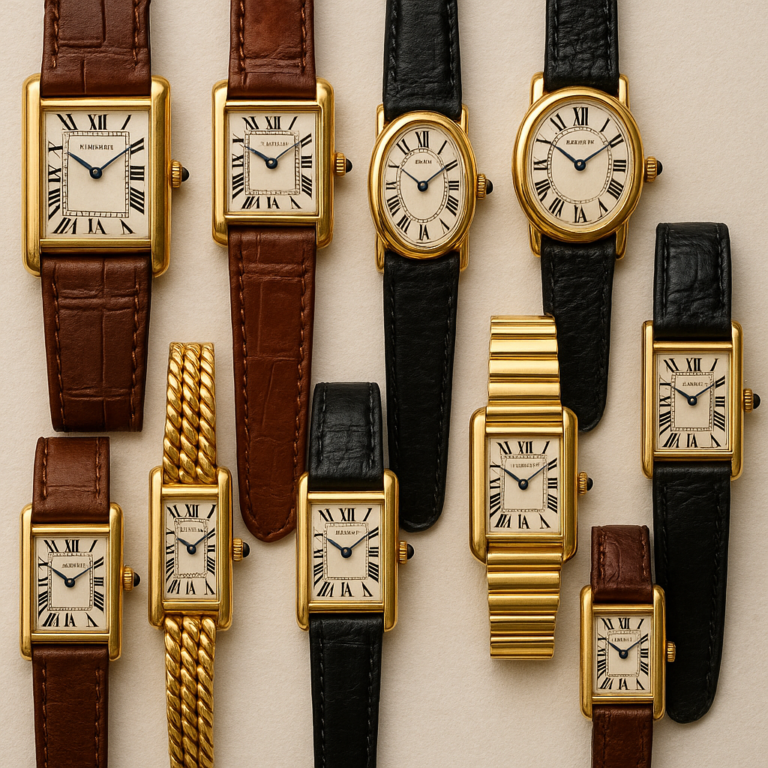
- Cartier Tank: introduced in 1917 and still instantly recognizable.
- Longines Heritage: vintage-inspired aviation and dress designs.
- Omega De Ville: elegant mechanical dress-watch styling.
- Hamilton Khaki Field: military-inspired practicality.
- Seiko Presage: traditional Japanese mechanical watchmaking.
The first video featured in this article emphasizes that the Cartier Tank was introduced in 1917 and has never disappeared. Its rectangular form, inspired by Renault tanks, shows how historical design can remain relevant without becoming a museum costume.
👉 CHECK PRICE on:
- Cartier Santos: Cartier Official Website
- Cartier Tank: Cartier Official Website
- Longines Heritage: Longines Official Website
- Omega De Ville: Omega Official Website
- Hamilton Khaki Field: Hamilton Official Website
- Seiko Presage: Seiko Official Website
What to look for in a historically inspired watch
When choosing a watch with early-wristwatch character, look for:
✅ Appropriate case shape
Oval, rectangular, or restrained round cases can feel more historically rooted than oversized modern silhouettes.
✅ Mechanical movement
A hand-wound or automatic movement connects you to traditional watchmaking.
✅ Legible dial
Historical charm should not make the time impossible to read.
✅ Quality strap and lugs
The watch must sit securely and comfortably.
✅ Service support
A beautiful movement is less charming when no qualified watchmaker can maintain it.
❌ Avoid buying solely because a brand says “first”
Marketing language often simplifies complex history.
❌ Avoid fragile vintage pieces for rough daily wear
A museum-style watch may need a gentler lifestyle.
What to Check When Researching Watch History

Historical watch claims deserve the same skepticism as a suspiciously shiny “Swiss-made” label.
Reliable museum and manufacturer sources
Start with:
- Patek Philippe Museum.
- Breguet’s official history.
- Cartier’s official Santos history.
- The British Museum.
- Guinness World Records.
- Imperial War Museums.
- National Association of Watch and Clock Collectors.
- Reputable horological publications.
Compare at least two independent sources before treating a “first” claim as settled.
Common myths about the first wristwatch
Myth: Breguet invented all wristwatches
Not exactly. Earlier wearable watches and bracelet-mounted timepieces existed. Breguet is associated with the earliest well-documented purpose-built wristwatch, not necessarily the first watch anyone ever wore on the wrist.
Myth: Patek Philippe was absolutely the first
Patek Philippe made the earliest famous surviving example and receives official credit from Guinness. But Breguet’s 1810 commission predates it.
Myth: Cartier invented the wristwatch
Cartier did not invent wristwear, but the Santos helped make the wristwatch desirable and credible for men, especially pilots.
Myth: World War I created the wristwatch
The war accelerated adoption and improved practical design. It did not create the concept from nothing.
How to separate marketing language from historical evidence
Look for careful wording:
- “First known” means earlier examples may exist.
- “First surviving” means the physical object remains.
- “First Swiss” excludes non-Swiss makers.
- “First men’s” excludes earlier women’s bracelet watches.
- “First commercial” concerns market availability, not invention.
- “First purpose-built” concerns original design intent.
That vocabulary resolves most disagreements. It also explains why Breguet and Patek Philippe can both appear in reputable histories without one source necessarily being careless.
Featured Video Perspective
The featured video’s interpretation is especially useful because it connects the abstract history of watchmaking to recognizable designs. It presents the Cartier Santos as a practical response to aviation and the Cartier Tank as a design that survived because its proportions and identity remained strong.
Its line that “The Santos Dumont wanted to pilot his rudimentary aircraft using both of his hands” neatly explains why the wristwatch became more than jewelry. The video also highlights how World War I accelerated the transition from pocket watches to wristwatches, reinforcing the idea that innovation came from both fashion and necessity.
The unresolved mystery remains Breguet’s lost watch. We cannot handle it, photograph it, or inspect its movement. Yet its archival trail reaches back to 1810, earlier than Patek Philippe’s surviving 1868 example. That combination of evidence and absence is precisely why the debate continues.