Support our educational content for free when you purchase through links on our site. Learn more
When Did the Cartier Watch Come Out? 🕰️

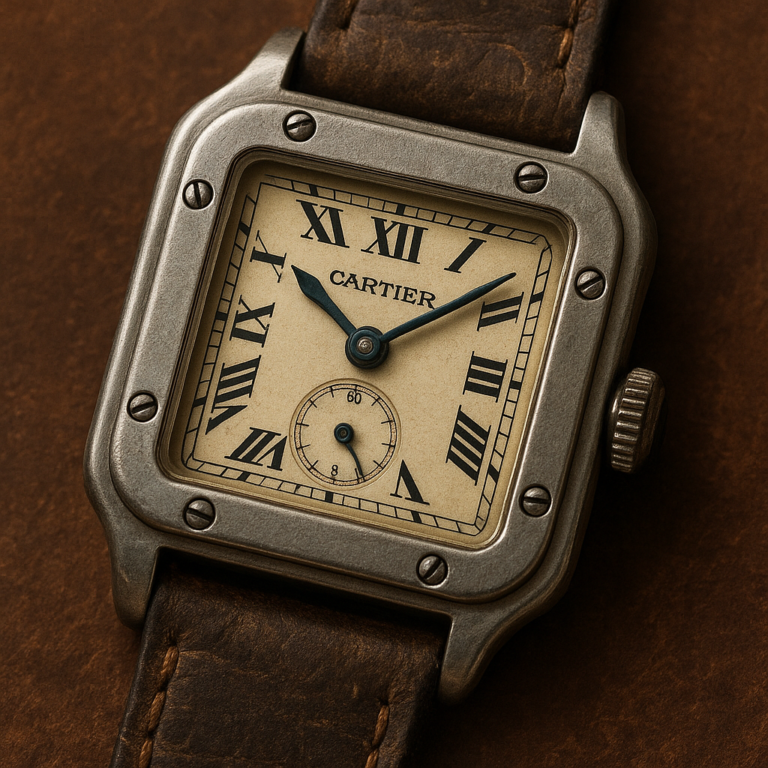
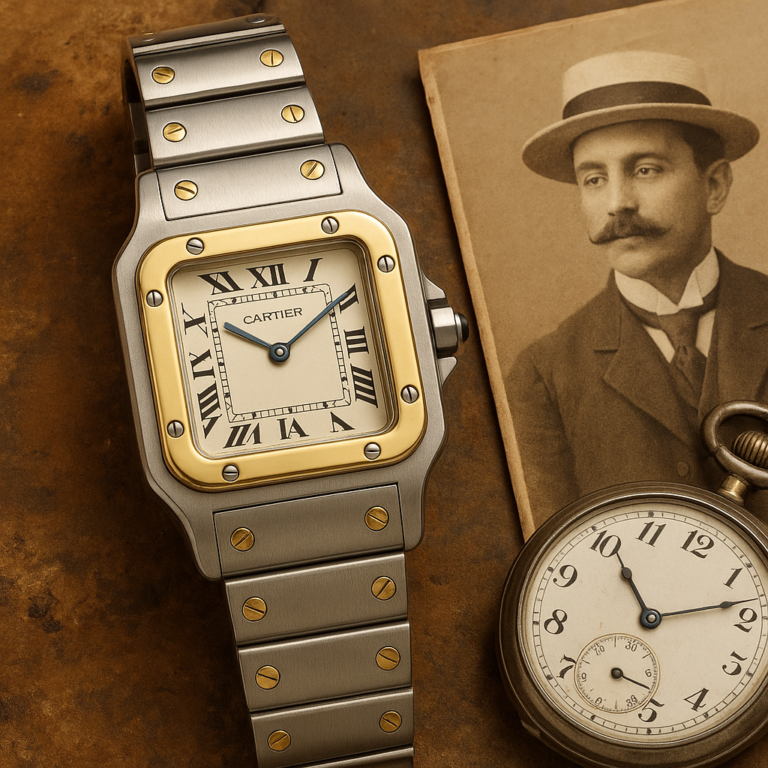
Cartier’s first purpose-built wristwatch, the Santos, came out in 1904. Louis Cartier created it for aviator Alberto Santos-Dumont, who needed to check the time without taking his hands off an aircraft’s controls.
That answer comes with a small but important footnote. Cartier sold watches before 1904, but the Santos is generally recognized as the maison’s first purpose-built men’s wristwatch, making it the starting point for Cartier’s modern watch legacy. Learn more in our guide to the first wristwatch in the world and Cartier.
The next landmark arrived in 1917, when Louis Cartier designed the Tank. Its rectangular case, Roman numerals, blue hands, and railroad minute track turned a wristwatch into something closer to wearable architecture. Production began around 1919, and the Tank has been ticking through fashion eras ever since.
Here’s the charming twist: Cartier did not invent the wristwatch outright. Instead, it helped make the wristwatch desirable for men, combining aviation practicality with Parisian style. That blend explains why the Santos and Tank remain more recognizable than many technically complicated watches.
We’ve handled Cartier watches that feel almost impossibly small on the wrist yet unmistakably substantial in character. So, was 1904 the true beginning of Cartier watchmaking, or merely the moment the brand found its signature? The answer becomes clearer when you compare the Santos, Tank, Pasha, Panthère, and Cartier’s modern collections.
Key Takeaways
- Cartier’s first purpose-built men’s wristwatch was the Santos, created in 1904.
- Alberto Santos-Dumont inspired the Santos because he needed a practical watch while flying.
- Cartier did not invent the first wristwatch ever, but it helped popularize the wristwatch as a stylish men’s accessory.
- The Cartier Tank was designed in 1917 and entered production around 1919, becoming the brand’s most iconic watch.
- Cartier’s best-known collections include the Santos, Tank, Ballon Bleu, Pasha, Panthère, Ronde, Baignoire, and Cartier Privé.
- Modern Cartier watches are primarily Swiss-made, while Cartier remains a French luxury maison.
- For a first Cartier, we recommend the Santos for versatility, the Tank for timeless design, and the Panthère for jewelry-led elegance.
- Historical dates can vary depending on whether a source refers to a prototype, commission, public debut, or commercial production.
Table of Contents
- ⚡️ Quick Tips and Facts: When Did the Cartier Watch Come Out?
- 🕰️ Cartier’s Origins: From Parisian Jeweler to Global Watchmaker
- The Cartier Brothers and the Birth of a Luxury House
- How Cartier’s Royal and Celebrity Clients Built Its Reputation
- 📜 The First Cartier Watch: A Timeline of Key Milestones
- When Did Cartier Start Making Watches?
- The 1904 Santos-Dumont Watch: Cartier’s First Purpose-Built Wristwatch
- Did Cartier Make the First Wristwatch Ever?
- Cartier’s 1917 Tank: The Watch That Defined the Brand
- 📅 Cartier Watch History: Important Dates from 1847 to Today
- 1847–1904: Cartier’s Early Jewelry and Watchmaking Foundations
- 1904–1917: Santos and Tank Innovations
- 1920s–1970s: Art Deco, Mystery Clocks, and Iconic Design
- 1970s–1990s: The Return of Cartier Watchmaking
- 200s to Today: Manufacture Movements and Modern Collections
- 🏆 1. Cartier Tank Collection: The 1917 Classic That Still Rules
- Tank Louis Cartier, Tank Américaine, Tank Française, and Tank Must
- Tank Cintrée and Tank Asymétrique: Sculptural Cartier Design
- Who Is the Cartier Tank Best For?
- ✈️ 2. Santos de Cartier: The Aviation Watch That Started It All
- Alberto Santos-Dumont and Louis Cartier’s Historic Collaboration
- Santos Case Design, Screws, Bracelet, and QuickSwitch System
- Santos-Dumont Versus Santos de Cartier
- 🎈 3. Ballon de Cartier: A Softer, More Sculptural Silhouette
- Ballon Bleu and the Signature Crown Guard
- Ballon de Cartier Sizes, Materials, and Movements
- 🧭 4. Pasha de Cartier: The Bold Sports-Luxury Revival
- The 1930s Pasha Story and Its Famous Screw-Down Crown Cap
- Pasha Features, Complications, and Wearability
- 🐆 5. Panthère de Cartier: Jewelry Watch Meets Everyday Icon
- The Panthère’s 1980s Origins and 2017 Return
- Why the Panthère Is Considered a Bracelet Watch
- ⭕ 6. Ronde de Cartier: Traditional Round Watchmaking
- Roman Numerals, Railroad Minute Tracks, and Blue Hands
- Ronde de Cartier Models and Movement Options
- 🛁 7. Baignoire: Cartier’s Oval Watch with Art Deco Roots
- The 1912 Oval Case and the Meaning of “Baignoire”
- Modern Baignoire Designs and High-Jewelry Variations
- 💎 8. Cartier Privé: Rare Reissues for Serious Collectors
- The Cartier Privé Collection and Its Collector Appeal
- Cloche, Tank Asymétrique, Crash, and Other Limited Editions
- 🌟 9. Cartier High Watchmaking and Complicated Timepieces
- Mystery Clocks and Cartier’s Illusion-Based Design
- Skeleton Watches, Flying Tourbillons, and Minute Repeaters
- Cartier Manufacture Movements and In-House Calibers
- ⚙️ Cartier Watch Movements, Materials, and Craftsmanship
- Quartz, Mechanical, and Automatic Cartier Watches
- Swiss-Made Production and Cartier’s Watchmaking Facilities
- Gold, Steel, Platinum, Diamonds, and Leather Straps
- 🔍 How to Identify a Genuine Cartier Watch
- Serial Numbers, Hallmarks, Reference Numbers, and Cartier Signatures
- Common Cartier Watch Counterfeiting Red Flags
- Why Professional Authentication Matters
- 🧾 Buying a Cartier Watch: New, Vintage, or Pre-Owned?
- How to Choose the Right Cartier Collection
- What to Check in a Pre-Owned Cartier Watch
- Box, Papers, Service History, and Warranty Considerations
- 🛠️ Cartier Watch Care, Servicing, and Water Resistance
- How Often Should a Cartier Watch Be Serviced?
- Cleaning Cartier Cases, Bracelets, and Straps
- Water Resistance: What Cartier Owners Need to Know
- ⚖️ Cartier Versus Other Luxury Watch Brands
- Cartier Versus Rolex
- Cartier Versus Omega
- Cartier Versus Jaeger-LeCoultre
- Is Cartier a Watchmaker, a Jewelry House, or Both?
- 🧠 Cartier Watch Design Terms You Should Know
- Cabochon Crown, Roman Numerals, and Railroad Tracks
- Guilloché Dials, Blued Hands, and Secret Signatures
- Tank, Tonneau, Oval, Round, and Rectangular Case Shapes
- ❓ Cartier Watch FAQs
- What Was the First Cartier Watch?
- Who Invented Cartier Watches?
- What Country Are Cartier Watches Made In?
- Did Cartier Make the First Ever Wristwatch?
- When Did the Cartier Tank Watch Come Out?
- When Did the Santos de Cartier Watch Come Out?
- Are Cartier Watches Swiss Made?
- Are Cartier Watches Good for Everyday Wear?
- Which Cartier Watch Is the Most Iconic?
- ✅ Conclusion: Why Cartier Watches Still Matter
- 🔗 Recommended Links
- 💬 FAQ
- 📚 Reference Links
Before we get tangled in dates, let’s answer the question plainly: Cartier’s first purpose-built wristwatch appeared in 1904. Louis Cartier created it for Brazilian aviator Alberto Santos-Dumont, who needed to read the time while keeping both hands on his aircraft’s controls. That watch became the Santos, now one of the most recognizable names in luxury watchmaking.
The story gets slightly trickier because “the first Cartier watch” can mean several things:
- Cartier began selling watches before 1904, largely through established Swiss movement suppliers.
- The Santos of 1904 is generally regarded as Cartier’s first purpose-built men’s wristwatch.
- The Tank arrived in 1917, with the first examples delivered in 1919.
- The Pasha de Cartier debuted in 1985, although its backstory reaches into an uncertain 1930s legend.
- The modern Tank Mini LC launched in 2024, showing that Cartier still knows how to make an old shape feel fresh.
The first relevant line in our history of the first wristwatch in the world and Cartier explains why “first wristwatch” claims need careful wording. Cartier did not invent the wristwatch outright, but it helped turn the wristwatch into a practical, stylish object for men.
A quick Cartier watch timeline
| Year | Cartier milestone | Why it matters |
|---|---|---|
| 1847 | Louis-François Cartier takes over the Paris workshop | The foundation of Cartier as a luxury house |
| 1904 | Santos wristwatch created for Alberto Santos-Dumont | Cartier’s first purpose-built men’s wristwatch |
| 1907 | Cartier works with Edmond Jaeger for movements | A major step toward reliable, dedicated watch production |
| 191 | Santos enters broader production | The aviation watch becomes commercially significant |
| 1912 | Early oval watch design appears | The design lineage that leads to the Baignoire |
| 1917 | Tank designed by Louis Cartier | A rectangular icon is born |
| 1919 | First Tank watches enter production | The Tank becomes a real collection |
| 1985 | Pasha de Cartier officially launches | Sporty luxury enters Cartier’s modern catalog |
| 1996 | Tank Française introduced | Bracelet-integrated Tank design gains momentum |
| 2001 | Ballon Bleu launched | A rounded contemporary Cartier icon emerges |
| 2017 | Santos is redesigned | Modern dimensions and interchangeable straps arrive |
| 2024 | Tank Mini LC announced for launch | Cartier embraces ultra-small, gender-neutral proportions |
The short answer, with one important qualification
If someone asks, “When did the Cartier watch come out?”, answer:
Cartier’s first purpose-built wristwatch, the Santos, came out in 1904.
If they mean the most famous Cartier watch, the answer may be:
The Cartier Tank was designed in 1917 and entered production in 1919.
That distinction solves most online confusion. A helpful Cartier history overview from The Watch Centre calls the Santos “Cartier’s first men’s wristwatch,” while the Cartier official Santos page presents the collection as part of the maison’s foundational watchmaking story.
The Cartier brothers and the birth of a luxury house
Cartier’s watch story begins with jewelry. In 1847, Louis-François Cartier took over the Paris workshop of his master, Adolphe Picard. His son Alfred later joined him, and Alfred’s sons, Louis, Pierre, and Jacques Cartier, transformed the family business into an international luxury powerhouse.
By the early 20th century, Cartier had established operations in:
- Paris
- London
- New York
That three-city structure mattered. Each branch served a different clientele, yet the maison maintained a recognizable visual language: precious materials, refined proportions, and an almost mischievous willingness to challenge convention.
Cartier’s own history of the maison describes the house’s development across jewelry, watches, objects, and design. We think of Cartier as a jeweler that became a watchmaker, but that undersells the relationship. The brand’s early watches were designed with a jeweler’s eye for shape, surface, proportion, and how the object sits on the body.
Why a jeweler made such influential watches
Traditional watchmaking often begins with the movement. Cartier frequently began with the case and the wearer’s experience.
That approach produced watches with:
- Strong geometric silhouettes
- Distinctive crowns and bezels
- Dials designed for quick reading
- Jewelry-like finishing
- Shapes that remain recognizable from across a room
This explains why a Cartier Tank can use a relatively restrained movement yet remain more visually memorable than many technically elaborate watches. The design does the heavy lifting. It is the watch equivalent of a perfectly tailored dinner jacket: no shouting required.
How Cartier’s royal and celebrity clients built its reputation
Cartier’s early clients included royalty, aristocrats, artists, aviators, and industrialists. The maison’s reputation grew through a mixture of craftsmanship and visibility. A watch on the wrist of a famous person becomes a moving advertisement, especially when the design looks unlike anything else.
The Santos benefited from its connection to Alberto Santos-Dumont, a pioneering aviator and social figure. The Tank later became associated with figures including:
- Jacqueline Kennedy Onassis
- John F. Kennedy
- Princess Diana
- Andy Warhol
- Elizabeth Taylor
- Muhammad Ali
The Metropolitan Museum of Art’s Cartier collection helps place Cartier’s designs in a wider history of decorative arts and modern luxury.
A personal observation from our watch box
We have handled plenty of watches that look impressive in a product photograph but become ordinary after a week on the wrist. Cartier is usually the opposite. The first impression may be “beautiful.” The tenth impression is often “why does this rectangle somehow work with everything?”
That staying power is a major reason Cartier remains central to discussions about luxury watch brands.
When did Cartier start making watches?
Cartier was involved in watchmaking before 1904, but the house did not initially manufacture every component or movement itself. Like many luxury maisons, it worked with specialist Swiss suppliers while concentrating heavily on case design, finishing, dial presentation, and client service.
The important distinction is:
| Claim | Accurate interpretation |
|---|---|
| Cartier sold watches before 1904 | Yes |
| Cartier invented the wristwatch | No |
| Cartier created one of the first modern men’s wristwatches | Yes |
| The Santos was made for Alberto Santos-Dumont in 1904 | Widely accepted |
| The Santos was immediately mass-produced in 1904 | Not quite; broader production followed later |
The Fondation de la Haute Horlogerie provides useful background on the development of mechanical watchmaking and the relationship between specialist movement makers and luxury brands.
The 1904 Santos-Dumont watch: Cartier’s first purpose-built wristwatch
Alberto Santos-Dumont needed a practical way to check the time during flight. Reaching into a pocket for a watch was awkward when both hands were occupied. Louis Cartier responded with a watch intended to be worn on the wrist, not a pocket watch awkwardly strapped to one.
The early Santos design featured:
- A flat case
- A square bezel
- Exposed screws
- A clear dial
- A leather strap
- A shape designed for rapid reading
The Watch Centre describes the Santos as “simple, elegant and practical.” That phrase is surprisingly accurate. It was not a gadget overloaded with aviation theatrics. It was a clean, wearable solution to a real problem.
Step-by-step: why the Santos was revolutionary
- Identify the problem: A pilot needed to read time without releasing the controls.
- Move the display: Put the watch on the wrist rather than inside a pocket.
- Improve visibility: Use a flat dial that could be read quickly.
- Create a stable case: The square form gave the watch a distinctive, structured identity.
- Make it desirable: Finish the practical object with Cartier’s luxury design language.
The result was a watch that was functional enough for aviation and elegant enough for society. That dual personality remains the secret of the Santos.
The 1907 movement partnership with Edmond Jaeger
In 1907, Cartier entered into a contract with French watchmaker Edmond Jaeger, who supplied movements exclusively for Cartier watches. Jaeger later became associated with Jaeger-LeCoultre, although the companies’ histories developed through several stages.
This partnership mattered because it gave Cartier access to specialized mechanical expertise while allowing the maison to focus on design and client-facing luxury.
Cartier’s watchmaking evolution is therefore best understood as a gradual process:
- Design leadership first
- Supplier partnerships second
- Greater manufacturing control later
- Modern in-house calibers and high complications today
That progression is common in luxury watchmaking. A brand can be historically important without producing every gear and spring under one roof from day one.
The Santos enters broader production
The Santos gained wider availability around 191, following interest in the “iconic square watch.” Dates vary across secondary sources because historians may refer to:
- The original commission
- The first prototype
- The first public appearance
- The start of commercial production
- The later revival of the collection
So when one source says 1904 and another says 191, they are not necessarily contradicting each other. They may be describing different points in the product’s journey.
The Santos is more than an early Cartier model. It established several design ideas that still define the brand:
- A recognizable case shape
- Visible screws as decoration
- A practical dial layout
- Luxury combined with utility
- A watch designed around the wearer’s lifestyle
Original Santos versus modern Santos de Cartier
| Feature | Early Santos-Dumont | Modern Santos de Cartier |
|---|---|---|
| Case shape | Square and flat | Square with softened edges |
| Primary material | Precious metal examples | Steel, gold, and two-tone options |
| Strap | Leather | Leather plus integrated bracelet options |
| Movement | Historically supplied mechanical caliber | Quartz or automatic, depending on model |
| Water resistance | Limited by period construction | Modern everyday water resistance |
| Design language | Art Nouveau and early modernism | Refined geometric luxury |
| Intended use | Aviation and formal wear | Daily wear, travel, formal occasions |
The Santos de Cartier collection at Cartier shows how carefully the brand preserves the original outline while updating comfort and engineering.
The Santos’s biggest strength
It is one of the easiest luxury watches to recognize without a logo. The square case, exposed screws, Roman numerals, and integrated bracelet create a visual signature stronger than many round sports watches.
The Santos’s main drawback
The design is distinctive enough that it can dominate an outfit. If you prefer a watch that disappears beneath a shirt cuff or quietly blends into business clothing, a slim Tank Louis Cartier may be more subtle.
No. Cartier did not make the first wristwatch ever, and it would be misleading to say so.
Wrist-worn timepieces existed before the Santos, especially as jewelry watches and adapted military pieces. The late 19th and early 20th centuries saw various experiments with wrist-mounted watches. Cartier’s major contribution was helping establish the wristwatch as a modern, desirable men’s accessory.
Why the myth persists
Several factors encourage the simplified claim:
- The Santos was among the earliest famous purpose-built men’s wristwatches.
- Cartier had enormous cultural influence.
- The story of an aviator commissioning a practical watch is memorable.
- “First influential luxury wristwatch” is less catchy than “first wristwatch.”
The Guiness World Records discussion of wristwatch history and the British Museum’s watch-related collections are useful reminders that horological history rarely has one uncontested starting point.
Our verdict
✅ Cartier made one of the first modern men’s wristwatches.
❌ Cartier did not invent the wristwatch itself.
✅ The Santos helped make wristwatches fashionable, practical, and culturally important.
Louis Cartier designed the Tank in 1917, drawing inspiration from the Renault FT tanks used during World War I. The parallel brancards resemble tank tracks, while the case recalls the armored vehicle’s architectural structure.
According to the Cartier Tank collection, the design has evolved repeatedly while retaining its essential identity.
Why the Tank looked radical in 1917
Most watches of the period were round or heavily decorative. The Tank introduced:
- A rectangular case
- Parallel side rails
- A strong vertical orientation
- A chemin de fer, or “railroad,” minute track
- Roman numerals
- Blue sword-shaped hands
- A cabochon crown
The first Tank watches entered production in 1919, with only a small number made initially. The first video featured in this article captures the popular story neatly: six Tank watches were produced in 1919, and the watch later appeared in films and on famous wrists. You can revisit that perspective through the featured video.
Tank timeline
| Year | Tank milestone |
|---|---|
| 1917 | Louis Cartier designs the Tank |
| 1919 | First production Tank watches appear |
| 192 | Tank Chinoise introduced |
| 1925 | Geometric Art Deco proportions become influential |
| 1936 | Tank Cintrée introduced |
| 197 | Must de Cartier expands access to Tank styling |
| 1996 | Tank Française launches |
| 2004 | Tank Américaine gains modern prominence |
| 2021 | Tank Louis Cartier receives a contemporary update |
| 2024 | Tank Mini LC joins the small-watch revival |
Why the Tank remains so wearable
The Tank works because it balances opposing ideas:
- Masculine structure with delicate proportions
- Formal styling with everyday versatility
- Historical detail with modern minimalism
- Jewelry appeal with genuine timekeeping function
That balance makes it relevant to both men’s watches and women’s watches without needing separate design identities.
A note on the Tank Mini LC
The Tank Mini LC, announced for a September 2024 launch, measures 24mm by 16.5mm, uses a quartz movement, and offers 30 metres of water resistance. Its tiny dial omits the traditional railroad minute track in favor of a faint line.
Hodinkee described the concept with the delightful phrase, “Honey they shrank the tank!” The article also called it a “Tiny Tank for all,” emphasizing that Cartier presented the watch as a style choice rather than a strictly gendered product.
The Tank is Cartier’s best-known watch family and arguably one of the most influential watch designs ever made. It is not one watch but a large group of related models, each interpreting the same architectural idea differently.
Tank Louis Cartier, Tank Américaine, Tank Française, and Tank Must
| Collection | Case character | Typical personality | Best suited to |
|---|---|---|---|
| Tank Louis Cartier | Slim, classic, curved edges | Dressy and discreet | Formal wear, collectors, minimalists |
| Tank Must | Accessible, colorful, quartz or mechanical options | Contemporary and playful | First Cartier buyers, daily wear |
| Tank Française | Integrated bracelet, stronger geometry | Polished and versatile | Office wear, bracelet-watch fans |
| Tank Américaine | Elongated, curved case | Luxurious and slightly dramatic | Larger wrists, modern formal style |
| Tank Cintrée | Pronounced curved profile | Sculptural and collector-focused | Enthusiasts seeking rarity |
| Tank Asymétrique | Angled case | Artistic and unconventional | Design collectors |
| Tank Mini | Very small proportions | Jewelry-like and fashion-forward | Small-watch enthusiasts, stacking |
Tank Louis Cartier: the purist’s choice
The Tank Louis Cartier is usually the model people imagine when they hear “Cartier Tank.” It emphasizes:
- Slim proportions
- Precious-metal case options
- A leather strap
- Classic Roman numerals
- A discreet profile
It can be almost absurdly elegant. We once watched a collector pair one with a denim jacket, and the result looked less like “formal watch with casual clothes” and more like “casual clothes finally got their act together.”
Tank Must: heritage with broader accessibility
The Tank Must revived a classic name and expanded the collection through:
- Steel cases
- Quartz and mechanical options
- Colorful dials
- Leather straps
- Solar-powered variants in the Tank SolarBeat line
The Must line is particularly useful for buyers who want Cartier design without jumping immediately into rare vintage references or complicated mechanical watches.
For more buying guidance, our Guide to Buying Watches covers questions about sizing, movements, service history, and authenticity.
Tank Française: the bracelet-focused evolution
The Tank Française, introduced in 1996, integrates the bracelet more closely with the case. It feels sportier than the Tank Louis Cartier while keeping the core visual vocabulary.
✅ Strong choice for daily wear
✅ More secure feeling than a thin leather strap
✅ Easy to dress up or down
❌ More visually assertive
❌ Less traditionally “dress watch” than the Tank Louis Cartier
Tank Cintrée and Tank Asymétrique
The Tank Cintrée, introduced in 1936, uses a curved case designed to follow the wrist. It is long, narrow, and distinctly elegant.
The Tank Asymétrique rotates the case geometry, creating a more playful and avant-garde appearance. These models show Cartier’s willingness to treat the watch case as a piece of architecture rather than a simple container for a movement.
Who is the Cartier Tank best for?
Choose a Tank if you value:
- Design history
- Slim proportions
- A recognizable silhouette
- Formal versatility
- A watch that does not resemble a typical sports watch
Think twice if you require:
- High shock resistance
- A rotating bezel
- Serious dive capability
- Large luminous markers
- A tool-watch aesthetic
The Tank is not trying to be a Submariner. Asking it to behave like one is like asking a tuxedo to go mountain biking.
The Santos de Cartier is the answer to the original question in its most meaningful form. It is the Cartier watch that came out in 1904 as a purpose-built wristwatch.
Alberto Santos-Dumont and Louis Cartier’s historic collaboration
Santos-Dumont was an aviation pioneer who needed practical timekeeping while flying. His relationship with Louis Cartier gave Cartier a real-world design brief:
- Make the time easy to read
- Keep the watch on the wrist
- Avoid unnecessary decoration
- Create something worthy of a prominent public figure
The result was not merely a pocket watch with a strap. It was designed as a wristwatch from the beginning.
Santos case design, screws, bracelet, and QuickSwitch system
Modern Santos models retain the key visual elements while adding contemporary engineering:
- Square case
- Rounded corners
- Exposed bezel screws
- Roman numerals
- Blue cabochon crown
- Integrated bracelet
- Interchangeable strap system
- SmartLink bracelet adjustment on selected models
| Santos feature | Practical benefit | Possible drawback |
|---|---|---|
| Square case | Strong identity and wrist presence | More noticeable than a round watch |
| Exposed screws | Distinctive industrial character | Can feel too bold for minimalist tastes |
| Integrated bracelet | Cohesive, premium appearance | Bracelet scratches may be visible |
| QuickSwitch | Easy strap changes | Replacement options remain specialized |
| SmartLink | Easier sizing | Requires care to avoid losing links |
| Automatic movement | Traditional mechanical appeal | Needs periodic servicing |
The official Santos collection provides the current model range and technical details.
Santos-Dumont versus Santos de Cartier
These names are related but not identical.
| Model | Character |
|---|---|
| Santos-Dumont | Slimer, dressier, closer to the original aviation-inspired form |
| Santos de Cartier | More substantial, often bracelet-equipped, sportier and more versatile |
The Santos-Dumont is an excellent choice for someone who wants a refined leather-strap watch. The Santos de Cartier is better for someone seeking a single Cartier that can handle office wear, travel, and casual clothing.
The Ballon de Cartier is known for its rounded case and distinctive relationship between the case, crystal, and crown. It offers a softer alternative to the Tank’s geometry and the Santos’s square structure.
Ballon Bleu and the signature crown guard
The Ballon Bleu de Cartier, introduced in 2007, features:
- A round case
- A blue cabochon crown
- A protective crown guard integrated into the case
- Roman numerals
- A curved, bubble-like profile
The design is immediately recognizable but less formal than a Tank. It also wears differently: the rounded case tends to feel smoother and more forgiving on the wrist.
Visit the official Ballon Bleu collection for current variations.
Ballon de Cartier sizes, materials, and movements
| Consideration | What to look for |
|---|---|
| Case size | Smaller options emphasize jewelry; larger versions feel more traditional |
| Material | Steel offers daily practicality; gold increases dressiness |
| Movement | Quartz simplifies ownership; automatic adds mechanical appeal |
| Bracelet | Metal bracelet creates a more integrated appearance |
| Strap | Leather can make the watch feel lighter and more formal |
| Dial | Classic Roman numerals preserve Cartier identity |
Strengths and weaknesses
✅ Comfortable rounded profile
✅ Strong brand recognition
✅ Works well as an everyday luxury watch
✅ Broad size and material variety
❌ Crown guard can make the case appear visually busier
❌ Less historically foundational than the Santos or Tank
❌ Some versions wear larger than their diameter suggests
The Pasha de Cartier officially debuted in 1985. Its history is colorful, but some of its origin story needs a careful asterisk.
The 1930s Pasha story and its famous screw-down crown cap
Cartier’s official narrative connects the Pasha to Thami El Glaoui, the Pasha of Marrakesh, who allegedly commissioned a water-resistant gold watch from Louis Cartier around 1931 or 1932.
However, Revolution Watch’s detailed Pasha history notes there is “no substantive proof” that this commission occurred exactly as later retellings suggest. A 1943 photograph does show a watch with related features, including a large case, crown cover, and protective grille.
The sensible interpretation is:
- The Pasha’s design language has historical precedents.
- The exact Pasha-of-Marrakesh commission remains uncertain.
- The modern collection unquestionably began in 1985.
- Gerald Genta and Cartier executive Alain-Dominique Perrin helped shape the modern launch.
1985 original Pasha specifications
| Feature | 1985 Pasha |
|---|---|
| Case | Approximately 38mm |
| Shape | Round case with broad bezel |
| Lugs | Vendôme-style |
| Crown | Screw-down cap with cabochon and retaining chain |
| Dial | Square minute track inside a circular dial |
| Water resistance | Designed as a water-resistant sports-luxury watch |
| Materials | Initially precious-metal focused |
| Bracelet | Early Figaro bracelet versions are especially collectible |
The Pasha’s defining trick is the square within the circle. That contrast gives it a personality unlike any other major Cartier family.
From steel Pasha to Pasha C and Pasha 42
Cartier introduced stainless-stel Pasha models around 1990, expanding the watch’s appeal. The Pasha C followed in 1995 with a smaller 35mm case and H-link bracelet.
The collection later expanded with:
- GMT models
- Chronographs
- Moon-phase watches
- Perpetual calendars
- Tourbillons
- Day-and-night displays
- The Pasha Seatimer
- CPCP limited editions
2020 Pasha de Cartier
The 2020 revival marked 35 years since the original launch. Modern features included:
- 35mm and 41mm case options
- Steel, yellow gold, and pink gold
- Caliber 1847 MC in core versions
- 100 metres of water resistance
- QuickSwitch strap system
- SmartLink bracelet adjustment
- Hidden engraving beneath the crown cap
✅ Best Cartier choice for a sportier personality
✅ More robust than a delicate Tank
✅ Strong historical design identity
❌ Crown cap can be polarizing
❌ Larger models may overwhelm smaller wrists
❌ The historical origin story is less certain than Cartier’s marketing suggests
The Panthère de Cartier first became famous in the 1980s and returned in 2017. It is best understood as a bracelet watch with timekeeping built into the design.
The Panthère’s 1980s origins and 2017 return
The Panthère uses a flexible bracelet with soft, articulated links. Unlike the Tank Française, whose bracelet feels architectural, the Panthère feels fluid and jewelry-like.
Its strengths include:
- A small square or rectangular case
- Highly flexible bracelet
- Polished surfaces
- Roman numeral dial
- Blue cabochon crown
- Strong stackability with bracelets and bangles
Explore the Panthère de Cartier collection for current models.
Why the Panthère is considered a bracelet watch
Many watches are worn with bracelets. The Panthère feels as though the bracelet is the main event and the dial is the elegant passenger.
| Panthère quality | Wearing effect |
|---|---|
| Articulated links | Drapes smoothly around the wrist |
| Small case | Looks refined rather than technical |
| High polish | Reflects light like jewelry |
| Quartz movement in many versions | Thin, convenient, and low maintenance |
| Square dial | Preserves Cartier identity |
Who should buy a Panthère?
The Panthère suits someone who wants:
- A jewelry-forward Cartier
- A comfortable bracelet
- A smaller profile
- Easy everyday wear
- A watch that can be stacked with other jewelry
It is less suitable for someone who wants visible mechanical watchmaking. Many Panthère buyers are purchasing the design and bracelet experience, not a horological spectacle.
The Ronde de Cartier is the maison’s clearest answer to the traditional round dress watch. It retains unmistakable Cartier details while using a familiar circular case.
Roman numerals, railroad minute tracks, and blue hands
The Ronde typically features:
- Roman numeral hour markers
- A railroad-style minute track
- Blue sword-shaped hands
- A cabochon crown
- Cartier branding
- A round case
The design is conservative in the best sense. It does not need a visual gimmick because the details are already deeply associated with the maison.
Ronde de Cartier models and movement options
| Version | Character |
|---|---|
| Quartz Ronde | Thin, convenient, low-maintenance |
| Automatic Ronde | Mechanical appeal and sweeping seconds hand |
| Ronde Solo | Cleaner, often more accessible entry point |
| Ronde Louis Cartier | Dressier, precious-metal emphasis |
| Complication models | Added calendar or chronograph functionality |
The official Ronde de Cartier collection is the best place to verify current references.
Ronde versus Tank
Choose the Ronde if you prefer:
- A conventional round case
- Easy pairing with formal clothing
- A quieter Cartier identity
- Traditional watch proportions
Choose the Tank if you want:
- Stronger design history
- Rectangular geometry
- A more distinctive silhouette
- A watch that attracts immediate recognition
The Baignoire takes its name from the French word for “bathtub,” referring to the oval shape of the case. Its lineage reaches back to an early 20th-century oval design, generally associated with 1912.
The 1912 oval case and the meaning of “Baignoire”
The Baignoire’s elongated oval silhouette stands apart from the Tank, Santos, and round Cartier collections. It is graceful, compact, and distinctly jewelry-oriented.
Common design features include:
- Oval case
- Roman numeral dial
- Blue hands
- Blue cabochon crown
- Leather strap or bracelet
- Precious-metal and gem-set versions
The Baignoire shows Cartier thinking beyond conventional watch geometry. Instead of asking, “What should a watch case look like?” Cartier asks, “What shape creates the most elegant relationship with the wrist?”
Modern Baignoire designs and high-jewelry variations
Recent Baignoire models have helped revive interest in small watches and bracelet-style timepieces. The collection can include:
- Traditional leather-strap references
- Miniature versions
- Bangle-style designs
- Diamond-set cases
- Gemstone bracelets
✅ Elegant and unusual
✅ Excellent formal or evening wear
✅ Strong choice for small-wrist styling
❌ Less legible than larger Cartier models
❌ Jewelry-first design may not satisfy movement enthusiasts
❌ Oval proportions require a particular personal style
The Baignoire’s recent popularity also helps explain why Cartier felt confident launching the very small Tank Mini. The market had already shown an appetite for watches that behave like jewelry.
Cartier Privé, formerly associated with Collection Privée Cartier Paris, is aimed at collectors who want historical forms, limited production, and more advanced watchmaking.
The Cartier Privé collection and its collector appeal
Cartier Privé references often appeal because they combine:
- Historical design research
- Limited production
- Mechanical movements
- Precious materials
- Unusual proportions
- Greater emphasis on watchmaking craft
The collection is not simply “vintage Cartier made new.” It interprets archival designs with modern engineering and finishing.
Cloche, Tank Asymétrique, Crash, and other limited editions
Models associated with Cartier’s collector-focused universe include:
- Tank Cintrée
- Tank Asymétrique
- Cloche
- Crash
- Masse Mystérieuse
- Skeletonized interpretations
- Complicated reissues
The Cartier Privé collection is worth consulting before relying on reseller descriptions, especially because names, editions, and availability can change.
Vintage collector caution
Cartier collector watches can be complicated to authenticate. Check:
- Case proportions
- Dial printing
- Movement caliber
- Serial number format
- Hallmarks
- Crown stones
- Provenance
- Service records
- Whether parts were replaced
A rare reference with a questionable dial is not a bargain. It is a detective story with an expensive ending.
Cartier is often associated with elegant quartz watches, but the brand also produces serious high-watchmaking pieces.
Mystery clocks and Cartier’s illusion-based design
Cartier’s Mystery Clocks use transparent supports and concealed mechanisms to create the impression that the hands float without a visible connection to the movement.
The concept began in the early 20th century and remains one of Cartier’s most distinctive contributions to decorative horology. The Cartier Mystery Clocks history shows how the maison connects mechanical ingenuity with visual illusion.
Skeleton watches, flying tourbillons, and minute repeaters
Cartier’s complicated watchmaking has included:
- Skeleton movements
- Flying tourbillons
- Minute repeaters
- Perpetual calendars
- Dual-time displays
- Day-and-night complications
- Jumping hours
- Mystery mechanisms
The Pasha family, for example, has included skeleton tourbillons using Cartier calibers such as the 946MC, while the skeleton Pasha uses the manually wound 9624MC.
Why Cartier skeleton watches look different
Cartier often integrates the movement’s bridges into the design language of the case and dial. In a skeleton Pasha, the bridges can incorporate:
- The minute track
- Hour markers
- Arabic numerals
- Cartier’s “C” motif
This is not skeletonization as mere window dressing. The movement becomes part of the watch’s graphic identity.
Cartier manufacture movements and in-house calibers
Modern Cartier uses a mixture of:
- Quartz movements
- Automatic movements
- Manually wound movements
- Complicated manufacture calibers
- Specialist-suplied movements in some historical and selected modern contexts
The Cartier watchmaking page provides the brand’s current perspective on its manufacture capabilities and technical development.
A Cartier watch can beautiful, historically important, mechanically interesting, or all three. But not every Cartier model is designed to maximize mechanical complexity.
Quartz, mechanical, and automatic Cartier watches
| Movement type | Benefits | Drawbacks | Best for |
|---|---|---|---|
| Quartz | Accurate, thin, easy to use | Less mechanical romance | Convenience and jewelry watches |
| Automatic | Self-winding, traditional appeal | Requires servicing and regular wear | Daily mechanical ownership |
| Manual wind | Thin and engaging | Needs regular winding | Enthusiasts and dress-watch fans |
| Complicated mechanical | High technical interest | More delicate and costly to service | Collectors |
A quartz Cartier is not an inferior Cartier. In a Tank or Panthère, quartz can be the correct choice because it supports the thin, elegant profile that defines the watch.
Swiss-made production and Cartier’s watchmaking facilities
Modern Cartier watches are associated with Swiss watchmaking production, particularly the maison’s facilities in La Chaux-de-Fonds. Cartier’s manufacturing operations include movement development, case production, assembly, gem-setting, and finishing.
The term Swiss Made has formal legal requirements. The Federation of the Swiss Watch Industry explains the standards governing the designation.
Gold, steel, platinum, diamonds, and leather straps
Cartier commonly works with:
- Stainless steel
- Yellow gold
- Pink gold
- White gold
- Platinum
- Diamonds
- Sapphires
- Spinel
- Alligator leather
- Calfskin
- Textiles and rubber on selected models
Material comparison
| Material | Visual character | Practical consideration |
|---|---|---|
| Steel | Crisp and versatile | Shows scratches over time |
| Yellow gold | Traditional and warm | Softer; marks more easily |
| Pink gold | Contemporary and elegant | Can appear more noticeable |
| White gold | Subtle luxury | Often requires careful finishing maintenance |
| Platinum | Dense and premium | Heavy and highly collectible |
| Diamond-set | Jewelry-forward | Requires careful impact and service handling |
| Leather | Lightweight and dressy | Sensitive to moisture and wear |
| Rubber | Sporty and practical | Less traditional for classic Cartier models |
Cartier’s popularity makes it a target for counterfeiting. Authentication should never rely one detail, one online photograph, or the confidence level of a seller who calls every scratch “patina.”
Serial numbers, hallmarks, reference numbers, and Cartier signatures
Check for consistency among:
- Case serial number
- Reference number
- Movement markings
- Gold or platinum hallmarks
- Dial printing
- Crown cabochon
- Case-back engraving
- Bracelet and clasp markings
- Documentation
- Service history
Many Cartier watches include a discreet signature hidden within the dial printing. However, counterfeiters know this too. A hidden signature can support authenticity but cannot prove it alone.
Common Cartier watch counterfeiting red flags
❌ Misspeled “Cartier” or uneven Roman numerals
❌ Incorrect font weight
❌ Poorly cut cabochon
❌ Loose or sharp bracelet links
❌ Misaligned case-back engravings
❌ Movement that does not match the reference
❌ Implausibly low offer
❌ Seller refuses independent inspection
❌ Papers that do not match the case or serial number
❌ “Limited edition” claims without verifiable documentation
Why professional authentication matters
A professional watchmaker or authorized Cartier service center can inspect:
- The external case and dial
- The movement and caliber
- Serial-number consistency
- Water-resistance seals
- Bracelet and clasp construction
- Evidence of replacement parts
- Signs of polishing or case reshaping
For expensive vintage or limited Cartier watches, independent authentication is not optional. It is part of the purchase.
The right Cartier depends less on age than on what you want the watch to do.
How to choose the right Cartier collection
| Your priority | Best starting point |
|---|---|
| First Cartier | Tank Must or Santos |
| Slim dress watch | Tank Louis Cartier or Santos-Dumont |
| Sportier daily wear | Santos de Cartier or Pasha |
| Jewelry styling | Panthère or Baignoire |
| Traditional round case | Ronde or Ballon Bleu |
| Collector rarity | Cartier Privé or vintage Tank |
| Mechanical watchmaking | Santos automatic, Tank mechanical, Privé complications |
| Tiny watch trend | Tank Mini or small Panthère |
Explore our Fashion Trends in Watches category for broader context on small watches, bracelet watches, and gender-neutral styling.
What to check in a pre-owned Cartier watch
Use this step-by-step checklist:
-
Confirm the exact reference.
Cartier collections can look similar across generations. -
Measure the case.
Do not rely on “medium” or “large.” Actual dimensions matter. -
Inspect the dial.
Look for refinishing, mismatched fonts, and uneven printing. -
Check the movement.
The caliber should make sense for the model and era. -
Review the case condition.
Excessive polishing can soften sharp edges and reduce originality. -
Examine the bracelet or strap.
Replacement bracelets can be costly, and stretched links affect comfort. -
Ask about service history.
A recently serviced watch is not automatically better, but undocumented service means uncertainty. -
Verify water resistance.
Vintage water resistance should never be assumed.
Box, papers, service history, and warranty considerations

“Full set” usually means a watch is accompanied by some combination of:
- Original box
- Warranty card
- Instruction booklet
- Certificate
- Service documentation
- Extra strap or links
Box and papers can help establish provenance, but they do not replace physical authentication. Conversely, a watch without its original box may still be entirely genuine.
A Cartier watch is luxurious, but it is not indestructible. The Santos may have aviation roots, and the Pasha may look sporty, but neither should be treated like a disposable tool watch.
How often should a Cartier watch be serviced?
Service intervals depend on:
- Movement type
- Age
- Wear frequency
- Exposure to moisture
- Accuracy changes
- Power-reserve behavior
- Previous service quality
Cartier recommends consulting its official care and servicing guidance rather than following a rigid calendar blindly.
Signs a service may be needed
- Noticeable loss or gain of time
- Reduced power reserve
- Difficulty winding
- Condensation under the crystal
- Date changing at the wrong time
- Stiff crown
- Rotor noise
- Bracelet or clasp problems
Cleaning Cartier cases, bracelets, and straps
Metal case and bracelet
- Use a soft, lint-free cloth.
- Avoid abrasive polishing cloths.
- Keep soap and chemicals away from leather.
- Have bracelet deep-cleaning performed professionally when needed.
Leather strap
- Avoid prolonged contact with water.
- Allow the strap to dry naturally.
- Rotate straps if you wear the watch frequently.
- Replace a cracked or hardened strap before it fails.
Diamond-set watch
- Avoid ultrasonic cleaning unless an authorized professional confirms it is safe.
- Inspect settings periodically.
- Do not assume a diamond-set watch is more durable because it is more expensive.
Water resistance: what Cartier owners need to know
Water resistance is not permanent. Gaskets age, crowns loosen, and previous servicing may affect seals.
| Rating | Sensible use |
|---|---|
| 30 metres | Splash resistance; avoid swimming |
| 50 metres | Light water exposure, still not ideal for swimming |
| 100 metres | More suitable for swimming when seals are confirmed |
| Vintage or unknown rating | Keep dry unless professionally tested |
A 2020 Pasha with 100 metres of water resistance is materially more water-capable than a 30-metre Tank Mini. That does not make the Pasha a dive watch, but it does give it a wider comfort zone.
Cartier is often compared with Rolex, Omega, and Jaeger-LeCoultre, but the brands emphasize different strengths.
Cartier versus Rolex
| Category | Cartier | Rolex |
|---|---|---|
| Core strength | Design, jewelry, cultural identity | Robust sports and tool watches |
| Signature shapes | Tank, Santos, Panthère | Oyster, Submariner, Datejust |
| Typical personality | Elegant, artistic, dressy | Durable, recognizable, sporty |
| Movement appeal | Varies widely by collection | Strong automatic focus |
| Best for | Design-led luxury | Everyday durability and sports performance |
Choose Cartier when the case shape matters more than maximum ruggedness. Choose Rolex when you want a watch built around water resistance, durability, and automatic sports-watch engineering.
Cartier versus Omega
Omega offers stronger associations with diving, aviation, space, and chronograph history. Cartier offers stronger associations with jewelry, Art Deco design, and cultural style.
The Omega official collections make the contrast clear: Speedmaster and Seamaster models prioritize performance narratives, while Cartier often starts with form.
Cartier versus Jaeger-LeCoultre
Jaeger-LeCoultre is deeply associated with manufacture movements and complications, especially the Reverso. Cartier also produces advanced movements, but its broad catalog includes many quartz and jewelry-led watches.
The Jaeger-LeCoultre Reverso makes an interesting comparison with the Tank: both are rectangular icons, but the Reverso is more overtly mechanical and reversible, while the Tank is more fashionably architectural.
Is Cartier a watchmaker, a jewelry house, or both?
Both.
Cartier’s watchmaking credibility comes from:
- Early wristwatch design
- The Santos and Tank
- Historical complications
- Mystery clocks
- Modern manufacture movements
- High-watchmaking collections
Its jewelry-house identity comes from:
- Gem-setting
- Precious-metal expertise
- Bracelet watches
- High-jewelry cases
- Design-led product development
The friction between these identities is not a weakness. It is precisely why a Cartier watch can function as both a timekeeper and a piece of personal style.
Cabochon crown, Roman numerals, and railroad tracks
Cabochon crown
A cabochon is a polished, rounded gemstone or decorative stone used in the crown. Cartier frequently uses blue sapphire or synthetic spinel, creating a recognizable flash of color.
Roman numerals
Cartier’s Roman numerals contribute to the brand’s formal, historical appearance. The bold typography is one of the fastest ways to recognize a Cartier dial.
Railroad minute track
The chemin de fer, or railroad track, is a segmented minute scale around the dial. It reinforces the watch’s precision and Art Deco character.
Guilloché dials, blued hands, and secret signatures
Guilloché
Guilloché is a patterned engraving technique that creates fine repeating textures. Cartier uses it to add depth without overwhelming a dial.
Blued hands
Blued steel hands appear blue because of controlled heat treatment or other finishing techniques. They offer strong contrast against pale dials.
Secret signature
Some Cartier dials contain a discreet “Cartier” signature hidden within the Roman numeral printing. It is anti-counterfeit feature, but not a standalone authentication test.
Tank, tonneau, oval, round, and rectangular case shapes
| Case shape | Cartier examples | Visual impression |
|---|---|---|
| Square | Santos | Structured and modern |
| Rectangular | Tank | Architectural and elegant |
| Oval | Baignoire | Jewelry-like and graceful |
| Round | Ballon Bleu, Ronde, Pasha | Familiar and versatile |
| Curved rectangular | Tank Cintrée, Tank Américaine | Sculptural and wrist-huging |
| Asymetrical | Tank Asymétrique | Artistic and unconventional |
What was the first Cartier watch?
The first purpose-built Cartier wristwatch was the Santos, created in 1904 for aviator Alberto Santos-Dumont.
Cartier sold or commissioned watches before that date, so the most precise wording is “first purpose-built men’s wristwatch,” not “first Cartier timepiece ever.”
Who invented Cartier watches?
No single person invented all Cartier watches. Several figures shaped the brand:
- Louis-François Cartier established the family business.
- Alfred Cartier expanded the company.
- Louis Cartier designed landmark watches including the Santos and Tank.
- Alberto Santos-Dumont provided the practical brief for the Santos.
- Edmond Jaeger supplied important movements through early partnerships.
- Gerald Genta helped shape the modern Pasha.
The most direct answer is that Louis Cartier designed the first major Cartier wristwatch, but Cartier watchmaking was a collaborative enterprise.
What country are Cartier watches made in?
Modern Cartier watches are primarily made in Switzerland, especially at the brand’s watchmaking facilities in La Chaux-de-Fonds. Cartier is a French luxury house with Swiss watch production, a structure shared by many major European brands.
Look for the Swiss Made designation and consult Cartier’s official product details for the specific model.
Did Cartier make the first ever wristwatch?
No. Wrist-worn watches existed before Cartier’s Santos. Cartier’s achievement was creating one of the earliest influential modern men’s wristwatches and helping make the format fashionable and practical.
When did the Cartier Tank watch come out?
Louis Cartier designed the Tank in 1917, and the first production examples appeared around 1919.
The design was inspired by the Renault FT tank, with parallel side rails echoing tank tracks. Later versions included the Tank Chinoise, Tank Cintrée, Tank Française, Tank Américaine, Tank Must, and Tank Mini.
When did the Santos de Cartier watch come out?
The original Santos was created in 1904. The model entered broader production around 191. Modern Santos de Cartier references are contemporary interpretations of that early aviation watch.
Are Cartier watches Swiss Made?
Modern Cartier watches are generally Swiss-made, although Cartier itself is a French maison. The country of production and the cultural identity of the brand are separate questions.
Are Cartier watches good for everyday wear?
Yes, but the best model depends on your lifestyle.
- Choose a Santos for a more robust, versatile daily watch.
- Choose a Tank Française for an integrated bracelet and polished office wear.
- Choose a Ballon Bleu for a rounded everyday profile.
- Choose a Tank Louis Cartier for lighter, more formal wear.
- Choose a Pasha for stronger water resistance and sportier styling.
- Treat a Baignoire or gem-set Panthère more like jewelry.
Which Cartier watch is the most iconic?
The Tank is probably Cartier’s most iconic watch overall, while the Santos is the most historically important early Cartier wristwatch.
Our practical ranking is:
- Tank for cultural recognition
- Santos for historical significance
- Panthère for jewelry-watch appeal
- Pasha for sporty personality
- Baignoire for distinctive elegance
The answer changes depending on whether you value history, design, mechanics, or jewelry styling most.