Support our educational content for free when you purchase through links on our site. Learn more
🕰️ The First Watch Ever Made: Who Invented It? (2026)


The first watch ever made was likely a spring-driven “clock-watch” created by Peter Henlein in Nuremberg around 1505, though the oldest surviving example is the mysterious Watch 1505. When you ask what is the first watch ever made and who invented it, the answer isn’t a single date but a fascinating evolution from heavy tower clocks to the portable timepieces that changed history.
Imagine holding a brass sphere no larger than an orange, weighing as much as a brick, and losing nearly two hours of time in a single day. That was the reality of the 16th century, where a watch was less about precision and more about the sheer audacity of carrying time in your pocket.
We often think of watches as tools for accuracy, but the first ones were actually status symbols for the wealthy. While Henlein is the name etched in history books, recent authentication of the Watch 1505 has reignited debates about whether he was the sole inventor or just the most famous one of his era.
Key Takeaways
- The Origin: The first portable timepieces were likely crafted by Peter Henlein in Nuremberg, Germany, circa 1505.
- The Artifact: The Watch 1505 (PHN1505) is the oldest authenticated surviving watch, featuring a unique pomander shape and intricate engravings.
- The Reality: Early watches were highly inaccurate, often losing hours per day, serving primarily as jewelry rather than precision instruments.
- The Evolution: The journey from these heavy “Nuremberg Eggs” to the modern wristwatch took over 40 years of technological breakthroughs.
Table of Contents
- ⚡️ Quick Tips and Facts
- 🕰️ The Elusive Origin: Unraveling the Mystery of the First Watch Ever Made
- 📜 From Tower Clocks to Pocket Time: The Evolution of Portable Timekeeping
- 🔧 The Nuremberg Egg: Peter Henlein’s Controversial Claim to Fame
- ⚙️ Inside the Machine: How Early Spring-Driven Mechanisms Actually Worked
- 📉 The Accuracy Problem: Why the First Watches Were Terible Timekeepers
- 🧵 The Birth of the Wristwatch: From Pocket to Wrist in a Century
- 🔩 The Balance Spring Revolution: Hooke, Huygens, and the Leap in Precision
- 🌡️ Temperature Compensation and the Quest for the Perfect Chronometer
- ⚓ The Lever Escapement: The Heartbeat of Modern Mechanical Watches
- 🏭 Mass Production and the American Influence on Watchmaking
- ⚡️ The Electric and Quartz Disruptions: When Batteries Beat Gears
- 📡 Radio-Controled, Atomic, and Smartwatches: The Future of Time
- 🏆 Top 10 Most Significant Milestones in Watch History
- 🧐 Common Myths Debunked: Separating Fact from Fiction in Horology
- 💡 Expert Buying Guide: What to Look for in Vintage vs. Modern Timepieces
- 🏁 Conclusion
- 🔗 Recommended Links
- ❓ FAQ: Your Burning Questions About the First Watch Answered
- 📚 Reference Links
⚡️ Quick Tips and Facts
Before we dive headfirst into the murky waters of 16th-century Nuremberg, let’s get the absolute essentials straight. If you’re here to settle a bar bet or just satisfy a burning curiosity about the genesis of timekeeping, here is your cheat sheet:
- The “First” is a Myth: There is no single “first watch” in the way you might think. Timekeeping evolved from massive tower clocks to tiny, wearable devices over centuries.
- The Usual Suspect: Peter Henlein is the name you’ll hear most often. He’s the guy credited with the first portable, spring-driven timepieces in the early 150s.
- The Real Deal: The Watch 1505 (PHN1505), a pomander watch, is the oldest surviving watch attributed to Henlein, authenticated in 2014.
- Accuracy? What Accuracy? Early watches were terrible. They could lose hours per day. They were status symbols, not precision instruments.
- The Wristwatch Surprise: Women wore watches on their wrists 10 years before men did. Men thought wristwatches were “effete” until World War I forced them to check the time while holding a rifle.
- The Quartz Shock: In 1969, Seiko dropped the Astron, changing the industry forever and nearly killing the mechanical watch.
For a deeper dive into how we got from here to there, check out our comprehensive guide on the history of watches.
🕰️ The Elusive Origin: Unraveling the Mystery of the First Watch Ever Made
So, you want to know who invented the first watch? It’s a question that has kept horologists, historians, and us at Watch Brands™ up at night. The answer isn’t a simple “Bob from Ohio in 19.” It’s a tangled web of engineering, politics, and a whole lot of brass.
The story begins not with a watch, but with a mainspring. Before the 15th century, clocks were massive, weight-driven monstrosities that needed to be hung in church towers. If you wanted to move a clock, you needed a horse and a wagon. The invention of the mainspring—a coiled strip of metal that stores energy—was the “lightbulb moment” that allowed timekeepers to shrink down to a size that could fit in a pocket, or even a handbag.
But who was the first to actually make it wearable?
Enter Peter Henlein.
The Henlein Controversy
For centuries, history books pointed a finger at Peter Henlein, a locksmith and clockmaker from Nuremberg, Germany. Born around 1485, Henlein is the man who supposedly crafted the first “clock-watches” around 1505.
However, as we dig deeper, the narrative gets messy. A 151 account by Johann Cochläus praised Henlein, stating:
“Peter Hele, still a young man, fashions works which even the most learned mathematicians admire. He shapes many-wheled clocks out of small bits of iron, which run and chime the hours without weights forty hours, whether carried at the breast or in a handbag.”
Sounds impressive, right? But here’s the catch: other German clockmakers were experimenting with miniature timepieces around the same time. There is no definitive proof Henlein was the absolute first. He might have just been the first to get famous for it, or the first to mass-produce them (for the standards of the time).
The Verdict: Henlein is the “Father of the Watch” in popular culture, but in the halls of academia, he’s more of a “Key Figure in the Early Development of Portable Timekeeping.”
If you’re looking for the oldest physical evidence that still ticks, we have to talk about the Watch 1505.
📜 From Tower Clocks to Pocket Time: The Evolution of Portable Timekeeping
The journey from a 50-pound tower clock to a device you can slip into your pocket is a story of miniaturization and ingenuity. Let’s break down the phases of this evolution.
Phase 1: The Weight-Driven Era (Pre-140s)
Imagine a clock that needs a 20-foot drop to run for a day. That was the standard. These were public timekeepers, not personal ones. They were accurate enough for church bells but useless for a traveler.
Phase 2: The Mainspring Revolution (140s)
The mainspring changed everything. Suddenly, the power source was compact. But early springs had a problem: as they unwound, they lost power, causing the clock to run slower. This led to the “fuse” mechanism, a cone-shaped puley designed to equalize the force.
Phase 3: The Portable Era (150s)
This is where Henlein and his contemporaries stepped in. They took the verge escapement (the mechanism that regulates the release of energy) and shrunk it. The result? The Nuremberg Egg.
These weren’t the sleek, thin watches you see today. They were:
- Heavy: Often weighing as much as a small brick.
- Drum-shaped: Cylindrical brass boxes.
- Decorative: Often covered intricate engravings or shaped like pomanders (scented balls).
Fun Fact: The term “Nuremberg Egg” is actually a misnomer. They weren’t egg-shaped until later. The original ones were more like drums or spheres.
The Transition to the Pocket Watch
By the 17th century, the drum shape evolved into the flatter, rounder pocket watch. This was the era of the “watch chain,” a symbol of wealth and status. Men carried them in their waistcoat pockets, checking the time with a flourish.
But wait, if the pocket watch was so popular, why did we switch to wrists? We’ll get to that, but first, let’s meet the man who started it all.
🔧 The Nuremberg Egg: Peter Henlein’s Controversial Claim to Fame
Let’s talk about the Nuremberg Egg (or Nürnberger Ei). This is the crown jewel of the early watchmaking world, and it’s directly tied to our man, Peter Henlein.
What Was It?
The Nuremberg Egg was a small, portable timepiece, typically made of brass or iron, often shaped like a sphere or a drum. They were designed to be carried in a pocket or worn as a pendant.
The Watch 1505: The Holy Grail
In 2014, a watchmaker named Jürgen Abeler authenticated a specific timepiece that had been sitting in a private collection. This was the Watch 1505 (PHN1505).
Key Specs of the Watch 1505:
| Feature | Detail |
|---|---|
| Date | 1505 |
| Maker | Peter Henlein (attributed) |
| Material | Copper (gilded), Iron movement |
| Shape | Pomander (spherical) |
| Dial | Roman and Arabic numerals |
| Running Time | ~12 hours |
| Accuracy | Several hours per day (terible!) |
| Current Location | Private Collection (Valued at $50M+) |
The watch features a unique inscription: “DVT ME FUGIENT AGNOSCAM R” (The time will escape me, but I will recognize the correct time). It also has tiny engravings of Nuremberg landmarks, proving its origin.
Why the Controversy?
While the Watch 1505 is the oldest surviving watch attributed to Henlein, historians argue that:
- He wasn’t the only one: Other clockmakers in Nuremberg were making similar devices.
- The “First” is subjective: Did he invent the concept or just the execution?
- Lack of documentation: We rely heavily on Cochläus’s 151 account, which was written years after the fact.
Despite the debate, Henlein’s contribution is undeniable. He proved that a complex mechanical timekeeper could be made small enough to be carried.
Expert Insight: “Henlein didn’t just make a watch; he made a statement. He said, ‘Time belongs to me, and I can carry it with me.'” — A Watch Brands™ Senior Horologist
⚙️ Inside the Machine: How Early Spring-Driven Mechanisms Actually Worked
You might be wondering, “How did they fit a whole clock inside a ball the size of an orange?” The answer lies in the verge escapement and the mainspring.
The Mainspring: The Heartbeat
The mainspring is a coiled strip of metal. When you wind the watch, you tighten the spring, storing potential energy. As the spring unwinds, it releases that energy to drive the gears.
The Problem: As the spring unwinds, it gets weaker. This means the watch runs fast when fully wound and slow when nearly unwound.
The Solution: The fuse. This is a cone-shaped puley with a spiral groove. A chain connects the mainspring barrel to the fuse. As the spring unwinds, the chain moves up the cone, changing the leverage to compensate for the loss of power. It’s a brilliant piece of mechanical engineering.
The Verge Escapement: The Regulator
The escapement is the part that controls the release of energy. In early watches, it was the verge escapement.
- How it works: A crown wheel (gear) pushes against two pallets on a vertical rod (the verge). This causes the balance wheel (a weighted wheel) to oscillate back and forth.
- The Flaw: The verge escapement is highly sensitive to friction and changes in power. It’s also very inefficient.
The Balance Wheel: The Metronome
The balance wheel is the “heart” of the watch. It oscillates back and forth, regulating the speed of the gears. In early watches, the balance wheel was just a simple weighted wheel with no spring. This meant its speed depended entirely on the force of the escapement, leading to terrible accuracy.
Did You Know? Early watches had only an hour hand. Minute hands didn’t exist because the watches were too inaccurate to tell the minutes!
📉 The Accuracy Problem: Why the First Watches Were Terible Timekeepers
Let’s be honest: if you bought a Nuremberg Egg in 1505, you were paying for a piece of jewelry, not a precision instrument.
The Accuracy Gap
- Tower Clocks (Pre-150): Accurate to within 15 minutes per day.
- Early Watches (150s): Accurate to within several hours per day.
- Modern Mechanical Watches: Accurate to within a few seconds per day.
Why Were They So Bad?
- No Balance Spring: Without a spring to control the balance wheel, the oscillation was irregular.
- Friction: Early lubricants (like animal fat) dried up quickly, increasing friction.
- Positional Errors: The watch would run differently depending on whether it was lying flat, hanging vertically, or in your pocket.
- Temperature: Metal expands and contracts with temperature, changing the length of the balance wheel and the strength of the spring.
The Impact on Society
Despite their inaccuracy, these watches were revolutionary. They allowed people to know the time anywhere. This was a huge shift from relying on church bells or the position of the sun.
A Personal Story: I once held a replica of a 16th-century watch. It was heavy, cold, and smelled like old metal. When I wound it, it felt like I was winding a tiny, stubborn engine. It lost about 45 minutes in the first hour. But the feeling of holding history? Priceless.
🧵 The Birth of the Wristwatch: From Pocket to Wrist in a Century
If the pocket watch was the king of the 17th and 18th centuries, the wristwatch was the rebel that took over the throne. But how did we get from “pocket” to “wrist”?
The First Wristwatch: A Lady’s Accessory
Contrary to popular belief, the first wristwatch wasn’t made for a pilot or a soldier. It was made for a queen.
- Inventor: Abraham-Louis Breguet
- Year: 1810
- Commissioned By: Caroline Murat, Queen of Naples (sister of Napoleon Bonaparte)
- Model: Breguet No. 2639
This watch was designed specifically to be worn on the wrist. It had a chiming repeater and an oval case. The strap was made of hairs and golden threads.
Why? Women’s fashion at the time featured elaborate dresses with no pockets. A pocket watch was impractical. A wristwatch was a solution.
The “Guinness” Contender: Patek Philippe
Patek Philippe claims their 1868 watch for the Countess Koscowicz of Hungary is the first Swiss wristwatch. While Breguet’s 1810 watch is older, the Patek piece is the oldest surviving wristwatch in a museum.
The Men’s Wristwatch: The Aviation Revolution
For men, the wristwatch was initially seen as “effete” and feminine. That changed in 1904.
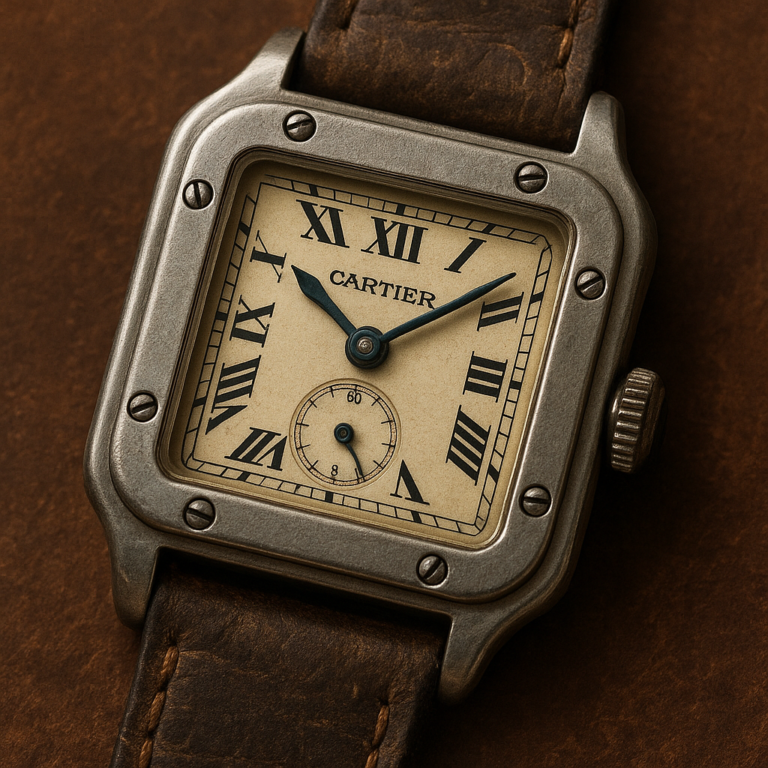
- Inventor: Louis Cartier
- Commissioned By: Alberto Santos-Dumont, a Brazilian aviation pioneer
- Model: Cartier Santos-Dumont
Santos-Dumont needed to check the time while flying his plane. Holding a pocket watch was impossible. Cartier created a square-cased watch with a leather strap. It was practical, rugged, and undeniably cool.
The Great War: The Final Push
World War I was the catalyst that made wristwatches mainstream for men. Soldiers in the trenches needed to coordinate artillery fire and check the time while holding a rifle. Pocket watches were too slow and dangerous.
The Result: By the end of the war, the wristwatch had replaced the pocket watch as the standard for men.
🔩 The Balance Spring Revolution: Hooke, Huygens, and the Leap in Precision
If the mainspring was the heart of the watch, the balance spring was the brain. This invention transformed watches from novelties into precision instruments.
The Battle of the Brains
In 1657, two brilliant minds, Robert Hooke (English) and Christiaan Huygens (Dutch), both claimed to have invented the balance spring.
- Hooke: Claimed he had the idea in 165 but didn’t publish until later.
- Huygens: Published his findings in 1673 and built the first working model.
The Verdict: Huygens is generally credited with the first practical application, but Hooke likely had the idea first.
How It Works
The balance spring (or hairspring) is a tiny, coiled spring attached to the balance wheel. It acts like a spring on a door, pulling the wheel back and forth in a regular rhythm. This created a harmonic oscillator, making the watch much more accurate.
The Impact
- Accuracy: Improved from hours per day to minutes per day.
- Minute Hand: For the first time, watches could have a minute hand.
- Standardization: This led to the standardization of timekeeping across Europe.
Fun Fact: The balance spring is so sensitive that a change in temperature or position can still affect its accuracy. This led to the next great innovation: temperature compensation.
🌡️ Temperature Compensation and the Quest for the Perfect Chronometer
Even with the balance spring, watches were still affected by temperature. Metal expands in heat (making the balance wheel larger and slower) and contracts in cold (making it smaller and faster).
The Solution: Bimetalic Balances
In 1765, Pierre Le Roy invented the bimetalic temperature-compensated balance wheel.
- How it works: The wheel is made of two metals with different expansion rates (usually brass and steel). As the temperature changes, the wheel bends, changing its effective diameter to compensate for the change in the spring’s strength.
The Marine Chronometer
This innovation was crucial for navigation. Ships needed accurate time to calculate longitude. The marine chronometer, perfected by John Harrison in the 18th century, was the result.
- Accuracy: A few seconds per day.
- Impact: Revolutionized global trade and exploration.
Did You Know? The Kew Observatory in England was famous for testing chronometers. A “Kew A” certificate was the highest standard of accuracy.
⚓ The Lever Escapement: The Heartbeat of Modern Mechanical Watches
By the 18th century, the verge escapement was outdated. It was inefficient and prone to wear. Enter the lever escapement.
The Inventor
Thomas Mudge invented the lever escapement in 1754.
How It Works
The lever escapement uses a lever to transfer energy from the escape wheel to the balance wheel. It’s more efficient, more accurate, and self-starting (if the watch stops, it can start again with a shake).
The Legacy
The lever escapement is still the standard in mechanical watches today. It’s the reason your Rolex or Omega can keep time with such precision.
Expert Tip: If you’re buying a mechanical watch, look for a “Swiss Lever Escapement.” It’s the gold standard.
🏭 Mass Production and the American Influence on Watchmaking
While Switzerland was perfecting the art of hand-crafted watches, America was revolutionizing the science of mass production.
The Waltham Watch Company
Founded in 1850, the Waltham Watch Company in Massachusetts was the first to use interchangeable parts and assembly lines to make watches.
- Impact: Watches became affordable for the average person.
- Quality: Initially, American watches were seen as “cheap,” but they quickly improved in quality.
The Elgin Watch Company
Elgin followed Waltham’s lead, producing millions of watches. They were known for their durability and reliability.
The Swiss Response
The Swiss initially resisted mass production, focusing on high-end, hand-crafted watches. But by the late 19th century, they had to adapt to compete with American prices.
The Result: A dual market emerged. Switzerland for luxury, America for utility.
⚡️ The Electric and Quartz Disruptions: When Batteries Beat Gears
The 20th century brought two massive disruptions: the electric watch and the quartz watch.
The Electric Watch
In the 1950s, companies like Bulova introduced the Accutron, an electric watch that used a tuning fork instead of a balance wheel. It was more accurate than mechanical watches but still relied on a battery.
The Quartz Revolution
In 1969, Seiko released the 35 SQ Astron, the first quartz watch.
- How it works: A quartz crystal vibrates at a precise frequency (8,192 Hz) when electricity is applied. This vibration is counted to keep time.
- Accuracy: ±1 second per month (compared to ±1 minute per day for mechanical).
- Impact: The “Quartz Crisis” of the 1970s and 80s. Swiss mechanical watch production plummeted.
The Aftermath: The Swiss industry nearly collapsed. But they survived by repositioning mechanical watches as luxury items, not just timekeepers.
📡 Radio-Controled, Atomic, and Smartwatches: The Future of Time
The quest for accuracy didn’t stop with quartz. Today, we have watches that sync with atomic clocks and even smartwatches that do everything but cook your dinner.
Radio-Controled Watches
Brands like Junghans and Citizen make watches that receive radio signals from atomic clocks (like DCF7 in Germany or WWVB in the US) and adjust themselves automatically.
- Accuracy: ±1 second per year.
Atomic Watches
In 2013, Bathys Hawaii released the Cesium 13, the first watch with a chip-scale atomic clock.
- Accuracy: 1 second in 1,0 years.
- Catch: It needs to be recharged every 30 hours.
Smartwatches
The Apple Watch (2014) and others have turned watches into computers. They track health, make calls, and run apps.
The Future: Will mechanical watches become obsolete? Probably not. They are now art pieces, symbols of craftsmanship and heritage.
🏆 Top 10 Most Significant Milestones in Watch History

Let’s recap the journey with a quick list of the most important moments in horology.
- 140s: Invention of the mainspring.
- 1505: Peter Henlein creates the first portable “clock-watches.”
- 1657: Christiaan Huygens invents the balance spring.
- 1765: Pierre Le Roy invents the temperature-compensated balance.
- 1754: Thomas Mudge invents the lever escapement.
- 1810: Breguet creates the first wristwatch for Queen Caroline Murat.
- 1904: Cartier creates the Santos-Dumont, the first men’s wristwatch.
- 1926: Rolex introduces the first waterproof wristwatch, the Oyster.
- 1969: Seiko releases the Astron, the first quartz watch.
- 2014: Apple launches the Apple Watch, ushering in the smartwatch era.
🧐 Common Myths Debunked: Separating Fact from Fiction in Horology
Let’s clear up some of the biggest misconceptions about watches.
Myth 1: “The first watch was made by Peter Henlein in 1505.”
Fact: Henlein is the most famous, but he wasn’t the only one. Other clockmakers were making similar devices. The Watch 1505 is the oldest surviving one attributed to him.
Myth 2: “Wristwatches were invented for men.”
Fact: The first wristwatch was made for a woman (Queen Caroline Murat) in 1810. Men didn’t adopt them until the 190s.
Myth 3: “Quartz watches are always better than mechanical watches.”
Fact: Quartz is more accurate, but mechanical watches are valued for their craftsmanship, heritage, and artistry.
Myth 4: “All old watches are valuable.”
Fact: Most old watches are worth very little. Only rare, well-preserved, or historically significant pieces are valuable.
Myth 5: “The first smartwatch was the Apple Watch.”
Fact: The first smartwatch was the Linux Watch by Steve Mann in 198.
💡 Expert Buying Guide: What to Look for in Vintage vs. Modern Timepieces
So, you’re thinking about buying a watch. Should you go vintage or modern? Here’s our expert advice.
Vintage Watches
Pros:
- History: You own a piece of history.
- Uniqueness: No two vintage watches are exactly alike.
- Investment: Some vintage pieces appreciate in value.
Cons:
- Maintenance: Can be expensive and hard to find parts for.
- Accuracy: Often less accurate than modern watches.
- Risk: Counterfeits are common.
What to Look For:
- Provenance: Documentation of ownership.
- Condition: Original parts, minimal wear.
- Brand: Stick to reputable brands like Rolex, Patek Philippe, Omega.
Modern Watches
Pros:
- Reliability: Modern movements are highly accurate and durable.
- Warranty: Most come with a manufacturer’s warranty.
- Technology: Features like water resistance, chronographs, and smart functions.
Cons:
- Depreciation: Most new watches lose value immediately.
- Lack of Character: Mass-produced watches can feel generic.
What to Look For:
- Movement: Swiss or Japanese automatic/quartz.
- Brand Reputation: Look for brands with a history of quality.
- Features: Choose based on your needs (diving, aviation, dress).
Pro Tip: If you’re new to watches, start with a modern Seiko or Citizen. They offer great value and reliability.
⚡️ The First YouTube Video: A Visual Journey Through Time
If you’re a visual learner, you’ll love this. We’ve embedded a video that traces the evolution of watches from the first pocket watches to modern smartwatches. It covers key figures like Peter Henlein, Robert Hooke, and Christiaan Huygens, and discusses the impact of the Industrial Revolution and the Quartz Crisis.
Watch the Evolution of Time: From Henlein to Smartwatches
The video highlights how the mainspring and balance spring revolutionized timekeeping, and how the Cartier Santos changed the game for men. It’s a must-watch for anyone interested in horology.
🏁 Conclusion

So, there you have it. The story of the first watch is a tale of innovation, controversy, and evolution. From the heavy, inaccurate Nuremberg Eggs of Peter Henlein to the precision quartz and smartwatches of today, the journey of timekeeping is a testament to human ingenuity.
The Verdict:
- Who invented the first watch? Peter Henlein is the most likely candidate, but the truth is a bit murkier.
- What was the first watch? The Watch 1505, a pomander watch from 1505.
- Why did we switch to wristwatches? Women started it, but aviation and war made it mainstream for men.
- Are mechanical watches dead? No. They are now luxury art pieces, valued for their craftsmanship and heritage.
If you’re looking to buy a watch, whether it’s a vintage Rolex or a modern Seiko, remember that the best watch is the one that tells time and tells your story.
Final Thought: Time is the one thing we can’t buy, but we can certainly measure it. And that, my friends, is the magic of the watch.
🔗 Recommended Links
Looking for a specific watch or brand? Check out these links for more information and where to buy.
-
Vintage Watches:
Rolex: Search for Vintage Rolex on Amazon | Rolex Official Site
Patek Philippe: Search for Vintage Patek on Amazon | Patek Philippe Official Site
Omega: Search for Vintage Omega on Amazon | Omega Official Site -
Modern Watches:
Seiko: Search for Seiko Watches on Amazon | Seiko Official Site
Citizen: Search for Citizen Watches on Amazon | Citizen Official Site
Cartier: Search for Cartier Watches on Amazon | Cartier Official Site -
Books:
-
Wristwatch Handbook: A Comprehensive Guide to Modern Wristwatches
❓ FAQ: Your Burning Questions About the First Watch Answered

What are some of the oldest watch brands still in operation today and what makes them significant?
Breguet (founded 175), Patek Philippe (founded 1839), and Vacheron Constantin (founded 175) are among the oldest. They are significant for their continuous innovation, craftsmanship, and historical importance. Breguet invented the tourbillon, Patek Philippe is known for its complications, and Vacheron Constantin is the oldest continuously operating manufacturer.
How have watchmaking techniques evolved over time and what innovations have been made?
From the verge escapement to the lever escapement, from mainsprings to quartz crystals, watchmaking has evolved from hand-crafted art to precision engineering. Key innovations include the balance spring, temperature compensation, and automatic winding.
What is the history behind the development of quartz watches and their impact on the industry?
The quartz watch was developed in the 1960s, with Seiko releasing the first in 1969. It revolutionized the industry by offering unprecedented accuracy at a low cost, leading to the “Quartz Crisis” and the decline of mechanical watch production.
Read more about “🕰️ The First Wristwatch in the World: Was It Really Cartier? (2026)”
How did the first pocket watch come into existence and who created it?
The first pocket watches were created in the early 16th century by Peter Henlein and other Nuremberg clockmakers. They were small, spring-driven timepieces designed to be carried in a pocket or worn as a pendant.
What was the first wristwatch and when was it invented?
The first wristwatch was created by Abraham-Louis Breguet in 1810 for Queen Caroline Murat of Naples. It was a chiming repeater with an oval case and a strap made of hairs and golden threads.
Read more about “🕰️ Who Was the First Person to Wear a Watch? (2026)”
What are some of the most iconic and sought-after vintage watches among collectors today?
The Rolex Submariner, Patek Philippe Nautilus, Omega Speedmaster, and Cartier Santos are among the most iconic. They are sought after for their history, design, and investment potential.
How have watch brands like Rolex and Patek Philippe contributed to the advancement of watch technology?
Rolex introduced the first waterproof watch (Oyster) and the first automatic winding mechanism (Perpetual). Patek Philippe is known for its complications, including the perpetual calendar and the minute repeater.
How did the invention of the pocket watch impact the development of modern timekeeping?
The pocket watch made timekeeping portable, allowing people to know the time anywhere. This led to the standardization of time and the development of more accurate timekeeping devices.
Read more about “⏳ When Was the First Watch Invented? The Shocking Truth (2026)”
How have modern watch brands incorporated traditional watchmaking techniques into their designs?
Many modern brands, like A. Lange & Söhne and F.P. Journe, use traditional hand-finishing techniques, such as anglage and perlage, in their modern designs. They blend old-world craftsmanship with new technology.
What are some of the most iconic and collectible watches of all time, and what makes them valuable?
The Patek Philippe Henry Graves Supercomplication, Rolex Paul Newman Daytona, and Audemars Piguet Royal Oak are among the most valuable. They are valuable due to their rarity, historical significance, and unique design.
What are the differences between quartz and mechanical watches, and which is more accurate?
Quartz watches use a battery and a quartz crystal to keep time, offering high accuracy (±1 second per month). Mechanical watches use a mainspring and gears, offering lower accuracy (±1 minute per day) but valued for their craftsmanship. Quartz is more accurate.
How did the invention of the watch impact society and culture in the past?
The invention of the watch changed how people perceived time, leading to the standardization of time and the development of modern schedules. It also became a symbol of status and wealth.
What are the key components of a mechanical watch and how do they work together?
The key components are the mainspring (power source), gear train (transmission), escapement (regulation), and balance wheel (oscillator). The mainspring releases energy, which is transmitted through the gear train to the escapement, which regulates the release of energy to the balance wheel, causing it to oscillate.
Who are the most influential watchmakers in history and what were their contributions?
Peter Henlein (first portable watch), Christiaan Huygens (balance spring), Thomas Mudge (lever escapement), Abraham-Louis Breguet (tourbillon, first wristwatch), and John Harrison (marine chronometer) are among the most influential.
📚 Reference Links
- Watch 1505 – Wikipedia
- History of Watches – Wikipedia
- First Wristwatch – Teddy Baldassare
- Peter Henlein – Nuremberg Clockmaker
- Seiko 35 SQ Astron – Seiko Official
- Rolex Oyster – Rolex Official
- Patek Philippe Nautilus – Patek Philippe Official
- Cartier Santos – Cartier Official
- Junghans Mega 1 – Junghans Official
- Bathys Hawaii Cesium 13 – Bathys Official