Support our educational content for free when you purchase through links on our site. Learn more
12 Watch Brands Leading in Eco-Friendly Materials 🌱

Watch brands leading in eco-friendly materials include Panerai, Oris, Cartier, Citizen, and Swatch—but the smartest choice depends on the exact model, its repairability, and how transparently the brand explains its materials. Recycled components are worth celebrating; a watch you can maintain and wear for years may be an even bigger win.
We’ve handled plenty of watches whose best feature wasn’t a complicated movement or a polished case—it was the fact that the owner had worn it faithfully for a decade. That’s the sustainability detail marketing can’t fake: a watch that earns a permanent place on your wrist.
From recycled-plastic dials and reclaimed metals to solar-powered movements, these 12 brands take different routes toward more responsible watchmaking. We’ll show you what each approach actually means, where the trade-offs are, and how to spot a feel-good claim that needs better evidence.
Key Takeaways
- Look beyond the “eco-friendly” label. Check the exact material, recycled-content percentage, sourcing, and verification.
- Longevity counts. Repair access, replacement parts, and a durable design can matter as much as recycled materials.
- Different brands offer different strengths: Oris uses recycled PET in select dials, Cartier and Citizen offer light-powered watches, and Panerai has explored ambitious recycled-material concepts.
- Bio-based doesn’t automatically mean biodegradable, and recyclable doesn’t mean made from recycled material.
- Consider pre-owned. A serviceable secondhand watch can extend an existing product’s life instead of creating demand for a new one.
Table of Contents
- ⚡️ Quick Tips and Facts
- 🌱 What Makes a Watch Truly Eco-Friendly?
- Recycled, Bio-Based, and Traceable Materials Explained
- Materials and Production: The Full Lifecycle
- Repairability, Longevity, and End-of-Life Recycling
- 🕰️ How Sustainable Watchmaking Took Shape
- 🏆 12 Watch Brands Leading in Eco-Friendly Materials
- 1. Panerai: Recycled Materials and the eLAB-ID Concept
- 2. Oris: Recycled Ocean Plastic and the Aquis Date Upcycle
- 3. Cartier: Solar Power and the Tank Must SolarBeat
- 4. TAG Heuer: Recycled Materials in Contemporary Sports Watches
- 5. Ulyse Nardin: Recycled Fishing Nets and Ocean-Inspired Materials
- 6. Norqain: Recycled Ocean-Bound Plastic and Adventure Watches
- 7. Swatch: Bioceramic and Bio-Based Watch Components
- 8. Tissot: Durable Swiss Watches and More Responsible Materials
- 9. Citizen: Light-Powered Watches and Recycled Materials
- 10. Seiko: Solar Movements and Long-Wearing Designs
- 11. ID Genève: Circular Design and Recycled Swiss Steel
- 12. Holzkern: Wood, Natural Materials, and Responsible Sourcing
- 💎 Sustainable Luxury Watches: What’s Worth Considering?
- Are Rolex and OMEGA Making More Sustainable Watches?
- How to Assess Claims About Luxury Watch Materials
- 🔍 How to Evaluate a Watch Brand’s Environmental Impact
- Brand Transparency and Supply-Chain Traceability
- Certifications, Standards, and What They Actually Mean
- Carbon Footprints, Packaging, and Manufacturing
- Greenwashing Red Flags to Watch For
- ♻️ Eco-Friendly Watch Materials Compared
- Recycled Stainless Steel, Aluminum, and Titanium
- Recycled Ocean Plastic and Fishing Nets
- Bio-Based Plastics, Bioceramic, and Plant-Based Straps
- Wood, Cork, and Other Natural Materials
- Vegan Straps and Lower-Impact Alternatives to Leather
- 🛒 How to Choose the Right Sustainable Watch
- Best Eco-Friendly Watches by Budget and Use
- Solar, Automatic, or Quartz: Which Movement Is Grener?
- Everyday, Dive, Dress, and Outdoor Watch Picks
- Questions to Ask Before You Buy
- 🧰 Care, Repair, and Extending Your Watch’s Life
- Battery Replacement and Solar-Watch Care
- Servicing, Parts, and Repairability
- Recycling or Reselling an Old Watch
- 🌍 Why Choose an Eco-Friendly Watch?
- ✨ Making Sustainable Luxury Your Legacy
- Conclusion
- Recommended Links
- FAQ
- Reference Links
⚡️ Quick Tips and Facts
If you’re comparing watch brands, here’s our enthusiast’s rule of thumb: start with the watch you’ll keep wearing, then check what it’s made of and how honestly the brand explains it. A recycled-material case is a useful feature; a watch that sits unworn in a drawer is not exactly a sustainability triumph.
| What to check | Why it matters | What to look for |
|---|---|---|
| Material specifics | “Eco-friendly” can mean almost anything without details | Named materials, recycled-content percentages, and sourcing |
| Movement | Batteries, charging, servicing, and lifespan affect impact | Solar, light-powered, repairable quartz, or serviceable mechanical |
| Durability | Long use can reduce replacement and disposal | Replaceable straps, available parts, solid water resistance, clear service support |
| Supply-chain information | Materials are only part of a watch’s footprint | Published reports, supplier standards, and traceable sourcing |
| End-of-life plan | Watches contain mixed materials and electronics | Take-back, repair, refurbishment, or recycling options |
A few fast facts:
- Solar-powered doesn’t mean impact-free. It can reduce routine battery replacement, but the case, movement, power cell, and manufacturing still count.
- Recycled plastic is not automatically recyclable again. Ask what happens to the watch when it reaches the end of its useful life.
- “Vegan leather” is not one material. Some alternatives are plant-based; others are largely synthetic polymers. The label alone won’t tell you which.
- Buying pre-owned is worth considering. A well-maintained secondhand watch avoids making a new case and movement for your wrist.
- The U.S. Federal Trade Commission’s Green Guides caution against broad, unqualified environmental claims. In watch shopping, details beat leafy marketing every time. 🍃
🌱 What Makes a Watch Truly Eco-Friendly?
There isn’t one universally “green” watch material or movement. A genuinely lower-impact watch is the result of several choices working together: responsible sourcing, efficient manufacturing, durable construction, repair access, and sensible end-of-life handling.
We’ve seen two common traps in watch shopping. The first is treating a recycled strap as proof that an entire brand is sustainable. The second is assuming traditional materials are automatically worse. A steel watch that lasts for decades and can be repaired may make more sense than a novelty watch made from a fashionable material that cracks after a season.
Recycled, Bio-Based, and Traceable Materials Explained
Recycled material is recovered from manufacturing scrap or discarded products and put back into use. Recycled steel and aluminum are well-established examples; recycled plastics can be harder to reuse repeatedly because some polymers degrade or become mixed with other materials.
Bio-based materials contain some material derived from plants or other biological sources. That does not necessarily mean they biodegrade, are compostable, or have a smaller impact in every situation. A castor-oil composite, for example, may still include non-bio-based ingredients and require industrial processing.
Upcycled materials are repurposed into a new application. In watches, this may mean reclaimed fishing nets or recovered plastic transformed into a case, strap, or dial. Upcycling can give waste a useful second life, but it doesn’t by itself prove responsible collection, safe processing, or long-term durability.
Traceability is the ability to explain where a material came from and how it moved through the supply chain. Look for claims that answer:
- What material is used?
- What percentage of the component is recycled or bio-based?
- Is the source pre-consumer manufacturing scrap, post-consumer waste, or something else?
- Who verified the claim?
- Can the finished part be repaired or recycled?
That level of detail is more useful than a vague “made with ocean plastic” label. For a broader perspective on luxury watch brands, we recommend evaluating the component and the evidence, not just the prestige on the dial.
Materials and Production: The Full Lifecycle
A watch’s environmental story begins before assembly. Mining, refining, polymer production, transport, factory energy, packaging, servicing, and disposal all contribute to its lifecycle footprint. The United Nations Environment Programme discusses lifecycle thinking as a way to assess impacts across a product’s stages rather than focusing one attractive feature (UNEP lifecycle information).
| Lifecycle stage | Questions worth asking |
|---|---|
| Raw materials | Are metals recycled, responsibly sourced, or traceable? |
| Component production | Does the brand disclose recycled content or material impacts? |
| Assembly | Does the company report energy use, renewable power, or waste reduction? |
| Shipping and packaging | Is packaging reusable, recyclable, or unnecessarily elaborate? |
| Ownership | Can the watch be repaired, serviced, and fitted with replacement parts? |
| End of life | Does the brand accept old watches or support responsible recycling? |
There are trade-offs. A mechanical movement avoids routine battery changes, but it requires skilled servicing and lubricants. Solar quartz avoids frequent battery swaps, but eventually its power cell may need attention. The greener choice depends partly on the watch’s actual lifespan and how you care for it.
Repairability, Longevity, and End-of-Life Recycling
A watch designed to be repaired can stay in use far longer than one that is sealed, unsupported, or uneconomical to service. Before buying, check for:
- A published service or repair process
- Replacement straps, crystals, crowns, and other common parts
- Water-resistance testing after service
- A realistic warranty and authorized service network
- Clear instructions for battery or power-cell replacement
Electronic watches also contain materials that shouldn’t go into ordinary household waste. In the United States, the Environmental Protection Agency advises using appropriate electronics and battery recycling routes (EPA electronics donation and recycling). Local rules differ, so check your municipality’s guidance.
Our practical test: if a brand can explain how you’ll keep the watch working after the warranty ends, that’s a sustainability signal we take seriously.
🕰️ How Sustainable Watchmaking Took Shape
Watchmaking has always involved longevity: mechanical watches were built to be maintained, passed on, and repaired. The modern sustainability conversation adds new questions about material sourcing, factory emissions, batteries, plastics, packaging, and labor conditions.
In recent years, brands have explored recycled ocean plastics, reclaimed metals, plant-derived composites, solar charging, and more transparent supplier information. Some projects are production models; others are prototypes designed to test whether a material can work at watchmaking tolerances. Those are not interchangeable achievements. A concept watch can inspire the industry, but a material used at scale tells us more about repeatable manufacturing.
A useful distinction comes from comparing three approaches:
- Reduce the need for replacements: emphasize durability, servicing, and spare parts.
- Reduce new resource use: incorporate recycled or responsibly sourced materials.
- Support wider environmental work: fund conservation or improve factory practices.
A brand can do one well and still have gaps in the others. We like the ambition, but we also like a sustainability report with measurable targets and progress updates. 🌍
🏆 12 Watch Brands Leading in Eco-Friendly Materials
There’s no single official ranking for sustainable watch brands. Below, we focus on specific, identifiable initiatives—not anointing any company “perfect.” Product availability, materials, and claims can change, so check the linked brand pages for current specifications.
| Brand | Notable example or approach | Strongest sustainability angle | Keep in mind |
|---|---|---|---|
| Panerai | Submersible eLAB-ID concept | High recycled-content ambition | Concept figures don’t describe every current model |
| Oris | Aquis Date Upcycle | Recycled-plastic dial | Recycled dial does not equal fully recycled watch |
| Cartier | Tank Must SolarBeat | Light-powered movement | Power-cell replacement and service still matter |
| TAG Heuer | Select material initiatives | Experimentation within luxury sports watches | Verify claims model by model |
| Ulyse Nardin | Diver Net family | Recycled and reclaimed materials | Distinguish concept specifications from retail models |
| Norqain | Recycled-material collaborations | Adventure-watch materials and partnerships | Check exact recycled content by reference |
| Swatch | Bioceramic and bio-based components | Broad experimentation with plant-derived materials | Bio-based does not mean fully biodegradable |
| Tissot | Durable, serviceable watches | Long-use potential | Many models are not specifically marketed as recycled-material watches |
| Citizen | Eco-Drive | Light-powered quartz technology | Power cells eventually require servicing |
| Seiko | Solar options and conservation projects | Efficient solar models plus environmental programs | Donations and product material claims are separate |
| ID Genève | Circular-material design | Recycled Swiss steel and reused components in select models | Small-brand supply and service networks may be limited |
| Holzkern | Wood and natural-material designs | Use of wood and other natural materials | Verify sourcing, coatings, and repair options |
1. Panerai: Recycled Materials and the eLAB-ID Concept
Panerai’s Submersible eLAB-ID made headlines for its ambition to use recycled materials across major components. Panerai reported that the prototype contained 98.6% recycled-based materials by weight, including recycled titanium and recycled luminous material (Panerai’s eLAB-ID announcement). It was also presented as a way to encourage suppliers to share circular-material processes.
The important nuance: eLAB-ID was a research-led concept, not proof that every Panerai uses the same material recipe. It’s a compelling demonstration of what’s possible when suppliers collaborate, but shoppers should verify the specific production model they’re considering.
- ✅ Why it stands out: ambitious recycled-content design and supplier collaboration.
- ❌ What to check: whether the exact watch is a production model and what materials it uses.
- 👀 Our take: one of the clearest examples of using a high-profile watch to test circular manufacturing.
2. Oris: Recycled Ocean Plastic and the Aquis Date Upcycle
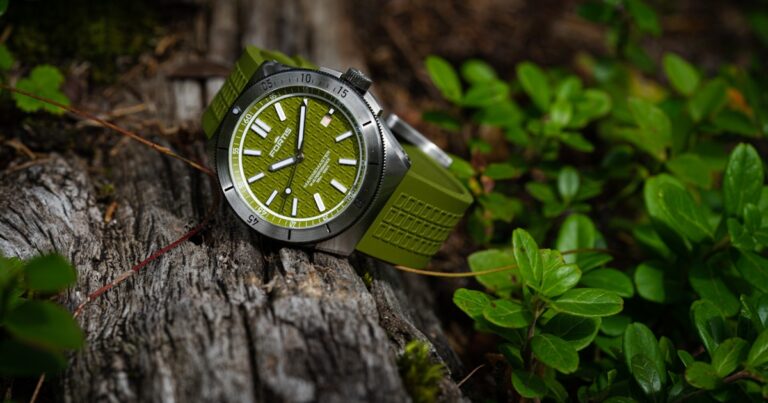
The Oris Aquis Date Upcycle uses a dial made with recycled PET plastic. Because the plastic pieces create a varied surface, each dial has a different pattern—a neat case of material variation becoming part of the design rather than a defect to hide.
Oris also connects its environmental messaging to projects and public sustainability reporting. The brand’s sustainability information is a useful place to verify current initiatives.
- ✅ Benefits: distinctive dial; clear material story; robust dive-watch format.
- ❌ Trade-offs: the recycled element is the dial, not necessarily the whole watch; the dial’s visual variation may not suit buyers who prefer uniformity.
- 🐠 Anecdotal note: in our experience, this is a conversation-starter watch. People often notice the dial before they notice the dive-watch specifications.
3. Cartier: Solar Power and the Tank Must SolarBeat
Cartier’s Tank Must SolarBeat uses photovoltaic technology to convert light into energy. Cartier described the movement as designed to operate for years without a conventional battery change; product availability and service details vary by market, so check the official Tank collection.
The model’s appeal is more than its movement: it keeps the recognizable Tank silhouette while making the power source less maintenance-heavy. Cartier has also introduced strap materials described as incorporating plant-industry byproducts on select watches.
- ✅ Benefits: iconic design, light-powered operation, reduced routine battery replacement.
- ❌ Trade-offs: availability may be limited; a photovoltaic power system still needs servicing eventually.
- Best for: someone who wants a refined dress watch and likes the idea of solar charging without a sporty look.
4. TAG Heuer: Recycled Materials in Contemporary Sports Watches
TAG Heuer’s environmental work spans corporate initiatives and selected product materials. Because product specifications differ by collection and release, don’t assume a recycled component is present across the entire catalogue. Start with the brand’s sustainability information and confirm the reference number’s materials.
- ✅ Benefits: broad range of durable sports watches and strong service infrastructure.
- ❌ Trade-offs: sustainability claims can be difficult to compare unless the brand names the component and recycled percentage.
- Our advice: evaluate the exact model, not the logo’s overall reputation.
5. Ulyse Nardin: Recycled Fishing Nets and Ocean-Inspired Materials
Ulyse Nardin’s Diver Net project explores materials including recycled fishing nets and other reclaimed components. The original concept and later commercial models do not necessarily share identical specifications, so check the exact version in the brand’s Diver collection.
The broader story is ocean-oriented: the company has connected some initiatives with marine conservation and plastic-reduction work. That’s worthwhile, but support for conservation should be counted separately from the physical materials in the watch.
- ✅ Benefits: materials research, distinctive contemporary design, ocean-conservation focus.
- ❌ Trade-offs: the word “Diver Net” alone doesn’t tell you which components are recycled in a given model.
- Good question for a retailer: “Which parts of this specific reference contain recycled material?”
6. Norqain: Recycled Ocean-Bound Plastic and Adventure Watches
Norqain has used recycled-material partnerships in select adventure-oriented watches. The brand’s product catalogue and model specifications are the best way to confirm whether a case, strap, or other component uses recovered plastic.
- ✅ Benefits: outdoor-ready designs and material experimentation.
- ❌ Trade-offs: recycled content may apply to particular models or components rather than the full watch.
- Our take: appealing for buyers who want a modern sports-watch aesthetic and a clearly described material story.
7. Swatch: Bioceramic and Bio-Based Watch Components
Swatch has brought Bioceramic into several collections. The composite combines ceramic with bio-sourced material, though composition varies by product and should be checked on the individual product page (Swatch Bioceramic collection).
This is not the same as a fully ceramic watch, nor does “bio” mean the finished case is home-compostable. It does show how a mainstream brand can test new materials at scale.
- ✅ Benefits: lightweight feel, bold colors, accessible experimentation.
- ❌ Trade-offs: material claims need to be read precisely; some models are not designed for extensive repair.
- Best for: buyers who want a casual, colorful watch and are comfortable with a simpler, fashion-forward product lifecycle.
8. Tissot: Durable Swiss Watches and More Responsible Materials
Tissot is known for producing a wide range of Swiss watches, including models with durable steel cases and serviceable mechanical movements. That can support a long-use approach, although it does not automatically make every Tissot a recycled-material watch. Confirm materials and movement details on the official Tissot site.
The PRX Powermatic 80 is a popular example of a mechanical watch designed for everyday use, with a stated power reserve of up to 80 hours on relevant versions. It is not primarily a recycled-material showcase; its sustainability case is more about durability and ongoing service.
- ✅ Benefits: versatile styling, established servicing network, long-wearing construction.
- ❌ Trade-offs: don’t mistake a robust build for a verified low-impact supply chain.
- Explore more: our guide to buying watches covers fit, movements, and practical ownership questions.
9. Citizen: Light-Powered Watches and Recycled Materials
Citizen’s Eco-Drive technology turns light into electrical energy and stores it in a rechargeable power cell. Citizen says its watches can operate for extended periods in darkness after charging, though exact reserve varies by model (Citizen Eco-Drive technology).
- ✅ Benefits: no routine disposable-battery changes; broad selection; practical everyday designs.
- ❌ Trade-offs: a rechargeable cell can age and may eventually need replacement; the watch still has a manufacturing footprint.
- Our take: one of the strongest straightforward choices for someone who wants low-fuss ownership more than an experimental case material.
10. Seiko: Solar Movements and Long-Wearing Designs
Seiko offers solar-powered watches in several collections, and its Save the Ocean editions connect specific models with marine themes and conservation activity. The brand’s Prospex collection includes many options, but environmental donations and a watch’s material composition are different claims.
- ✅ Benefits: solar options, broad repair ecosystem, choices from compact daily watches to dive models.
- ❌ Trade-offs: not every Save the Ocean model uses recycled components; confirm the specific product’s specifications.
- Best for: shoppers who want a functional, familiar watch brand and a solar option without paying for a niche material story.
11. ID Genève: Circular Design and Recycled Swiss Steel
ID Genève places circularity at the center of its design approach. Its models have featured recycled Swiss steel and other reused or alternative materials; materials vary by collection, so consult the ID Genève product pages.
- ✅ Benefits: unusually direct focus on circular watchmaking and material reuse.
- ❌ Trade-offs: smaller production and service networks can mean fewer local options than established major brands.
- Our advice: ask about servicing, movement sourcing, replacement parts, and how each material claim is verified.
12. Holzkern: Wood, Natural Materials, and Responsible Sourcing
Holzkern is known for watches that use wood, stone, and other natural materials. The visual appeal is easy to understand: a wood dial can look warmer and more individual than a standard sunray finish. But natural does not automatically mean sustainably sourced.
Check the wood species, origin, coatings, water resistance, and service options. A wood component can be a good fit if the brand provides credible sourcing information and the watch suits your habits.
- ✅ Benefits: distinctive natural textures; broad design variety.
- ❌ Trade-offs: wood may need more careful treatment than steel; sourcing and repair details deserve scrutiny.
- Best for: someone who prioritizes natural-material aesthetics and is happy to care for the watch accordingly.
💎 Sustainable Luxury Watches: What’s Worth Considering?
Luxury and environmental responsibility can coexist, but the watch’s price or status does not establish its sustainability credentials. As Bob’s Watches’ overview puts it, “luxury and environmental responsibility can coexist.” We agree—with one caveat: ask for evidence about the specific watch and the wider company.
A useful luxury-watch checklist includes:
- Materials: recycled, responsibly sourced, or traceable components?
- Longevity: are parts and authorized service available?
- Manufacturing: does the brand report energy, emissions, or waste?
- Claims: are numbers and terms explained, rather than simply advertised?
- Ownership: is the watch likely to be worn for years, resold, and repaired?
Are Rolex and OMEGA Making More Sustainable Watches?
Rolex and OMEGA are better assessed through their documented corporate programs and individual product details than through broad assumptions about luxury. Rolex highlights manufacturing, energy, and environmental initiatives on its Perpetual Planet page. Its Oystersteel is an alloy known for corrosion resistance, but recyclability is not the same as a disclosed recycled-content claim.
OMEGA’s ocean-focused partnerships and select strap or packaging initiatives are worth evaluating separately from the materials used in each watch. Start with OMEGA’s corporate and sustainability information and the specifications for the exact Seamaster reference.
The comparison is less “which famous brand is green?” and more:
| Question | Rolex | OMEGA |
|---|---|---|
| Corporate environmental programs | Review current official reporting | Review current official reporting and partnerships |
| Product-level recycled content | Confirm by reference | Confirm by reference, strap, and packaging |
| Long-term service | Consider service support and parts | Consider service support and parts |
| Best evidence | Specific published data | Specific published data |
How to Assess Claims About Luxury Watch Materials
A steel case may be durable and recyclable at the end of its life, yet still be made from newly refined metal. A recycled strap can be a real improvement without changing the movement or bracelet. Both facts can be true at once.
When a brand makes a material claim, look for:
- The named material and the component it appears in.
- A percentage or a clear explanation if the amount is not disclosed.
- A description of the source.
- Independent verification or an auditable report.
- Information on whether the component can be repaired or recycled later.
That’s the difference between a real product detail and a green halo. For more on choosing watches for your wardrobe, browse our men’s watches and watch fashion trends guides.
🔍 How to Evaluate a Watch Brand’s Environmental Impact
Think of this as a little detective work. 🕵️ Start with the watch, then follow the claim upstream: material, supplier, factory, shipping, repair, and end of life.
Brand Transparency and Supply-Chain Traceability
Look for public information that is specific, current, and comparable. Stronger disclosures may include:
- A sustainability report with a date and defined boundaries
- Emissions targets and progress against them
- Supplier standards and audit information
- Materials and recycled-content descriptions
- A repair, take-back, or refurbishment policy
A pledge without a baseline is hard to measure. A target without updates is hard to trust. We’d rather see a modest, measurable improvement than a sweeping promise with no numbers attached.
Certifications, Standards, and What They Actually Mean
Certifications can help, but each one covers a particular issue. For example, the Responsible Jewellery Council sets standards for businesses in the jewelry and watch supply chain. An RJC certification is not a blanket guarantee that every material in every watch is low-impact; check the certification’s scope and the company’s current status.
Also distinguish:
- Company certification from product certification
- Recycled-content verification from ethical sourcing standards
- Carbon-neutral claims from actual emissions reduction
- Factory-level energy claims from the entire supply chain
The ISO 1401 environmental management standard, for instance, concerns an organization’s environmental management system. It does not certify that a particular watch is “green.”
Carbon Footprints, Packaging, and Manufacturing
A watch’s environmental impact includes more than its visible parts. Ask whether the brand reports:
- Scope 1 and 2 emissions from its operations and purchased energy
- Scope 3 emissions from suppliers, transport, and product use
- Factory renewable-energy use
- Waste and water management
- Packaging volume and material
- Shipping methods or logistics changes
Beware of carbon-neutral statements that rely heavily on offsets without explaining the company’s direct emissions-reduction plan. Offsets may have a role, but they are not a substitute for reducing avoidable emissions. The Greenhouse Gas Protocol explains common corporate emissions accounting frameworks.
Greenwashing Red Flags to Watch For
🚩 Vague wording: “eco-conscious,” “planet friendly,” or “green” with no details.
🚩 One small component presented as the whole product: a recycled strap does not mean the entire watch is recycled.
🚩 No source or percentage: “ocean plastic” without explanation.
🚩 No dated progress: goals without a baseline or reporting schedule.
🚩 Confusing support with product impact: a donation is positive, but it does not change the watch’s material footprint.
🚩 Biodegradable claims without conditions: ask where, how long, and under what treatment conditions.
The FTC’s Green Guides are designed to help businesses make environmental marketing claims accurately. They’re also a handy reader’s guide to spotting claims that sound bigger than the proof.
♻️ Eco-Friendly Watch Materials Compared
No material wins in every category. A good comparison asks how much new material is needed, how it is processed, how long it lasts, and what happens after use.
| Material | Potential benefit | Main caveat | Good questions |
|---|---|---|---|
| Recycled steel | Can reduce reliance on newly produced steel | Recycled percentage may be undisclosed | What percentage and which components? |
| Recycled titanium | Retains useful strength-to-weight properties | Processing and traceability still matter | Is the source verified? |
| Recycled plastic | Gives waste material another use | Mixed polymers can be difficult to recycle again | What polymer, source, and end-of-life route? |
| Bio-based composite | Can replace some fossil-derived feedstock | Not necessarily biodegradable | What percentage is bio-based? |
| Wood or cork | Renewable potential when responsibly sourced | Origin, finish, and water resistance vary | Is sourcing certified or traceable? |
| Vegan strap | Avoids animal-derived leather | May rely on synthetic plastics | What is the actual material composition? |
Recycled Stainless Steel, Aluminum, and Titanium
Metals are durable and often recoverable through established recycling streams. Recycled content can reduce the need for virgin feedstock, but the benefit depends on the metal, energy mix, processing route, and amount of recycled input.
- Stainless steel: familiar, durable, widely used, and corrosion-resistant when properly manufactured.
- Aluminum: light and recyclable, though watch applications and finishes vary.
- Titanium: light and strong, but extraction and processing can be energy-intensive; recycled titanium can be valuable when its source is documented.
Don’t confuse “recyclable” with “made from recycled material.” The first describes what might happen later; the second describes what went into the watch.
Recycled Ocean Plastic and Fishing Nets
Ocean-bound or recovered plastic can be transformed into watch straps, cases, and dials. Projects such as the Oris Aquis Date Upcycle and select Ulyse Nardin models demonstrate how waste-derived materials can become visible product features.
Still, the source matters. Plastic collected before it reaches the ocean is not the same as plastic recovered from marine environments. Both may help reduce leakage into waterways, but the collection, cleaning, sorting, and processing details determine what the claim means.
Our tip: ask whether the recycled plastic is used in a structural component or a replaceable accessory. A strap is easier to replace; a case raises different questions about durability and repair.
Bio-Based Plastics, Bioceramic, and Plant-Based Straps
Bio-based components may use feedstocks such as castor oil or agricultural byproducts. Bioceramic products combine ceramic with a bio-sourced component. These materials can be interesting alternatives, but “bio-based” describes origin, not automatically disposal behavior.
Look for:
- The proportion of the component that is bio-based
- Whether it contains conventional plastics or binders
- Wear, scratch, and water-resistance information
- Whether the manufacturer offers replacement parts
- Disposal or recycling instructions
A plant-derived material can still be hard to recycle if it is bonded to multiple other substances.
Wood, Cork, and Other Natural Materials
Wood and cork can bring appealing textures and may come from renewable sources, but sourcing is the central question. Check the species, origin, chain of custody, and finish. A naturally sourced material can still be environmentally problematic if it comes from poorly managed harvesting.
Natural materials may also need more careful use around moisture, heat, or impact. If you want an everyday watch for swimming, cycling, and the occasional accidental doorframe collision, a natural-material accent paired with a durable metal case may be more practical than an all-wood design.
Vegan Straps and Lower-Impact Alternatives to Leather
Vegan straps avoid animal-derived leather, but the label covers a wide range of materials: recycled nylon, cork, plant-fiber blends, synthetic polyurethane, and other composites. Some “plant leather” contains only a portion of plant material, with polymer coatings or backing.
Before buying, ask:
- Is it PVC-free?
- Is it made with recycled or plant-derived content?
- Can it be replaced using a standard lug width?
- Is it repairable, washable, or recyclable?
- Does the brand provide a material breakdown?
Vegan is animal-welfare description, not a complete environmental rating. For some buyers it is a priority; for others, a durable, responsibly sourced leather strap may be preferable. The best choice depends on your values and how long the strap will last.
🛒 How to Choose the Right Sustainable Watch
Start by defining the job. Dress watch? Daily office watch? Dive watch that will actually see water? The best lower-impact choice is usually the one that fits your routine and stays in rotation.
Best Eco-Friendly Watches by Budget and Use
Rather than ranking watches by a single “green score,” match the feature to your priorities:
| Your priority | Consider | Why |
|---|---|---|
| Low-maintenance everyday use | Citizen Eco-Drive or Seiko Solar models | Light-powered operation avoids routine disposable-battery changes |
| Recycled-material design | Oris Aquis Date Upcycle | Recycled PET dial is part of the visible design |
| Dress-watch styling | Cartier Tank Must SolarBeat, where available | Solar technology in a classic case shape |
| Experimental luxury materials | Panerai or Ulyse Nardin selected models | Notable material research; verify production specifications |
| Natural textures | Holzkern models with documented sourcing | Distinctive wood and natural-material design |
| Circular-material focus | ID Genève | Material reuse is central to the brand’s approach |
| Lower-impact shopping overall | Pre-owned, serviceable watches | Extends the useful life of an already-manufactured product |
For broader comparisons, browse our affordable watches and guide to buying watches.
Solar, Automatic, or Quartz: Which Movement Is Grener?
There isn’t a universal winner. Here’s the practical comparison:
| Movement | Upsides | Trade-offs |
|---|---|---|
| Solar/light-powered quartz | Reduces routine battery replacement; convenient | Has a power cell that can eventually need replacement |
| Standard quartz | Accurate, affordable to maintain, widely repairable | Requires periodic battery changes |
| Automatic mechanical | No battery; can last a long time with service | Needs periodic servicing; not automatically lower-impact to manufacture |
| Manual mechanical | Battery-free and mechanically simple | Requires regular winding and servicing |
For low-maintenance daily use, solar is often a strong choice. For longevity and repairability, a well-supported mechanical watch may make sense. A standard quartz watch that is repaired and worn for years may be preferable to buying a new watch every few seasons.
Everyday, Dive, Dress, and Outdoor Watch Picks
- Everyday: choose scratch-resistant materials, a comfortable strap, and accessible servicing. Citizen Eco-Drive and Seiko Solar have practical options.
- Dive: verify the stated water resistance and whether the watch is designed for actual diving. Oris Aquis models offer a robust sports-watch format.
- Dress: Cartier’s Tank Must SolarBeat, when available, pairs a classic profile with light-powered technology.
- Outdoor: prioritize legibility, case protection, water resistance, and replaceable straps. A sustainable claim is no use if the watch can’t handle your use case.
- Natural-material style: Holzkern offers distinctive looks, but confirm the care requirements and sourcing.
Questions to Ask Before You Buy
Use this quick checklist in-store or before clicking “add to cart”:
- Which exact component uses recycled or bio-based material?
- What percentage of that component is recycled or bio-based?
- Where does the material come from, and how is the claim verified?
- Can the watch be serviced locally?
- Are straps and common replacement parts available?
- What happens to the battery or power cell at end of life?
- Is the watch comfortable and versatile enough that I’ll wear it often?
- Would a quality pre-owned version meet my needs?
If a salesperson can answer the first three without reaching for a fog machine, that’s a promising start.
🧰 Care, Repair, and Extending Your Watch’s Life
Sustainability doesn’t end when the box is opened. Basic care can help a watch last longer, preserve its water resistance, and avoid unnecessary replacement.
Battery Replacement and Solar-Watch Care
For standard quartz watches, replace the battery through a qualified watchmaker when possible. If the watch is water-resistant, ask about new seals and pressure testing after the case is opened.
For solar watches:
- Give the watch regular exposure to light according to the manufacturer’s instructions.
- Avoid leaving it for long periods in a dark drawer.
- Don’t assume sunlight through a window or a quick burst of light will fully charge every model.
- Have an aging or malfunctioning power cell assessed by an authorized service provider.
The exact charging and reserve guidance varies by model, so use the owner’s manual rather than general internet folklore.
Servicing, Parts, and Repairability
Service intervals depend on the movement, use, and manufacturer recommendations. Mechanical watches generally require periodic cleaning and lubrication; quartz watches may need battery, gasket, or power-cell service. Water-resistant watches should have seals inspected if they’re frequently exposed to water.
Before purchase, check:
- The brand’s service locations
- Whether independent watchmakers can obtain parts
- Availability of replacement straps and crystals
- Warranty terms and service history for secondhand watches
- The cost and turnaround time of common repairs, without assuming all models are alike
A watch with a service path is a better long-term bet than one that becomes disposable after a small component fails.
Recycling or Reselling an Old Watch
If the watch still works, resale, donation, or repair usually keeps it in service longer than immediate disposal. If it no longer works, ask the brand or a local jeweler about refurbishment and recycling. Remove batteries only if the manufacturer or local recycling guidance says you can do so safely.
For a secondhand purchase, request clear photos, movement and service history, and confirmation that the watch is authentic. A reputable dealer should explain what has been serviced and what remains unknown. Vintage can be a smart circular choice, but a heavily damaged watch that cannot be repaired isn’t automatically the greener option.
🌍 Why Choose an Eco-Friendly Watch?
A watch is a small object, but it connects to a large supply chain. Choosing a model with durable construction, transparent sourcing, recycled components, or efficient power can support better practices—especially when brands publish evidence and consumers reward it.
There are personal benefits, too:
- Less maintenance hassle with light-powered models
- A stronger story behind a material that would otherwise be waste
- Better long-term ownership when repair and parts are available
- More thoughtful purchasing when you consider pre-owned options
We’re not asking you to buy a watch only because it carries a sustainability label. Buy one you genuinely like and will wear. That’s how the materials, movement, and design earn their keep.
✨ Making Sustainable Luxury Your Legacy
A watch can be more than a short-lived accessory. The most convincing sustainability story may be a well-chosen watch that gets serviced, repaired, and passed along rather than replaced whenever tastes change.
That idea applies to luxury and everyday watches alike. Buy less, choose carefully, maintain what you own, and look at pre-owned before assuming new is necessary. As Time+Tide’s eco-watch guide argues, vintage mechanical watches can be a particularly compelling option because their manufacturing footprint has already happened and they may continue working for generations.
Here’s the question we teased earlier: is recycled material always the strongest sustainability signal? No. A specific, verifiable material claim is valuable, but long service life, repair access, and responsible production can matter just as much. The best watch is the one whose claims you can verify—and whose company you’re still happy to own years from now.