Support our educational content for free when you purchase through links on our site. Learn more
The Fascinating History of Watches: From Sundials to Smartwatches ⌚ (2025)

Have you ever wondered how the tiny device on your wrist evolved from clunky, ornamental gadgets to the sleek, high-tech marvels we wear today? The history of watches is a captivating journey through innovation, artistry, and human ingenuity that spans over five centuries. From the first portable “clock-watches” crafted by Peter Henlein in 16th-century Germany to the quartz revolution that nearly upended the Swiss watch industry, and finally to today’s smartwatches syncing with atomic clocks—this story is as much about culture and craftsmanship as it is about technology.
Stick with us as we unravel the secrets behind iconic timepieces like the Omega Speedmaster—the first watch on the Moon—and explore how breakthroughs like the balance spring and lever escapement transformed accuracy forever. Plus, discover how watches shaped society, fashion, and even warfare. Ready to travel through time with us? Let’s dive in!
Key Takeaways
- Watches evolved from large mechanical clocks to portable “clock-watches” in the 1500s, thanks to the invention of the mainspring.
- The balance spring and lever escapement were pivotal innovations that dramatically improved accuracy and reliability.
- The Quartz Crisis of the 1970s revolutionized the industry, making watches more affordable but threatening traditional Swiss craftsmanship.
- Wristwatches gained popularity through military necessity, evolving into essential fashion and status symbols.
- Modern watches include radio-controlled, atomic, and smartwatches, blending precision with digital convenience.
- Understanding watch history enriches appreciation for craftsmanship, technology, and cultural impact behind every tick.
Table of Contents
- ⚡️ Quick Tips and Fascinating Facts About Watches
- 🕰️ The Evolution of Timekeeping: From Sundials to Mechanical Marvels
- 🔍 Early Innovations: The Dawn of Clock-Watches and Portable Timepieces
- 1. Pocket Watches: The Status Symbol of Centuries Past
- 2. The Balance Spring Breakthrough: Precision Takes a Leap
- 3. Mastering Time: Temperature Compensation and the Rise of Chronometers
- 4. The Lever Escapement Revolution: Making Watches Reliable
- 5. Mass Production and the Democratization of Watches
- ⌚ Wristwatches: From Military Necessity to Fashion Icon
- ⚡ Electric Watches: The First Steps Toward Modern Timekeeping
- 💎 Quartz Watches: The Crystal Clear Revolution
- 📡 Radio-Controlled Wristwatches: Syncing with Atomic Precision
- 🕳️ Atomic Wristwatches: The Pinnacle of Accuracy
- ⌚ Smartwatches: The Digital Age on Your Wrist
- 🛠️ Watchmaking Craftsmanship: Techniques, Materials, and Innovations
- 🌍 Cultural Impact: How Watches Shaped Society and Fashion
- 🔧 Maintenance and Care: Keeping Your Timepiece Ticking
- 📚 Recommended Links for Watch History Enthusiasts
- ❓ Frequently Asked Questions About the History of Watches
- 📖 Reference Links and Further Reading
- 🎯 Conclusion: Why the History of Watches Still Matters Today
Here is the main body of the article, crafted by the expert team at Watch Brands™.
⚡️ Quick Tips and Fascinating Facts About Watches
Welcome, fellow time-travelers! Before we dive deep into the intricate gears of horological history, let’s get your mainspring wound with some truly mind-boggling tidbits. The history of watches is a story of innovation, artistry, and human ambition packed into a tiny, ticking machine.
Here are some of our favorite conversation-starters at Watch Brands™:
- A Woman’s World First: Forget the image of a gentleman pulling out a pocket watch. The very first “wristwatch” was created in 1810 by the legendary Abraham-Louis Breguet for Caroline Murat, the Queen of Naples. It was considered a piece of jewelry, exclusively for women, for centuries!
- What’s in a Name?: The word “watch” likely comes from the Old English word woecce, meaning “watchman”. These early timepieces were used by town watchmen to keep track of their shifts. Another theory suggests it came from 17th-century sailors timing their “watches” or duty shifts at sea.
- The Quartz Crisis Tsunami 🌊: In the 1970s and 80s, the arrival of ultra-accurate and affordable quartz watches from Japan, led by Seiko, nearly wiped out the traditional Swiss mechanical watch industry. This period is famously known as the “Quartz Crisis”.
- First Watch on the Moon 🌕: While Yuri Gagarin wore a Russian Shturmanskie on the first manned spaceflight, the first watch worn on the lunar surface was the Omega Speedmaster Professional. It was standard issue for NASA’s Apollo astronauts and remains an icon today.
- Accuracy is Everything: A standard mechanical watch is considered excellent if it’s accurate to within a few seconds per day. A modern quartz watch is accurate to within a few seconds per month. But it gets crazier! The Citizen Caliber 0100 is accurate to within one second per year, and the Bathys Hawaii Cesium 133 atomic watch boasts an accuracy of one second in 1,000 years!
- Not-So-Good Vibrations: Early luminous watch dials used radium-based paint to glow in the dark. This was before the health risks of radioactivity were fully understood, leading to the tragic story of the “Radium Girls,” factory workers who suffered from radiation poisoning. Radium was banned from watches in 1968.
Ready to learn more? Our Guide to Buying Watches can help you navigate the modern landscape once you’ve mastered the history!
🕰️ The Evolution of Timekeeping: From Sundials to Mechanical Marvels
Have you ever wondered how humanity went from staring at shadows on the ground to glancing at a super-computer on their wrist? Long before the first tick-tock of a clock, ancient civilizations tracked time by observing the heavens. Devices like sundials, water clocks (clepsydras), and even incense clocks were the original timekeepers, marking the passage of hours through continuous, natural processes.
The real revolution, however, was the shift from measuring a process to creating one. This happened in medieval Europe with the invention of the first purely mechanical clocks. These were massive, weight-driven contraptions housed in church towers. The game-changer for portability was the invention of the mainspring in the early 15th century. This coiled piece of metal could store and release energy, freeing timekeeping from the grip of gravity and paving the way for the first personal timepieces.
🔍 Early Innovations: The Dawn of Clock-Watches and Portable Timepieces
Enter the 16th century. In the German cities of Nuremberg and Augsburg, clockmakers began shrinking their creations. A locksmith named Peter Henlein of Nuremberg is often credited with creating the first “clock-watch” around 1505-1524.
But don’t picture a sleek wristwatch! These early devices were:
- Bulky and Ornamental: Often drum-shaped brass boxes, they were worn as pendants on a chain around the neck.
- Stylistically Bold: Their shape evolved into the ovoid “Nuremberg eggs,” and some were even crafted into fanciful shapes like skulls or fruit.
- Wildly Inaccurate: With errors of several hours per day, they were more of a novelty and a status symbol for the nobility than a practical tool.
- Simple in Function: They typically had only an hour hand and needed to be wound twice a day.
These were less about telling time and more about telling the world you were rich and fashionable enough to own a ticking piece of jewelry.
1. Pocket Watches: The Status Symbol of Centuries Past
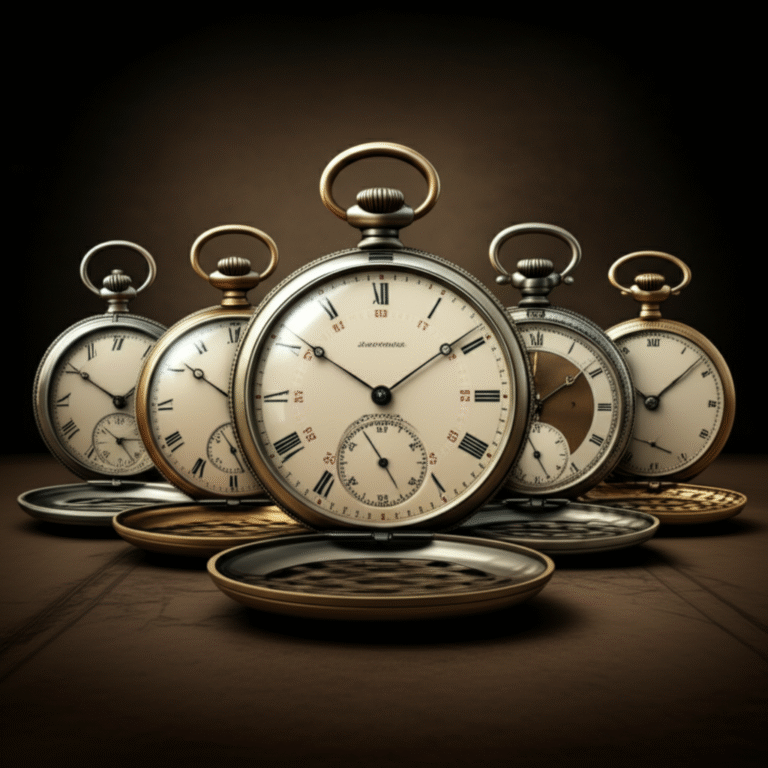
Around 1675, fashion changed, and so did watches. With the introduction of the waistcoat by King Charles II of England, men began carrying their timepieces in pockets rather than around their necks. This practical shift protected the delicate mechanisms and led to a new, flatter, and more rounded design—the birth of the classic pocket watch.
The Quest for Consistent Power
The biggest challenge for these early watches was the verge escapement, a crude mechanism that was highly sensitive to the mainspring’s waning power. As the spring unwound, the watch would slow down dramatically. Two ingenious, albeit complex, solutions emerged to equalize the force:
| Mechanism | Description | Outcome |
|---|---|---|
| Stackfreed | A spring-loaded cam system that added friction to the mainspring when it was fully wound and reduced it as it unwound. | ✅ Provided some regulation but was inefficient and quickly abandoned due to high friction. |
| Fusee | A cone-shaped pulley connected to the mainspring barrel by a tiny chain. As the mainspring unwound, the chain would pull on a wider part of the cone, using leverage to even out the torque. | ✅ A far more effective solution that was used in high-quality timepieces for over 200 years. |
This era also saw the addition of glass covers to protect the dial around 1610. These beautiful timepieces are now the heart of many Vintage Watch Collections.
2. The Balance Spring Breakthrough: Precision Takes a Leap
If there’s one invention that turned the watch from a novelty into a scientific instrument, it’s the balance spring. Introduced around 1657-1675, this tiny, hair-like coiled spring was a stroke of genius, with credit often debated between English scientist Robert Hooke and Dutch polymath Christiaan Huygens.
By attaching this spring to the balance wheel, they transformed it into a harmonic oscillator, giving it a natural, consistent resonant frequency. The impact was immediate and astounding:
- Accuracy skyrocketed. Daily error rates plummeted from hours to roughly 10 minutes.
- New possibilities opened up. With this newfound precision, watchmakers could finally add a minute hand around 1680 and, shortly after, a seconds hand.
This single component elevated the watch to a new plane of existence. It was the horological equivalent of inventing the microprocessor.
3. Mastering Time: Temperature Compensation and the Rise of Chronometers
With watches now ticking more consistently, a new, insidious enemy revealed itself: temperature. Metal expands when hot and contracts when cold. This meant the balance spring would lose its elasticity in the heat, causing the watch to run slow, and stiffen in the cold, making it run fast.
The solution came in 1765 from Pierre Le Roy and was later perfected by masters like Thomas Earnshaw. They invented the bimetallic temperature-compensated balance wheel. This wheel was made of two different metals fused together. As temperatures changed, the metals would expand or contract at different rates, causing the wheel’s rim to bend slightly, automatically compensating for the change in the spring’s elasticity. It was a brilliant piece of self-regulating engineering.
This innovation was crucial for the development of the marine chronometer, an ultra-precise portable clock essential for determining longitude at sea. English clockmaker John Harrison famously won the Longitude Prize with his H4 chronometer in 1761, a device so accurate it was essentially a large, perfect watch. Today, the term “chronometer” refers to a watch that has passed rigorous accuracy tests, like those certified by the COSC in Switzerland.
4. The Lever Escapement Revolution: Making Watches Reliable
The escapement is the heart of a mechanical watch; it’s the set of parts that gives the balance wheel a tiny push with each swing, keeping it moving, and “escapes” the gear train’s power in controlled, equal beats. While early escapements like the verge and cylinder did the job, they were inefficient and prone to wear.
The lever escapement, invented by Englishman Thomas Mudge in 1754, was the final piece of the precision puzzle. Its key advantage was that the balance wheel was detached from the lever for most of its oscillation, allowing it to swing more freely and with less interference. This made it:
- More Accurate: Less friction meant better timekeeping.
- More Robust: It was less susceptible to wear and tear.
- Self-Starting: This is a critical feature. As the expert in our featured video points out, if a watch with a non-self-starting escapement gets a jolt and stops, it stays stopped. The lever escapement will kick back into action on its own.
Though invented in the mid-18th century, it took until the 19th century for manufacturing techniques to catch up, but by 1900, the lever escapement became the undisputed standard for virtually all mechanical watches, a title it still holds today.
5. Mass Production and the Democratization of Watches
For centuries, watches were handcrafted, bespoke items for the wealthy. That all changed in the 19th century, thanks to the Industrial Revolution and, surprisingly, the United States. While the Swiss and British focused on craftsmanship, American innovators focused on process.
Led by figures like Aaron Lufkin Dennison, the Waltham Watch Company in Massachusetts pioneered the use of machine tools and interchangeable parts. For the first time, watches could be mass-produced on an assembly line. This had two huge effects:
- Consistency and Quality: The “American System” of manufacturing led to highly reliable and accurate timepieces, so much so that they became the standard for the burgeoning railroad industry, which desperately needed precise timing to avoid collisions.
- Affordability: The efficiency of mass production drove down costs. This culminated in the invention of the pin-pallet escapement by Georges Frederic Roskopf in 1876, a simpler, cheaper version of the lever escapement. This innovation made possible the “dollar watch,” a timepiece an ordinary worker could afford.
The watch was no longer just for the elite. It was becoming an essential tool for everyone, a trend perfectly captured in our category of Affordable Watches. This era also saw the convenience of keyless winding (using a crown) replace the cumbersome winding key.
⌚ Wristwatches: From Military Necessity to Fashion Icon
So, when did men finally strap a watch to their wrist? It was a slow burn, driven by pure necessity. As we mentioned, wristwatches were initially seen as delicate, feminine jewelry. But on the battlefield, fumbling for a pocket watch was impractical and dangerous.
Military men began unofficially strapping small pocket watches to their wrists during colonial campaigns in the late 19th century. Companies like Mappin & Webb produced “campaign watches” for soldiers, and Girard-Perregaux supplied the German Imperial Navy around 1880.
The pioneers who cemented the wristwatch’s place in history were:
- Louis Cartier: In 1904, he designed a purpose-built wristwatch with integrated lugs for his friend, the aviator Alberto Santos-Dumont, who needed to check the time while keeping both hands on his aircraft’s controls. The Cartier Santos was born.
- Hans Wilsdorf: The visionary founder of Rolex, he was an early and passionate advocate for the wristwatch’s reliability and style. He proved their accuracy by obtaining the first-ever chronometer certification for a wristwatch in 1910.
It was World War I that sealed the deal. The need for synchronized artillery barrages and infantry movements made the wristwatch, or “trench watch,” an essential piece of military equipment. As the British Horological Institute noted in 1917, “The wristwatch was little used by the sterner sex before the war, but now is seen on the wrist of nearly every man in uniform…”
By 1930, the wristwatch was outselling the pocket watch 50 to 1. The revolution was complete, giving rise to the incredible world of Men’s Watches and Luxury Watch Brands we know today. The first successful self-winding (automatic) system for a wristwatch, invented by John Harwood in 1923, added the final touch of convenience.
⚡ Electric Watches: The First Steps Toward Modern Timekeeping
The 1950s saw the first major departure from centuries of purely mechanical tradition. Watchmakers began experimenting with batteries. The first electric watches, pioneered by the American companies Elgin and Hamilton, used a battery to power an electromechanical system that still used a traditional balance wheel. The Hamilton 500, released in 1957, was the first of its kind.
But the real leap forward came from Bulova with their Accutron watch. Instead of a balance wheel, the Accutron used a battery to vibrate a tiny tuning fork at 360 Hz. This higher frequency resulted in unprecedented accuracy for a wristwatch and produced a distinct, humming sound instead of a tick-tock. It was a true bridge between the mechanical and electronic ages.
💎 Quartz Watches: The Crystal Clear Revolution
If the electric watch was a step, the quartz watch was a quantum leap. The principle is simple: when you pass an electric current through a quartz crystal, it oscillates at an incredibly stable and high frequency (typically 32,768 Hz today). A microchip counts these vibrations and translates them into a precise time signal.
In 1959, the Japanese company Seiko began a secret project to miniaturize this technology for a wristwatch. On Christmas Day, 1969, they unveiled the Seiko Astron, the world’s first commercially available quartz watch. It was revolutionary. It was more accurate, more durable, and required far less maintenance than any mechanical watch.
What followed was the “Quartz Crisis.” As Swiss and other traditional watchmakers struggled to adapt, affordable and reliable quartz watches from Japan flooded the market, decimating the old guard. While many Swiss brands perished, the crisis also forced the industry to innovate, eventually leading to a resurgence of mechanical watchmaking as a luxury craft.
👉 Shop Quartz Watches on: Amazon | Walmart
📡 Radio-Controlled Wristwatches: Syncing with Atomic Precision
How do you make a quartz watch even more accurate? You make it correct itself! That’s the idea behind radio-controlled watches. These timepieces have a small internal antenna that receives low-frequency radio time signals broadcast from government-run atomic clocks around the world.
The Junghans Mega was a pioneer in 1991. Today, brands like Citizen and Casio are masters of this technology. Several times a day (usually overnight), the watch will automatically listen for the signal and adjust its time down to the exact second. It’s the perfect blend of quartz convenience and atomic accuracy.
🕳️ Atomic Wristwatches: The Pinnacle of Accuracy
Just when you thought it couldn’t get any more precise, it did. While radio-controlled watches sync with an external atomic clock, an atomic wristwatch has one inside. In 2013, the Bathys Hawaii Cesium 133 Atomic Watch was unveiled. It contains a chip-scale atomic clock (CSAC) that uses the natural, unvarying resonance of cesium atoms to measure time.
The result is an accuracy of one second in 1,000 years, completely independent of any external signal. While still a niche and expensive technology, it represents the absolute pinnacle of personal timekeeping accuracy.
⌚ Smartwatches: The Digital Age on Your Wrist
The final chapter in our history (so far!) is the evolution of the watch into a wearable computer. The seeds were sown with early digital watches like the Pulsar LED watch in 1972 and data-storing watches like the Timex Datalink in the 90s.
But the modern smartwatch era truly began in the 2010s with the Kickstarter success of the Pebble and the subsequent launches of major players like the Apple Watch and Samsung Galaxy Watch. These devices do more than tell time; they deliver notifications, track fitness, monitor health with functions like an EKG, and run apps, all while being tethered to your smartphone. They represent a fundamental shift in what a “watch” can be.
👉 Shop Smartwatches on:
- Apple Watch: Amazon | Walmart | Apple Official Website
- Samsung Galaxy Watch: Amazon | Walmart | Samsung Official Website
- Garmin: Amazon | Walmart | Garmin Official Website
🛠️ Watchmaking Craftsmanship: Techniques, Materials, and Innovations
Beyond the timeline, the story of watches is a story of incredible materials science and micro-engineering.
Watch Crystals: The Window to Time
The crystal is a watch’s first line of defense. The choice of material involves a trade-off between scratch resistance and shatter resistance.
| Crystal Type | Material | Mohs Hardness | Pros & Cons |
|---|---|---|---|
| Acrylic | Polymethyl methacrylate | 3-4 | ✅ Very shatter-resistant, cheap, can be polished. ❌ Scratches very easily. |
| Mineral | Tempered Glass | 5-6 | ✅ More scratch-resistant than acrylic. ❌ Can still scratch and is more prone to shattering than acrylic. Seiko’s Hardlex is a well-known proprietary version. |
| Sapphire | Synthetic Corundum | 9 | ✅ Extremely scratch-resistant (only a diamond can reliably scratch it). ❌ More brittle and can shatter on severe impact. Often has anti-reflective (AR) coatings. |
Protecting the Movement: Shock and Magnetism
Two of a mechanical watch’s greatest enemies are sudden impacts and magnetic fields.
- Shock Protection: The delicate pivots of the balance wheel are highly vulnerable. Early systems like Breguet’s “parachute” (c. 1790) offered some protection. The modern standard is the Incabloc system (1933), which uses a lyre-shaped spring to allow the jewel bearings to move slightly upon impact, absorbing the shock.
- Magnetic Resistance: Magnetic fields can magnetize the steel balance spring, causing it to stick together and run erratically. Solutions range from placing the movement inside a soft-iron inner case (a Faraday cage), as seen in the IWC Pilot’s Watch, to making the critical components out of anti-magnetic materials like silicon or special alloys. The Omega Co-Axial Master Chronometer movements are famously resistant to fields up to 15,000 gauss.
🌍 Cultural Impact: How Watches Shaped Society and Fashion
From the moment they appeared, watches have been more than just time-tellers. They are potent symbols of status, technology, and personal style.
- A Symbol of Status: Early clock-watches and pocket watches were the exclusive domain of the aristocracy. In the modern era, a luxury mechanical watch from a brand like Patek Philippe or Rolex serves the same purpose. As one collector told The New York Times, “We try to explain why it makes sense to spend $500,000 on a watch.”
- An Essential Tool: Watches were indispensable for the growth of railroads, the coordination of armies, and the exploration of the deepest oceans and outer space. The Omega Speedmaster isn’t just a watch; it’s the “Moonwatch,” a piece of history that played a critical role in the Apollo missions.
- A Fashion Statement: The transition to the wrist made the watch a key part of personal attire. From the elegant Cartier Tank, inspired by WWI tanks, to the rugged Rolex Submariner, watches communicate a person’s identity, profession, or aspirations.
🔧 Maintenance and Care: Keeping Your Timepiece Ticking
Owning a fine watch comes with a little responsibility. Here’s how to care for your timepiece:
- Mechanical vs. Quartz: A quartz watch is low-maintenance; it just needs a battery change every few years. A mechanical watch is a complex machine that requires servicing by a professional every 5-7 years to clean, lubricate, and replace worn parts.
- Understanding Water Resistance: This is one of the most misunderstood aspects of watches! The ratings can be deceiving.
| Rating | What it Really Means | Good For |
|---|---|---|
| Water Resistant / 30M | Can withstand splashes, rain. | ✅ Washing hands. ❌ Swimming, showering. |
| 50M | Can be worn for swimming in shallow depths. | ✅ Swimming. ❌ Diving, watersports. |
| 100M | Suitable for swimming and snorkeling. | ✅ Snorkeling. ❌ Scuba diving. |
| 200M+ (ISO 6425 Diver’s) | A true dive watch, built to specific standards for scuba diving. | ✅ Recreational scuba diving. |
As the expert in our featured video explains, a true diver’s watch certification (ISO 6425) involves much more than just depth rating; it includes tests for shock resistance, magnetic resistance, and visibility.
📚 Recommended Links for Watch History Enthusiasts
If this article has whetted your appetite, we highly recommend diving deeper with these fantastic resources:
- The Evolution of the Waterproof Watch by David Boettcher: An incredibly detailed look at the history of making watches water-resistant.
- The History of Dive Watches by David Brendan: A great overview of one of the most popular watch categories.
- HODINKEE: One of the most respected publications in the watch world, with endless articles on vintage and modern timepieces.
- The National Association of Watch & Clock Collectors (NAWCC): A fantastic resource for serious collectors and history buffs.
❓ Frequently Asked Questions About the History of Watches

Who invented the first watch?
While it’s difficult to credit one single person, Peter Henlein of Nuremberg, Germany, is widely recognized for creating some of the first portable timepieces, known as “clock-watches,” in the early 16th century.
What was the “Quartz Crisis”?
The Quartz Crisis was a period in the 1970s and 1980s when the widespread adoption of highly accurate and affordable quartz watches, primarily from Japan, caused a massive decline in the traditional Swiss mechanical watch industry.
Why are expensive mechanical watches still popular?
Mechanical watches are appreciated today not for their superior accuracy (a quartz watch is far more accurate), but for their craftsmanship, history, and the artistry of their complex inner workings. They are seen as pieces of functional art and enduring status symbols.
What is the difference between a “chronometer” and a “chronograph”?
A chronometer is a high-precision watch that has been certified for its accuracy by an official body, like the COSC in Switzerland. A chronograph is a watch with a stopwatch function; it’s a complication that allows you to time events. A watch can be both, one, or neither.
📖 Reference Links and Further Reading
For this article, we consulted a variety of sources to bring you the most comprehensive history. We encourage you to explore them for even more detail:
🎯 Conclusion: Why the History of Watches Still Matters Today

What a journey! From the clunky “Nuremberg eggs” worn as pendants to the sleek smartwatches buzzing on our wrists, the history of watches is a testament to human ingenuity, artistry, and our eternal quest to master time itself. We’ve seen how early mechanical innovations like the balance spring and lever escapement laid the foundation for precision, how mass production democratized timekeeping, and how the quartz revolution reshaped the industry forever.
But beyond technology, watches have always been cultural icons—symbols of status, tools of exploration, and expressions of personal style. Whether you’re a fan of vintage pocket watches, a lover of luxury mechanical masterpieces, or a tech-savvy smartwatch user, understanding this rich history deepens your appreciation for the tiny marvel on your wrist.
So, next time you glance at your watch, remember: you’re holding centuries of human history, craftsmanship, and passion. And that’s pretty amazing.
📚 Recommended Links for Watch History Enthusiasts
Ready to explore or shop some of the watches and brands that shaped history? Here are some curated links to get you started:
Shop Iconic Watches and Brands
- Seiko Quartz Watches: Amazon | Walmart | Seiko Official Website
- Omega Speedmaster (Moonwatch): Amazon | Walmart | Omega Official Website
- Rolex Wristwatches: Amazon | Rolex Official Website
- Cartier Santos: Amazon | Cartier Official Website
- Citizen Atomic Watches: Amazon | Citizen Official Website
- Bulova Accutron: Amazon | Bulova Official Website
- Apple Watch: Amazon | Apple Official Website
- Garmin Smartwatches: Amazon | Garmin Official Website
Recommended Books on Watch History and Horology
- A Man and His Watch by Matt Hranek — Amazon
- Watchmaking by George Daniels — Amazon
- The Wristwatch Handbook by Ryan Schmidt — Amazon
- Longitude by Dava Sobel (for the story of John Harrison’s marine chronometer) — Amazon
❓ Frequently Asked Questions About the History of Watches

What are some of the most iconic and influential watch brands in history?
Iconic brands include:
- Rolex: Pioneer of the wristwatch chronometer certification and luxury sports watches.
- Omega: Known for the Speedmaster “Moonwatch,” the first watch on the Moon.
- Patek Philippe: Renowned for exquisite craftsmanship and complications.
- Seiko: Revolutionized the industry with the first quartz wristwatch.
- Cartier: Early innovator of wristwatch design with the Santos and Tank models.
These brands shaped watchmaking through innovation, design, and cultural impact.
How did the invention of automatic watches impact the watch industry?
The automatic (self-winding) watch, invented by John Harwood in 1923, eliminated the need for manual winding by harnessing the wearer’s motion to wind the mainspring. This innovation:
- Increased convenience and reliability.
- Boosted wristwatch popularity.
- Paved the way for modern mechanical watches that combine tradition with practicality.
What role did quartz watches play in the history of timekeeping?
Quartz watches, introduced commercially by Seiko in 1969, were:
- More accurate than mechanical watches by a factor of 10 or more.
- More affordable and easier to maintain.
- Responsible for the Quartz Crisis, which nearly destroyed the Swiss mechanical watch industry.
- Ultimately forced the industry to innovate and reposition mechanical watches as luxury items.
Who are some of the key figures in the development of modern watches?
- Peter Henlein: Credited with creating the first portable clock-watch.
- Christiaan Huygens & Robert Hooke: Invented the balance spring.
- Thomas Mudge: Invented the lever escapement.
- John Harrison: Developed the marine chronometer.
- Hans Wilsdorf: Founder of Rolex and promoter of the wristwatch.
- John Harwood: Invented the first successful automatic wristwatch.
What are some of the most significant milestones in the history of watchmaking?
- 15th century: Invention of the mainspring.
- 1657: Introduction of the balance spring.
- 1754: Lever escapement invention.
- 1765: Temperature-compensated balance wheel.
- 19th century: Mass production and interchangeable parts.
- 1904: Cartier Santos, first purpose-built wristwatch.
- 1923: First automatic wristwatch.
- 1969: Seiko Astron, first quartz wristwatch.
- 1991: First radio-controlled wristwatch.
- 2010s: Rise of smartwatches.
What is the origin of the first wristwatch?
The earliest wristwatch was made by Abraham-Louis Breguet in 1810 for Caroline Murat, Queen of Naples. It was a decorative piece for women, not yet a practical timekeeping device for men.
What is the oldest wristwatch?
The oldest surviving wristwatch is believed to be the Breguet watch made for Caroline Murat in 1810. Early wristwatches were rare and mostly ornamental until the late 19th and early 20th centuries.
What is the oldest watch brand in the world?
Blancpain, founded in 1735, holds the title of the oldest surviving watch brand. Other venerable names include Vacheron Constantin (1755) and Breguet (1775).
What is the history behind watch?
Watches evolved from portable spring-driven clocks in the 16th century, initially as ornamental “clock-watches.” Over centuries, innovations in escapements, balance springs, and manufacturing transformed them into precise, portable timekeepers. The wristwatch rose to prominence in the early 20th century, followed by electronic, quartz, and smartwatches in the modern era.
Who invented watch first?
While no single inventor can claim the title, Peter Henlein of Nuremberg is often credited with creating the earliest known portable watches in the early 1500s.
What is the history of watches?
The history spans from early mechanical clock-watches in 16th-century Germany, through the development of pocket watches, the wristwatch revolution in the early 20th century, the quartz revolution in the 1970s, to today’s smartwatches—a continuous evolution driven by technology, fashion, and human needs.
Additional FAQs
How did watches influence military operations?
Watches enabled synchronized maneuvers and precise timing during wars, especially WWI, when wristwatches became standard military issue for their practicality.
Why are mechanical watches still made despite quartz accuracy?
Mechanical watches are prized for craftsmanship, heritage, and aesthetic complexity, serving as luxury collectibles and status symbols rather than just timekeepers.
What is a chronometer certification?
A chronometer is a watch tested and certified by official bodies (like COSC) for superior accuracy under various conditions.
📖 Reference Links and Further Reading
- History of watches – Wikipedia
- Watch – Wikipedia
- History of timekeeping devices – Wikipedia
- Seiko Official Website
- Omega Official Website
- Rolex Official Website
- Cartier Official Website
- Citizen Official Website
- Bulova Official Website
- Apple Official Website
- Garmin Official Website
- COSC – Official Swiss Chronometer Testing Institute
- National Association of Watch & Clock Collectors (NAWCC)
We hope this comprehensive journey through the history of watches has inspired you to look at your timepiece with fresh eyes—and maybe even start your own collection! ⌚✨